Critique - Anvillea radiata
9.50ر.س
Product description
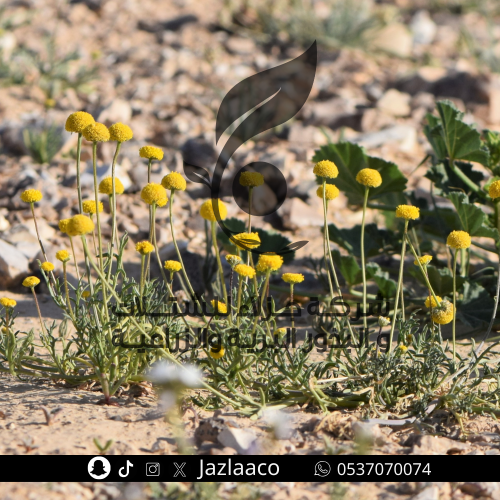
The common squill (Anvillea radiata) is a perennial herbaceous plant belonging to the Asteraceae family. It is a wild plant adapted to the desert and semi-desert environments of North Africa and the Arabian Peninsula. It is characterized by its yellow flowers, lobed leaves, and fine hairy foliage, and it exhibits good tolerance to drought and heat.
General Description
It grows as a branching herbaceous shrub, and its height usually reaches about 30–70 cm. The stems are branched from the base, and the branches may spread widely, while the parts of the plant are covered with fine hairs that give it a gray or silver appearance.
Papers
Its leaves are alternate, lobed or divided into irregular lobes, and covered with fine hairs. This covering helps reduce water loss and protects the leaves from the intense heat and sunlight in the desert environment.
flowers
It produces bright yellow flower heads that appear at the ends of the branches, consisting of small ray and disc-shaped flowers. The flowers give the plant a distinct aesthetic value and also attract a number of insects and pollinators during the flowering season.
Fruits and seeds
It produces small, dry, seed-like fruits equipped with down or structures that aid in dispersal. Seeds are the primary means of plant reproduction and the renewal of its natural populations after the growing season.
Endurance and suitability
The plant is highly tolerant of drought, heat, and intense sunlight, and thrives in sandy and gravelly soils and open desert areas. The fine hairs covering its leaves and stems help reduce water loss and adapt to harsh climatic conditions.
Uses
The plant is valued both environmentally and aesthetically, and can be utilized in natural gardens, wildlife conservation projects, and the rehabilitation of vegetation cover in arid regions. Its flowers also provide a source of pollen and nectar for a number of insects.
natural spread
Anvillea radiata is naturally distributed in parts of North Africa and the Arabian Peninsula, and in Saudi Arabia it is found in desert and semi-desert environments. It grows in sandy and gravelly soils, plains, and open areas.
Preservation status
Anvillea radiata is not currently known to be globally threatened and is characterized by its natural distribution across wide areas of arid environments. Its density varies locally depending on rainfall availability and the condition of its natural habitat.