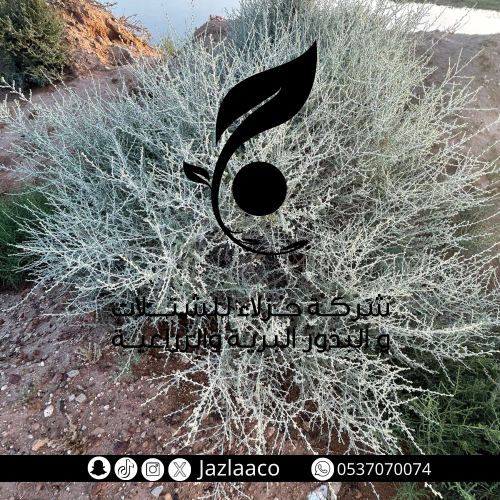
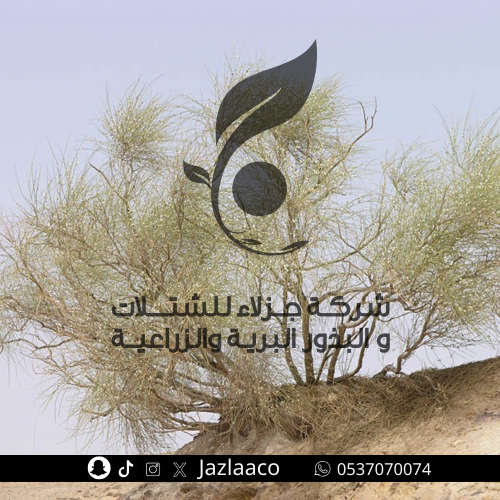
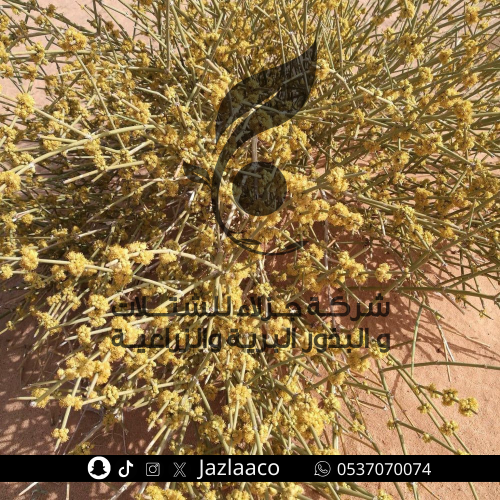
Acacia raddiana
9.50ر.س
Product description
Acacia raddiana is a perennial desert tree of the legume family (Fabaceae), currently known by the scientific name Vachellia tortilis subsp. raddiana in many references. It is one of the most important trees of desert environments, and is characterized by its extreme tolerance to drought and heat and its ability to grow in sandy and gravelly areas.
General Description
It grows as a small to medium-sized tree, typically reaching a height of 3–10 meters, and may be larger under suitable conditions. It has a wide, flat or umbrella-shaped crown, spreading, branching limbs, and provides good shade despite its sparse foliage.
bark and stem
Its bark is often gray to brownish-gray, and may become darker, rougher, and more fissured with age. Straight or paired thorns appear on the branches, and newer branches are relatively smoother and greener.
Papers
The leaves are bipinnately compound, very small, and composed of numerous tiny leaflets, which reduces water loss. They may fall off during periods of severe drought to further conserve water.
flowers
It produces small, spherical flower heads, white to cream in color, that appear in the leaf axils or on short branches. The flowers are relatively fragrant and attract bees and pollinating insects.
Fruits and seeds
It produces twisted or spiral-shaped pods, a defining characteristic of the tree, which turn from green to brown or grayish-brown when mature. The pods contain hard, brown seeds, and both the pods and seeds are consumed by animals, aiding in the tree's dispersal.
Endurance and suitability
It is one of the trees most adapted to desert environments; it tolerates drought, heat, wind, and grazing to a good degree, and can grow in sandy, gravelly, and poor soils. It also has deep roots that help it access moisture in the lower soil layers.
Uses
It is used in desert afforestation, combating desertification, and stabilizing sand dunes, and it provides shade, shelter, and food for wildlife. Its leaves and pods are an important food source for some grazing and wild animals, and it is of great importance in desert ecosystems.
natural spread
This acacia is widespread in large areas of North Africa and the Arabian Peninsula, including desert environments in Saudi Arabia, Yemen, Oman and neighboring regions, and grows especially in valleys and sandy and gravelly plains.
Preservation status
It is not considered a globally threatened species, but it may be affected locally by overlogging, overgrazing, and habitat degradation. It is a very important tree for maintaining natural vegetation cover in desert environments.