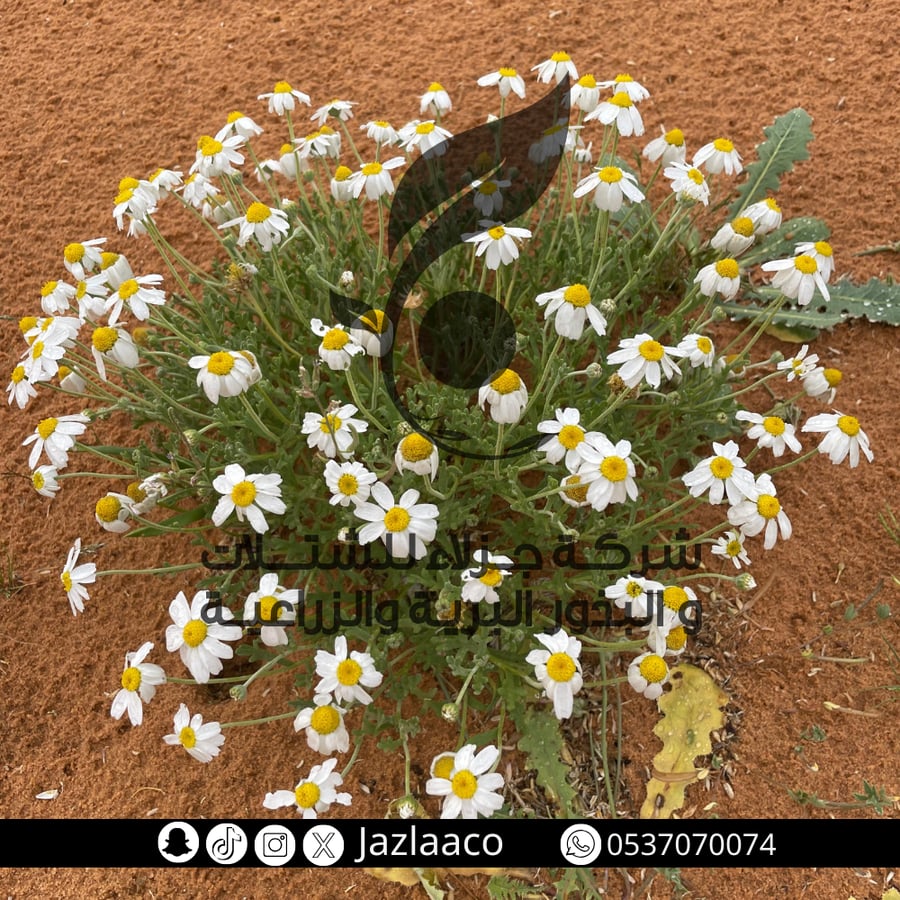
Wild daisy seeds - Anthemis deserti
9.50ر.س
Product description
Wild daisy (Anthemis deserti) is an annual herbaceous plant of the Asteraceae family. It is a desert wild plant that is adapted to drought and heat, and often appears during the rainy season in sandy and gravelly areas.
General Description
It grows as a small, upright or spreading herbaceous plant that branches out from the base, and usually reaches a height of about 10–30 cm. Its stems are thin and branched, and it appears during the appropriate season and then completes its life cycle by producing seeds before the drought intensifies.
Papers
Its leaves are green to grayish-green, alternate, and divided into fine or thread-like lobes, giving them a feathery appearance. They may be covered with fine hairs that help reduce water loss and adapt to the desert environment.
flowers
It produces daisy-like flower heads, consisting of white ray florets surrounding a yellow central disc. The heads appear singly at the ends of the stems and provide a source of nectar and pollen for insects and pollinators.
Fruits and seeds
It produces small, dry, drupe-like fruits that are small and ribbed or relatively smooth, and are released after the flower heads dry. The seeds help the plant to regenerate and spread in subsequent seasons.
Endurance and suitability
Wild chrysanthemums are adapted to drought and heat, growing in sandy and gravelly soils and open areas. Their annual life cycle allows them to take advantage of seasonal rains, completing growth, flowering, and seed production during periods of available moisture.
Uses
It has ecological importance as a seasonal wild plant, contributing to plant diversity and providing food for insects and pollinators during the flowering season. It can be utilized in wild plant conservation programs and desert habitat rehabilitation.
natural spread
Anthemis deserti is widespread in parts of the Middle East, the Arabian Peninsula and North Africa, and grows in desert and semi-desert environments, sandy and gravelly areas and open plains.
Preservation status
Anthemis deserti is not currently known to be globally threatened with extinction, but its density and appearance may vary from season to season depending on the amount of rainfall and the state of natural habitats.
