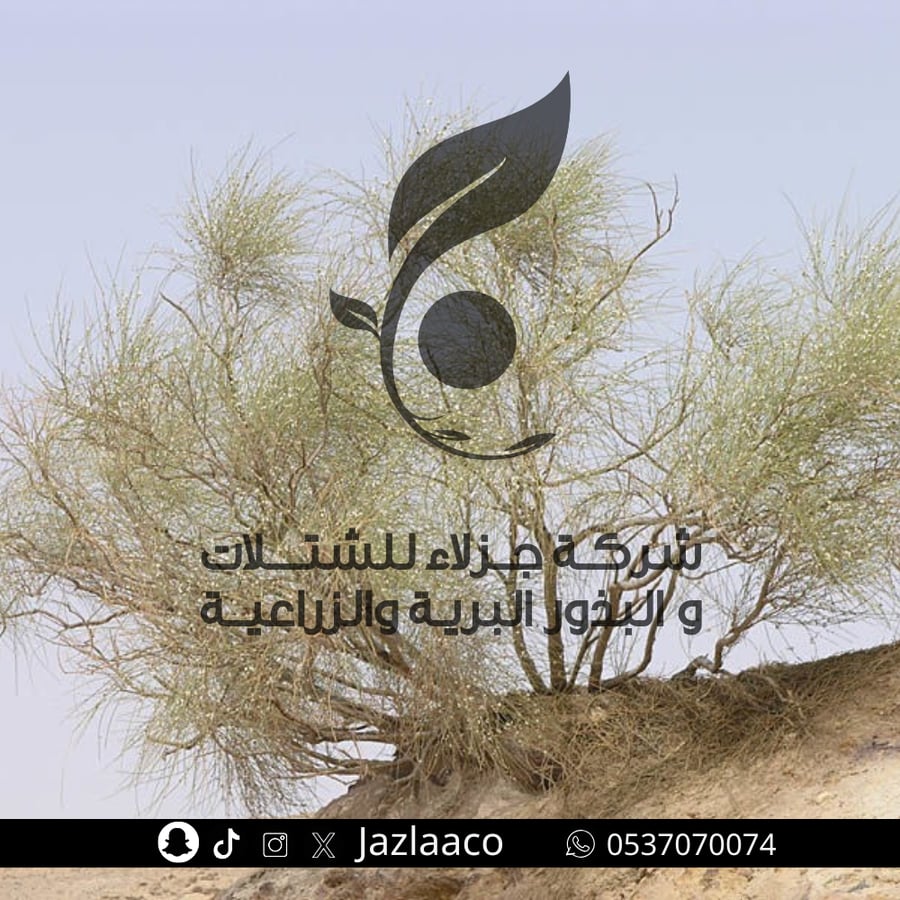
Retama - raetan
9.50ر.س
Product description
Retama raetam is a perennial desert shrub belonging to the legume family (Fabaceae). It is well-adapted to the arid and sandy environments of North Africa and the Arabian Peninsula. It is characterized by its slender, green stems, sparse foliage, fragrant white flowers, and its remarkable tolerance to drought, heat, wind, and sand movement.
General Description
It grows as a dense, branching shrub, typically reaching a height of 2–4 meters, with branches that can spread widely. It is characterized by thin, green stems that perform photosynthesis, while the leaves are very small and fall quickly, helping to minimize water loss.
Papers
Its leaves are small and simple, appearing on the branches for a short time before falling off, while the green stems continue photosynthesis. This adaptation is one of the main reasons for its ability to withstand drought, heat, and harsh desert environments.
flowers
It produces small, fragrant white flowers that appear singly or in clusters on the branches. Flowering is most intense during the growing season, and the flowers attract a number of insects and pollinators.
Fruits and seeds
It produces small, round or oval pods that typically contain one or a few seeds. The fruits and seeds help the plant to regenerate and spread in its natural habitats once suitable germination conditions are present.
Endurance and suitability
It is highly tolerant of drought, heat, wind, and shifting sands, and grows well in sand dunes and poor, well-drained soils. Its strong root system also helps to anchor the sand and access moisture deep within the soil.
Uses
It has significant environmental importance in stabilizing sand dunes, combating desertification, and protecting the soil from erosion. It also provides shelter and food for some wildlife, and can be utilized in desert rehabilitation projects, sand dune stabilization, and the restoration of native vegetation.
natural spread
Retama raetam is naturally distributed across large areas of North Africa, the Arabian Peninsula and the Levant, and is found in desert and sandy environments and open areas with limited rainfall.
Preservation status
Retama raetam is not currently known to be globally threatened and has a wide natural distribution and good adaptability to desert environments. Conserving its natural habitat remains important due to its role in stabilizing sand dunes and supporting desert vegetation.
