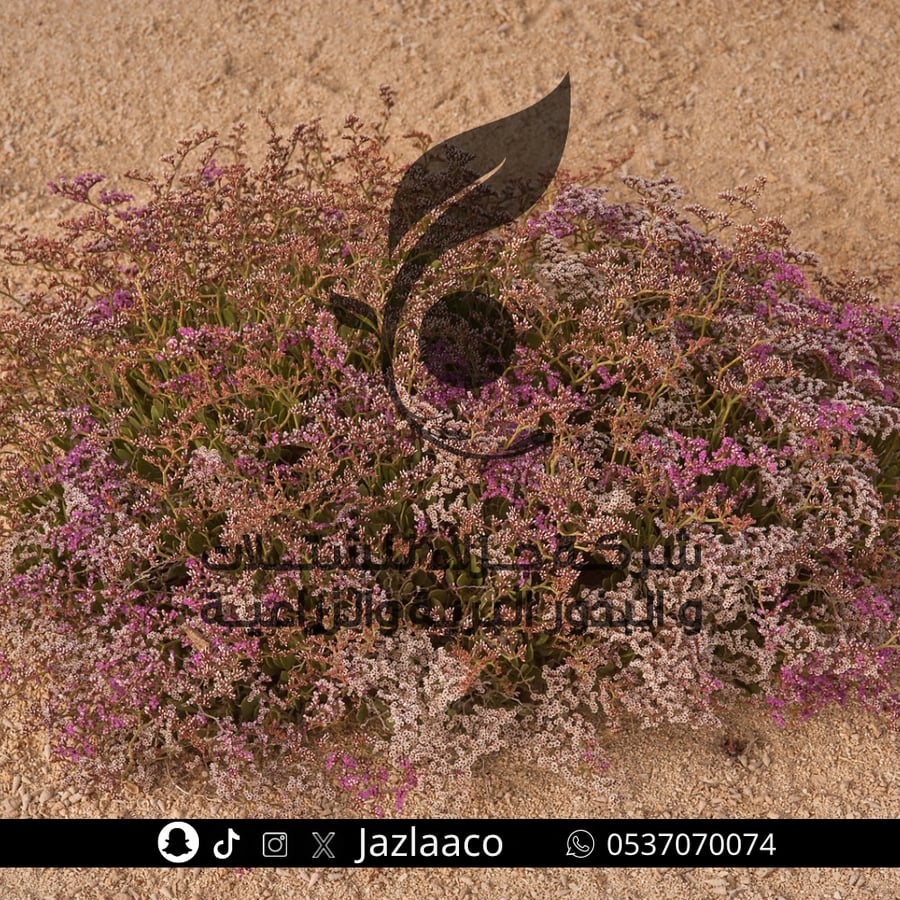


Sea lavender - picked - Limonium axillare
9.50ر.س
Product description
Sea lavender (Limonium axillare) is a perennial herbaceous plant from the Plumbaginaceae family. It is a characteristic salt-tolerant plant of coastal and desert environments, and it has a high tolerance to salinity, drought, and heat.
General Description
It grows as a branching herbaceous plant, usually reaching a height of about 20–60 cm, with branches spreading from the base of the plant, and may take a semi-spherical or elongated shape. It is characterized by its ability to grow in highly saline coastal environments.
Papers
Its leaves are simple and relatively thick, ovate to spoon-shaped or oblong, and range in color from green to gray-green. The thickness of the leaves and their salt-tolerant properties help them retain water and tolerate high salt concentrations.
flowers
It produces small flowers, purple to pink or white, clustered in branching inflorescences at the tips of the stems and in the leaf axils. These appear during the flowering season and provide a source of nectar and pollen for a number of insects and pollinators.
Fruits and seeds
It produces small, dry fruits containing a single seed, which ripen after flowering and help the plant reproduce and spread in coastal and saline environments.
Endurance and suitability
Sea lavender is characterized by its high tolerance to salinity, drought, and heat, and it grows in salt marshes, coastal salt flats, dunes, and sandy areas near the sea. Its physiological properties help it cope with the accumulation of salts in the soil and water.
Uses
It has environmental importance in stabilizing coastal soils and contributing to the vegetation cover of salt marshes and saline areas, and its flowers provide a food source for insects and pollinators. It can be utilized in coastal vegetation restoration projects and the rehabilitation of salinity-affected lands.
natural spread
Limonium axillare is naturally distributed on the dry coasts of the Red Sea, the Arabian Gulf and the coastal areas of the Indian Ocean, and is found in saline environments, salt marshes and coastal sandy areas.
Preservation status
Limonium axillare is not currently known to be globally threatened and is well-adapted to saline coastal environments. Its density varies locally depending on the condition of the coastal habitat and the level of disturbance and environmental changes.
