Fava bean seeds
6ر.س
Product description
Common name: Fava bean
Scientific name: Vicia faba
Also called: Broad bean
Original habitat of the bean:
• Its original habitat is Western Asia and North Africa, known in China, and its cultivation spread in Europe in Italy, France, and Spain, then its cultivation qualified and transferred from Europe to North America.
Description of the bean plant:
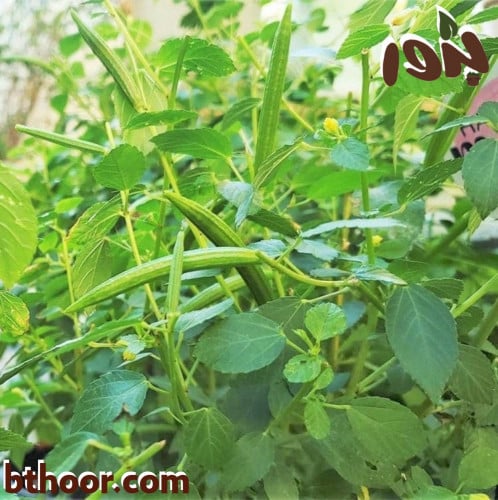
• The bean plant belongs to the leguminous family, its root is a taproot that penetrates the soil to depths of 60 to 80 cm, branching from above into roots extending horizontally to about 50 cm, the stem is quadrangular with four sides, its length ranges from 60 to 160 cm, branching from the bottom into 3-6 branches above the soil surface, hollow, green in color, darkening during drought.
• The leaf is a compound pinnate with three, five, or seven leaflets, oval-shaped, with full edges, and the terminal leaflet is transformed into a short stipule with two small stipels below which are nectar-producing glands.
• The fruit is a pod consisting of a single cavity, its skin is leathery lined with white fuzz, its length ranges between 8-40 cm, and its width between 1-3.5 cm.
• The number of seeds per pod ranges from 1 to 8 depending on the variety and agricultural conditions.
• The pod is straight, slightly curved, green, and darkens when fully ripe.
• The seeds are oval-shaped, rounded at the edges, flattened, brownish-green or light green at the start of ripening, then tend to light purple as ripening progresses.
Description of the bean flower:
• The flowers of the bean are borne in axillary racemes, each consisting of 2-6 flowers.
• The flower is a bisexual, white, zygomorphic flower with black spots on the sides.
• The flower's calyx consists of 5 sepals, and the corolla is made up of a style, two wings, and a banner.
• The stamen consists of 10 stamens, 9 of which are fused, and one is free.
Uses and benefits of the bean:
• Beans are cultivated to obtain their dry seeds, which are used in food and are characterized by a high content of nutrients, especially protein.
• They are widely used in Arab cuisine, and are considered the primary traditional dish in Egypt.
• Cultivating beans is important because they are used as food in the Arab world, especially in Egypt and Sudan.
Suitable climate for the bean:
• Grows in moderate and hot climates.
• The bean plant needs temperatures between 30-6°C, and is sensitive to low temperatures below 4°C, especially during flowering and seed formation.
• The bean is a long-day plant, and light affects its vegetative growth and flowering, increasing growth with longer daylight periods.
• Sensitive to frost, cold, and drought.
Suitable soil for the bean:
• Grows in various fertile, well-drained, and aerated soils.
• Successful cultivation in sandy loam soils with good drainage or light soils with high organic matter.
• Does not tolerate soil infected with Halaouk, as its spread weakens or kills plants by parasitizing their roots and absorbing nutrients.
• Does not tolerate soil salinity.
• Should be irrigated regularly, especially in summer.
Method of bean propagation:
• Propagates through seeds.
Planting time:
• Beans are planted in October and November.
Method of planting:
• Prepare the soil, which should be moist but without dew.
• Sow the seeds at a depth of 6 inches.
• Leave a distance of 10 cm between each seed to prevent seedlings from being too close, which can lead to pests and diseases.
• Water the soil regularly, and it is preferable to leave the beans in the soil (agricultural land) for a period as it helps fix nitrogen in the soil.
Fertilization method:
• Beans need fertilization with compound chemical fertilizers at a rate of 100 kilograms per dunam, applied in two doses:
• First: after germination, about two to three weeks after planting.
• Second: after flowering.
• The bean plant should also be regularly sprayed with a 2% superphosphate solution six times, every fifteen days, starting one month after planting.

From Buraydah
Questions you might have