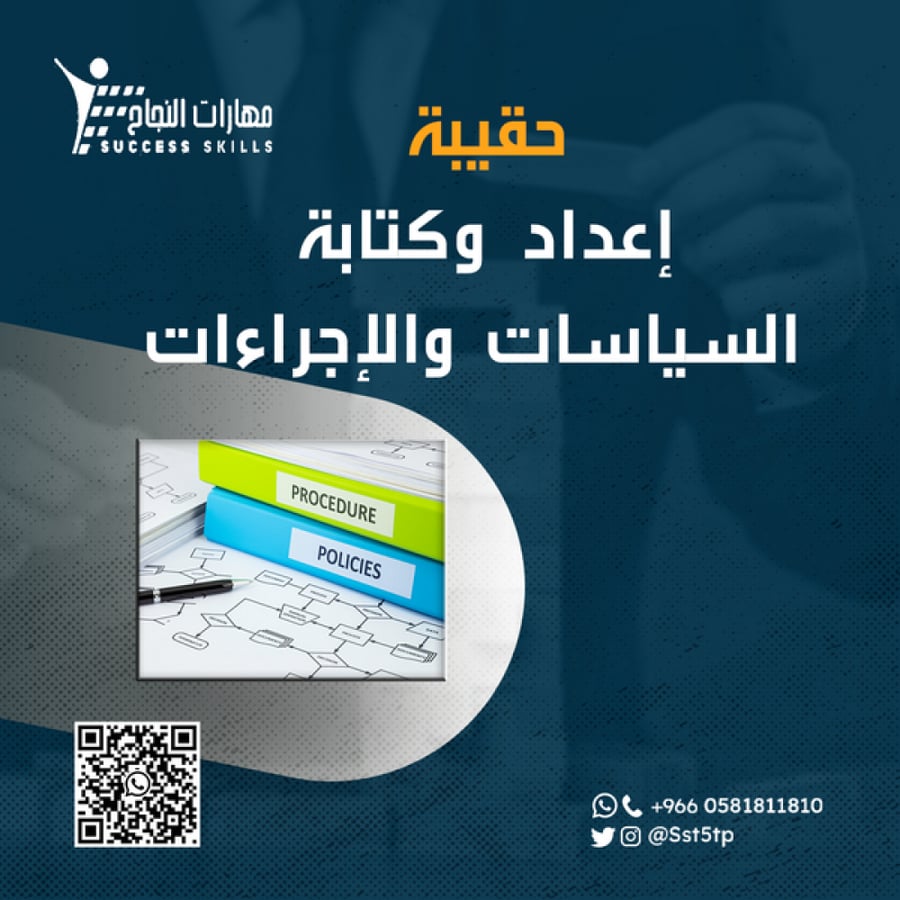

Policy preparation and writing bag
700ر.س
Product description
Training Bag: "Policy Preparation and Writing Bag
General Objective:
Equip participants with the skills and knowledge necessary to prepare and write effective, accurate, and implementable policies and procedures.
Digital training bag in policy and procedure preparation and writing to organize work, improve governance, and enhance institutional performance efficiency.
Policy and Procedure Preparation and Writing Digital Product aims to enable the trainee to prepare and formulate organizational policies and procedures, contributing to unified work and improved institutional performance.
The digital product is delivered electronically after completing the request and does not include any physical shipping.
Detailed Objectives:
Create professional documents.
Identify the main sentences in which they appear.
Understand real examples of policies and procedures.
Understand the methods used in formulating effective policies and procedures.
Avoid ambiguity and uncertainty.
Apply methods to highlight potential problems with current policies and procedures and improve their effectiveness.
Increase practical knowledge of the implications and potential issues with policies and procedures.
Better awareness of the business impact of drafting issues.
Improve the ability to reduce risks.
Gain an opportunity to review policies and procedures and understand their importance to business.
Understand the different roles of documents.
Learn drafting skills that will be usable in a wide range of situations.
Have an opportunity to practice drafting skills in a risk-free environment.
Improve their strategic thinking about how to develop policy and procedure documents.
Learn practical techniques for drafting policies and procedures.
Clarify the impact of non-compliance and build fully compliant procedures.
Demonstrate the ability to manage and reduce risks effectively.
Program Duration:
Number of days: 5 training days
Number of hours: 25 training hours
Target Groups:
Employees responsible for writing policies and procedures, managers at all levels, quality assurance specialists, and HR professionals
Training Methods:
Brainstorming, discussion, briefing, workshops, multiple choice, error correction, classification comparison
Assessment Methods:
Pre- and post-tests, formative evaluation, final evaluation
Introduction:
The activity of organization and methods concerns issues of organization and procedures in public and private organizations, giving them special attention. It involves conducting studies related to administrative organization and procedures for new and existing administrative bodies. Experts establish the rules and foundations on which new departments and bodies are built when first created, based on modern scientific concepts and trends in organization. They also design the procedures necessary for any new work. They study the organization and workflows of existing organizations to identify problems and implement improvements. The goal is to provide the best services to citizens, deliver these services quickly and at the lowest cost, and maximize the utilization of organizational resources.
Organizations of all types (governmental, profit, non-profit) continuously seek to develop how work is implemented to increase efficiency and effectiveness and provide better services. This continuous development must be based on a well-structured and thorough administrative system to prevent organizations from becoming experimental fields for ideas that could deplete financial and human resources without achieving desired results. Building policies and procedures is a fundamental component of establishing a thorough and effective administrative system to ensure ongoing development within organizations. Policies and procedures are essential tools for effective management, defining rules and guidelines employees must follow, helping achieve organizational goals, ensuring compliance with laws and regulations, and protecting the rights of employees and customers.
Policies and procedures include principles, rules, and frameworks that govern the behavior and performance of organizations and their employees. They aim to guide organizational operations, ensure adherence to applicable laws and regulations, enhance performance, and achieve long-term success. The types of policies and procedures vary depending on the sector, business activity, and size of the organization.
At Maharat Al-Najah for Consulting, as experts in management and training, we designed a training bag focused on meeting the actual needs of senior and middle management in building a policy and procedures manual. It aims to impart knowledge and experience and develop skills in preparing and writing policies and procedures through effective administrative tools. Our trainers' and consultants' expertise in administrative sciences and continuous improvement supports us. The training bag has been refined through repeated presentations across multiple Arab countries, enriching it with diverse administrative experiences.
This training bag provides a comprehensive conceptual view of skills for building a policy and procedures manual. It goes beyond this to include practical applications from real practice experiences, which we transfer to participants.
This program may not be a traditional one, as it does not merely aim to provide participants with specific knowledge and skills about organizational fundamentals and work methods. Instead, it is based on active participation and experience exchange between participants and trainers through workshops and daily group exercises, using models and tools that make the training a complete process. By the end of the program, trainees will be able to analyze and document procedures and processes in their organization and identify key elements of administrative procedures.
This experience aligns with Maharat Al-Najah for Consulting's approach, which cares about integrating theoretical and practical aspects in a practical training context that has a place in both theoretical thinking and practical application. In this context, Maharat Al-Najah aims to offer a training bag that participants find useful and beneficial in their practical practices.
We hope this training bag, along with others produced by Maharat Al-Najah for Consulting, will serve as an entry point for broader and deeper dialogue, leading to the creation of interactive educational environments that result in a transformational change in the administrative and organizational process as a whole, especially within the organizational environment of the business sector in all its dimensions.
Our focus at Maharat Al-Najah is to make this a fun and useful course, which is why it is an actual training workshop where participants actively learn and practice how to build a policy and procedures manual.
Training Bag Topics:
First Training Day
First Session (Introduction to Writing Policies and Procedures)
Concept of Policies and Procedures.
Difference between Policies and Procedures.
Importance of Policies and Procedures.
What makes a policy appropriate.
The role of policies and procedures within organizations.
Requirements for policies or procedures.
Policy Building Skills Course
Second Session (Effective Writing of Policies and Procedures)
Policy and procedures structure.
How to start writing policies and procedures.
How to write procedures to increase control.
Writing procedures for results.
Browse: Second Training Day
First Session (Governance Policy for Policies and Procedures)
Legal role and compliance with policies and procedures.
Policy review process.
Policy disclaimer.
Corporate Governance Course
Read also: Corporate Governance Bag
Second Session (Follow-up on Governance Policy for Policies and Procedures)
Approval process for policies and procedures.
Writing methods for policies and procedures.
Merging and editing different documents; integration into a single style.
Maintaining a strategic distance from ambiguity.
Management commitment: key to using procedures.
How to ensure employee compliance.
Meeting work plans and notification forms.
Resistance factors and dealing with resistance.
Read also: Administrative Leadership Bag
Third Training Day
First Session (Introduction to Quality Path)
Definition of quality.
Historical development of quality.
Elements of quality.
Definition of Total Quality Management.
Main features of Total Quality Management.
Basic principles of Total Quality Management.
Benefits of Total Quality Management.
Stages of development of Total Quality Management.
Read also: Modern Trends in School Leadership
Second Session (Quality Management Standards)
Quality standard.
What ISO means.
ISO is a real need, not just promotional.
ISO 9000.
Basic principles of quality systems ISO 9000.
ISO 9000 series.
Standards for external quality assurance.
Read also: Institutional Communication Bag
Fourth Training Day
First Session (Audit and Monitoring Policy)
Definition of auditing.
Importance of auditing.
Objectives of auditing.
Types of auditing.
Second Session (Internal Control System)
Factors that helped develop the internal control system.
Concept of internal control.
Objectives of internal control.
Types of internal control.
Relationship between internal control system and external auditing.
Responsibility of external auditor regarding internal control systems.
Read also: Electronic Governance Control Bag
Fifth Training Day
First Session (Policy and Procedures Documents)
Policy and procedures documents.
Elements of policy and procedures documents.
Principles of preparing policy and procedures documents.
Dissemination of policy and procedures documents.
Standard Operating Procedures (SOPs).
Steps for Standard Operating Procedures (SOPs).
Licensing, production, and distribution of standard operating procedures.
Case study analysis.
Browse
Second Session (Scope of Audit and Review)
Advantages and compensations.
Performance evaluation of employees.
Review of job descriptions.
Employee records.
Review process steps.
Read also: Child Centers Management Bag
Keywords: Leadership in Education#Educational Leadership#Leadership#Training Bag#Training Packages#Ready Training Packages#Custom Training Packages#Training Package Structure#Success Skills for Training Packages#Diploma Packages#Family, Child, and Home Packages#Scientific Specializations Packages#Business Management Packages#Free Package Specializations#Economics Packages#Modern Trends in School Leadership#Scientific Specializations#Fine Arts Packages#Family, Child, and Home Packages#Humanities Packages#Diploma Packages#Research Related to Ready Training Packages#Free Ready Training Packages#Ready Training Packages PDF#Training Packages PDF#Self-Development Training Package#Ready Training Course#Free Children's Training Packages#Free Training Packages PDF#Ready Training Packages#Ready PowerPoint Templates#Free Training Packages#Training Templates#Training Package Design#My Training Package#Training Package Design#Training Preparation#Training Skills#Administrative Instructions and Regulations for Trainers#Training Methods for Training Programs:
Generally, trainers tend to use the following methods in all their training programs: (Educational activities (workshops) + Cooperative learning + Training lecture + Role-playing + Brainstorming workshops).
Training tools used in training programs:
Laptop + Projector (Data Show) + White screen + 2 paper whiteboards + Paperboard stand + Large colored pens + Audio equipment + Transparent tape.
Desired training hall specifications:
1. A nearby mosque or prayer room, no more than 50 meters away (for women’s and men’s courses, separate prayer spaces are required). We pause for each call to prayer, giving trainees time to prepare and perform, not exceeding 20 minutes including break and prayer.
2. Suitable, clean, and nearby restrooms (separate for women and men, close to the hall).
3. Organized, secure, and close parking for trainees.
4. Signage inside the venue with the institution’s name, program, trainer, course location, date, and start/end times.
4. The hall should be spacious, clean, with extra space inside for practical exercises.
5. Seating arrangements should be coordinated with the trainer, with women’s seats separated from men’s according to our Sharia, principles, and societal values. Seating can be in a U-shape, V-shape, or circle workshops, with adjustable and movable tables and comfortable, mobile chairs. The trainer’s position should ensure comfort and good eye contact, facilitating movement.
6. Good audio systems with a portable wireless microphone.
7. A table for the trainer’s tools: computer, training bags, and materials.
8. A large display screen and a large whiteboard.
9. Coordination with the hall management for hanging explanation papers on a stand or wall.
10. Ensure good ventilation and air renewal.
11. Proper lighting, preferably white light.
12. No distracting images or content conflicting with values or advertisements for other entities.
13. For courses with a TV circle for male and female trainees, ensure the TV circle is ready, with two screens—one for training display and another for trainer videos—and wireless microphones for communication between halls.
14. Smoking is strictly prohibited inside the training hall.
15. Cleaning staff should organize, clean, and perfume the hall before the program and during breaks.
16. Ventilate the hall by opening all windows an hour before the training begins to refresh air, oxygen, and energy, and periodically during breaks.
17. Arrange trainees’ notebooks and chairs, ensuring their condition before and during breaks.
18. The organizing body and course management should prepare a card with trainees’ names, placed in front of each for easy acquaintance and trainer recognition.
19. The organizing body should print trainee cards with the training institution’s logo, Maharat Al-Najah logo, program name, and hang them on the trainer’s chest. These are collected from the course secretary at the hall entrance and returned after the trainee leaves to monitor attendance and systematize participation.
20. Hall decor colors should be light and calm.
21. Excess chairs beyond the number of trainees should be removed regularly.
22. Two high chairs should be provided for the trainer to be visible during applications and sitting.
23. A printer should be available in the training hall for printing urgent training forms.
24. A reception table should be placed outside the hall entrance, managed by the course secretary for welcoming trainees, coordinating attendance, departure, and inquiries.
25. A welcoming stand with the institution’s name, logo, program, trainer, course location, date, and start/end times should be placed outside the hall to greet participants.
26. A large advertising board should be placed inside the hall behind the trainer, displaying the institution’s name, logo, program, trainer, course location, and date.
27. Welcome and motivational posters should be placed at entrances and corridors leading to the course venue.
29. Regularly check the cleanliness, fragrance, and sterilization of restrooms, with welcoming signs for trainees.
(Refer to Appendices – Ideal Design for Training Hall)
Buffet:
A buffet for trainees twice daily, including water, fresh juices, pastries, tea, coffee, cappuccino, and cake (with attention to renewal, innovation, and presentation quality). Also, place the following items on the trainees’ table, with each trainee receiving:
1. A large, fresh, cold, original, and healthy water bottle.
2. A clean glass cup beside the water bottle.
3. A new box of tissues on the trainees’ table.
4. A selection of refreshing candies that melt in the mouth, containing natural sweets to help activate energy.
Notes and Educational Materials:
The trainer will provide the course coordinator with a course manual within 72 hours, including (course overview, scientific material, exercises). These are the intellectual property of the trainer, bearing the Maharat Al-Najah logo, and should be properly photographed and packaged. The trainer’s name, Maharat Al-Najah logo, website, and contact numbers should be prominently displayed on the cover (see Appendices – Training Bag Covers). They should be professionally printed and packaged at the organizer’s expense, with the printing cost deducted from the course revenues.
Training Program Evaluation and Assessment Methods:
1. Evaluation tools by the trainer and course management:
Training is a performance gap filler. For the training program to succeed, a system of factors contributes to its success: the trainer, course management, services, training hall, training bag, training objectives, trainees, internal and external training environment. The course is evaluated before, during, and after, with a pre-meeting to confirm training needs, understand trainees’ and training entity’s objectives, review the program, and assign tasks (see Appendices – Pre-Program Evaluation Meeting). A daily meeting is held 15 minutes after the end of each training day, lasting 30 minutes, with the trainer, training team, and program manager to review the day’s program and discuss improvements for the next day (see Appendices – Daily Evaluation Meeting). A final meeting is held after the program ends for an hour for final evaluation and recommendations for improvement (see Appendices – Final Evaluation Meeting).
Initial evaluation relies on expectation boards and trainee experience forms (see Appendices – Expectation Board and Trainee Experience Form). Participants are asked to fill these out before the program begins. During and after the program, evaluation depends on observation, measurement, daily trainee evaluation forms, and evaluation boards.
2. Evaluation tools by trainees:
a. Experience forms (see Appendices – Expectation Board and Trainee Experience Form)
b. Daily and final evaluation forms (see Appendices – Training Program Evaluation Form)
c. Daily evaluation board (see Appendices – Daily Evaluation Board)
d. Suggestion box (see Appendices – Suggestion Box)
These evaluation tools are reviewed periodically and analyzed using Excel daily (see Appendices – Evaluation Form Analysis).
Conditions for Passing Any Training Program:
To obtain a certificate of completion, the participant must:
- Attend at least 90% of the training hours.
- Actively participate in all training activities.
- Pass the training tests designed by the trainer.
Rules to Follow During Training Organization:
1. The trainer is the team leader of the training program and has the right to request everyone to increase effort and performance.
2. The course coordinator or manager should hold a briefing session with the trainer at least one day before the program starts, explaining participant backgrounds, training needs, main issues, and their social, religious, and cultural backgrounds.
3. A daily evaluation session should be held at the end of each training day, involving the trainer, course manager, and coordinator, to review trainee and trainer feedback and improve the course.
4. Smoking is strictly prohibited inside the training hall, corridors, and restrooms, especially for the administrative, marketing, and training staff.
5. All training, administrative, and marketing team members must respect prayer times and perform prayers in congregation with trainees, as they serve as role models. Prayer will be paused immediately upon the call to prayer, with no delays or interruptions.
6. No one other than the trainer is allowed inside the hall without special permission, which should serve the training program, and only the trainer has the authority to decide on entry.

Questions you might have