Seeds of the Sissoo tree - Sissoo (Dalbergia sissoo)
7ر.س
Product description
Common name: Sersoua - Sismal
Scientific name: Dalbergia sissoo
Also known as: Sasmal
Sersoua is a perennial tree from the Sasm genus of the Fabaceae family, reaching a height of 25 meters with a circumference of 180 cm at the base of the trunk. Its leaves are deciduous, arranged in a spiral pattern, interlaced in an incomplete manner, and remain green year-round.
- Flower of the Sersoua - Sismal:
Its small yellow flowers bloom in summer.
- Fruit and seeds of the Sersoua - Sismal:
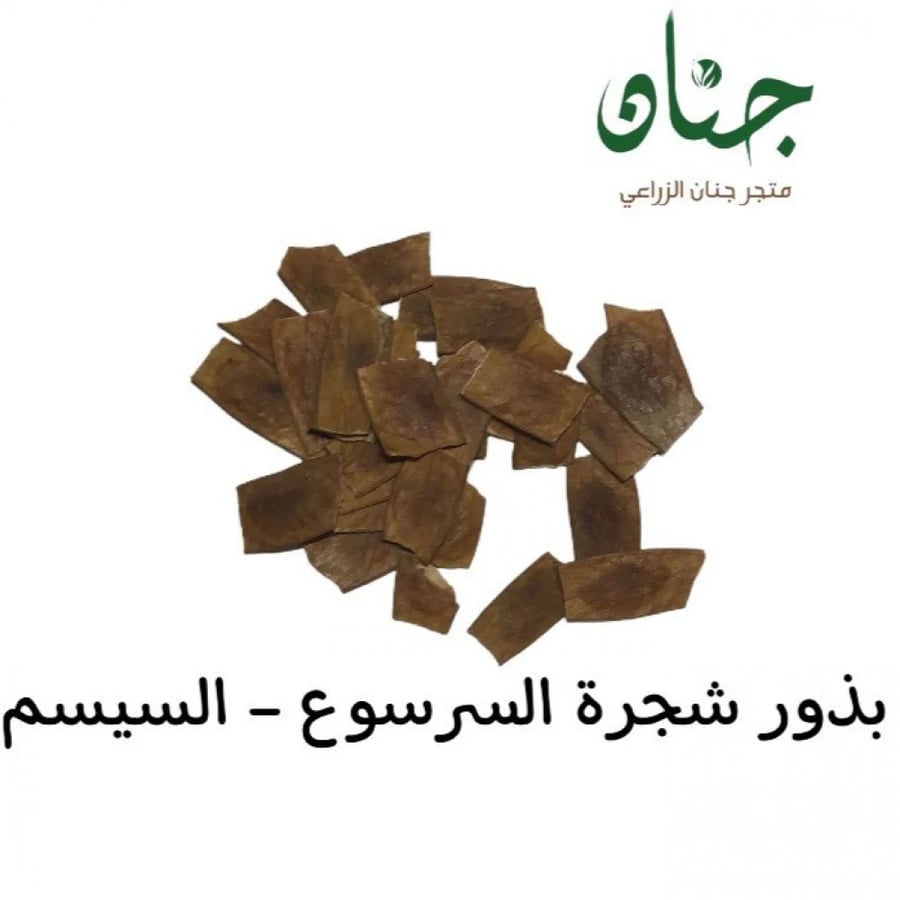
Its fruits are pod-shaped, with each fruit containing a single brown seed with a rectangular shape.
- Sowing season for the Sersoua - Sismal:
It is planted in spring, but can also be cultivated throughout the year in agricultural protected areas, enclosed or plastic places where temperature can be controlled, sunlight reaches the plant, or where adequate lighting is available.
- Suitable climate and soil for the Sersoua - Sismal:
The Sersoua grows well in sandy and alluvial soils near rivers but does not grow in heavy clay soils. It tolerates a wide range of temperatures: 0–50°C. It needs sunlight and shade, is frost and drought resistant, and is watered regularly.
- Method of cultivating the Sersoua - Sismal:
It reproduces through seeds, which are soaked in water for two days before planting at a depth of 0.5 cm from the soil surface. It can also be fertilized with organic fertilizer at least once to accelerate growth and development.
- Its benefits and uses:
Oil of rosewood is extracted from the tree, which has effective properties for cell growth and tissue regeneration. It is used to remove wrinkles and treat acne, as well as in some perfumes. Its wood is used to make household furniture.
- Native habitat of the Sersoua - Sismal:
Its original habitat is India. It is cultivated in Saudi Arabia and many Arab countries.

From Buraydah