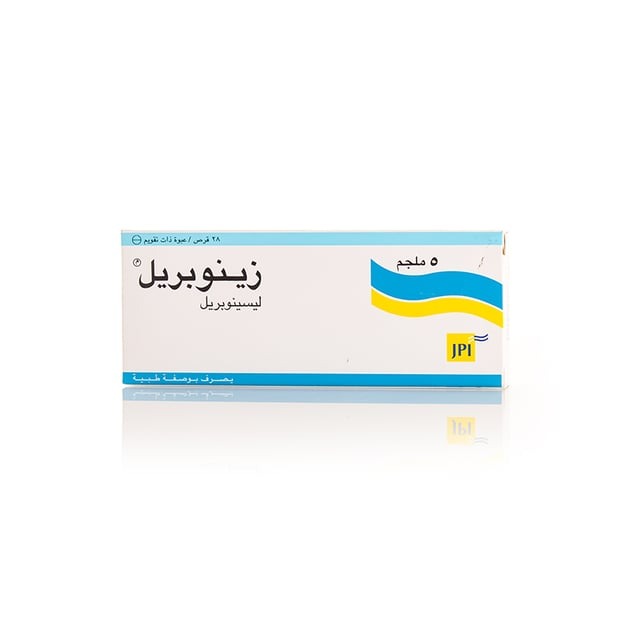
Zinopril 5 mg tablets 28 pcs
15.80ر.س
Product description
Please attach the medical prescription in the attachments below.
Zinopril 5 medication is one of the widely used medications in the treatment of high blood pressure and various heart conditions.
This medication contains an active substance known as Lisinopril, which belongs to a class of drugs called Angiotensin-Converting Enzyme (ACE) inhibitors.
Information about Zinopril 5 mg:
Scientific name: Lisinopril.
Pharmacological classification: ACE inhibitors.
Number of tablets: 28 tablets.
How does Zinopril (Lisinopril) 5 mg work?
Zinopril belongs to the "ACE inhibitors" class, a group of drugs mainly used to treat high blood pressure and heart failure.
These drugs work by relaxing and widening blood vessels and reducing blood volume, leading to lowering blood pressure and decreasing the heart's oxygen consumption.
Additionally, Zinopril prevents the conversion of Angiotensin 1 into Angiotensin 2, and inhibits the breakdown of prostaglandins that dilate blood vessels, reducing vasoconstriction caused by Angiotensin 2 and promoting vasodilation.
What are the uses of Zinopril 5 mg?
Treating high blood pressure: Hypertension is a common condition where the force of blood against artery walls is high enough to cause long-term health problems, such as heart disease.
Treating heart failure: The medication is used to treat heart failure, a condition where the heart cannot effectively pump blood throughout the body.
After a heart attack: It is recommended for people who recently experienced a heart attack to improve heart functions.
Treating kidney problems related to type 2 diabetes: It is also used to treat kidney issues caused by type 2 diabetes in patients with high blood pressure.
What is the dosage and how to use Zinopril 5 mg?
High blood pressure: The recommended starting dose is 10 mg once daily. The usual dose for long-term maintenance is 5 mg once daily.
Heart failure: The recommended starting dose is 2.5 mg once daily. The long-term therapeutic dose ranges from 5 to 35 mg once daily.
After a heart attack: The recommended starting dose is 5 mg within 24 hours of the heart attack, and another 5 mg after one day. The usual long-term dose is 10 mg once daily.
Kidney problems due to diabetes: The recommended dose is 10 mg or 5 mg once daily.
For elderly or people with kidney problems or taking diuretics, the doctor may prescribe a lower dose than usual.
For children weighing between 5 and 50 kg: The initial recommended dose is 2.5 mg once daily.
For children weighing more than 50 kg: The initial recommended dose is 5 mg once daily.
The tablet should be swallowed with water.
Try to take your tablets at the same time every day, regardless of whether it is before or after food.
Continue taking the medication for the duration prescribed by your doctor, as it is a long-term treatment.
This medication is not recommended for children under 6 years old or children with severe kidney problems.
The doctor will determine the appropriate dose for your child based on their body weight.
Blood pressure should be measured regularly, and readings recorded especially within 1-3 hours of the first dose or a new dose.
Avoid taking antacids within two hours of this medication.
What are the side effects of Zinopril?
Common side effects include:
Headache.
Dizziness or lightheadedness, especially when standing up quickly.
Diarrhea.
Dry cough.
Vomiting.
Kidney problems (detected in blood tests).
Uncommon side effects:
Mood changes.
Color change in fingers or toes (pale blue followed by redness) or numbness or tingling in the fingers.
Taste changes.
Feeling sleepy.
Feeling dizzy.
Difficulty sleeping.
Stroke.
Increased heart rate.
Runny nose.
Nausea.
Stomach pain or indigestion.
Skin rash or itching.
Impotence (sexual weakness).
Feeling tired or weak (loss of strength).
A significant drop in blood pressure may occur in people with:
Coronary heart disease.
Aortic stenosis (heart artery narrowing) or kidney artery narrowing or heart valves.
Thickening of the heart muscle.
If this happens, you may feel dizziness or lightheadedness, especially when standing up quickly.
What are the contraindications of Zinopril 5 mg?
Allergy to this medication or any other ACE inhibitors.
Patients with unknown cause or hereditary angioedema, or those caused by previous use of ACE inhibitors.
What precautions should be taken when using Zinopril?
Lisinopril should be used cautiously in the following cases:
Low blood pressure or fainting: Some people may feel dizziness caused by a drop in blood pressure during the first few days of taking this medication.
It is preferable to take the first dose at bedtime, and the first dose should be taken under medical supervision in the hospital for patients over 70 years old.
Severe low or high blood pressure.
Low blood volume or electrolyte levels in the blood.
Unstable heart failure.
Kidney problems.
Taking high doses of diuretics or vasodilators.
Dizziness: Avoid performing dangerous tasks such as driving or operating machinery if feeling dizzy, as alcohol may enhance the blood pressure-lowering effect of this medication and increase the risk of fainting.
Regularly monitor blood pressure, kidney function, and potassium levels in the blood.
Dry cough: May occur when using ACE inhibitors, usually appearing within the first few months of treatment, and stops within 14 weeks after discontinuation.
Other causes of cough should be considered and ruled out before stopping treatment.
Narrowing of the arteries supplying the kidneys (renal artery stenosis) and decreased body fluid volume due to diuretics, dialysis, diarrhea, vomiting, or dehydration.
Patients with atherosclerosis, aortic stenosis, mitral valve stenosis, or diabetes.
Conditions affecting connective tissue such as scleroderma (lupus or rheumatoid arthritis).
Low blood pressure: May not be a reason to stop ACE inhibitors in the future, especially in patients with heart failure, as a decrease in systolic blood pressure is a desired effect.
How to store Zinopril?
Keep in the original packaging to ensure its safety.
Store at an appropriate temperature, avoiding humidity.
Do not refrigerate.
Do not use the product after the expiration date printed on the package.
In conclusion, Zinopril is an important option in treating heart diseases and hypertension, but it should be used carefully and under medical supervision to ensure maximum benefit and avoid any unwanted complications.

From Riyadh
Questions you might have