
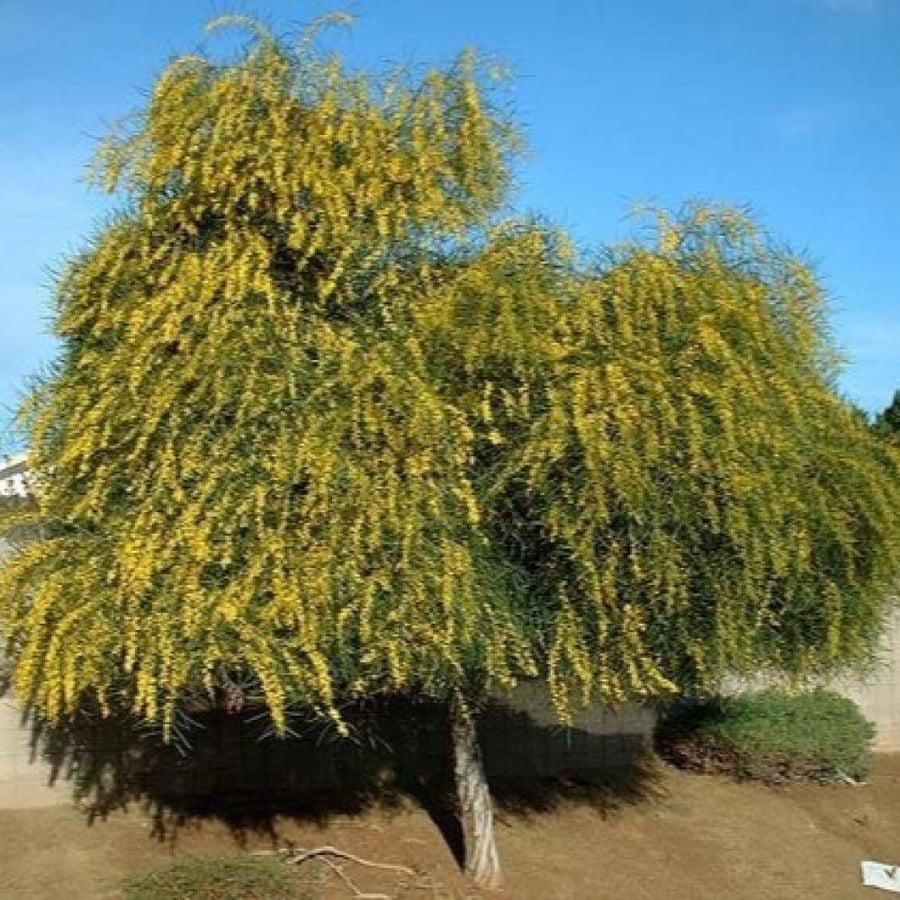


Acacia saligna seeds
42ر.س
Out of Stock
Product description
Number 1000 seeds
Common name: Acacia Saligna
Scientific name: Acacia Saligna
Other names: Golden Crown Acacia - Acacia Saligna - Acacia Saligen
Acacia Saligna is a small tree belonging to the Fabaceae family, densely spread with a short trunk, reaching a height of up to eight meters. It contains plant-like leaves instead of true leaves, and grows quickly.
• Flower of Acacia Saligna tree: Its flowers are yellow-golden in small spherical clusters (7-12 mm in diameter) arranged in larger compound groups, blooming in summer.
• Fruit and seeds of Acacia Saligna tree: Its fruits are elongated and somewhat flat pods (50-140 mm long and only 4-6 mm wide), slightly constricted between each seed. The seeds are small, black in color.
• Germination season of Acacia Saligna tree: It is planted in spring and autumn, and can also be cultivated year-round in agricultural nurseries, enclosed or plastic-covered places where temperature can be controlled, sunlight is available, or where adequate lighting for the plant exists.
• Suitable climate and soil for Acacia Saligna tree: It grows well in well-drained sandy soil under full sunlight. It requires little watering, high light exposure, wind tolerance, moderate salt tolerance, and high drought tolerance.
• Method of cultivating Acacia Saligna tree: Before planting the seeds, soak them in cold water for 12 to 48 hours, then soak them in boiling water for 2 to 3 minutes or treat them with concentrated sulfuric acid for 1 to 2 hours, then wash before planting. This helps in the growth process. These soaked seeds are mixed with river sand and peat moss, planted at a depth of 1 cm, and cared for, as they need moist soil and warm environments until the seedlings grow.
• Benefits and uses: Acacia Saligna has many benefits and uses. It is used in leather tanning, as high-value animal feed, and as an ornamental tree. It has been widely planted in semi-arid regions of Africa, South America, and the Middle East as windbreaks, in stabilizing sand dunes, and preventing soil erosion.
• Native habitat of Acacia Saligna: Australia.

From Buraydah