

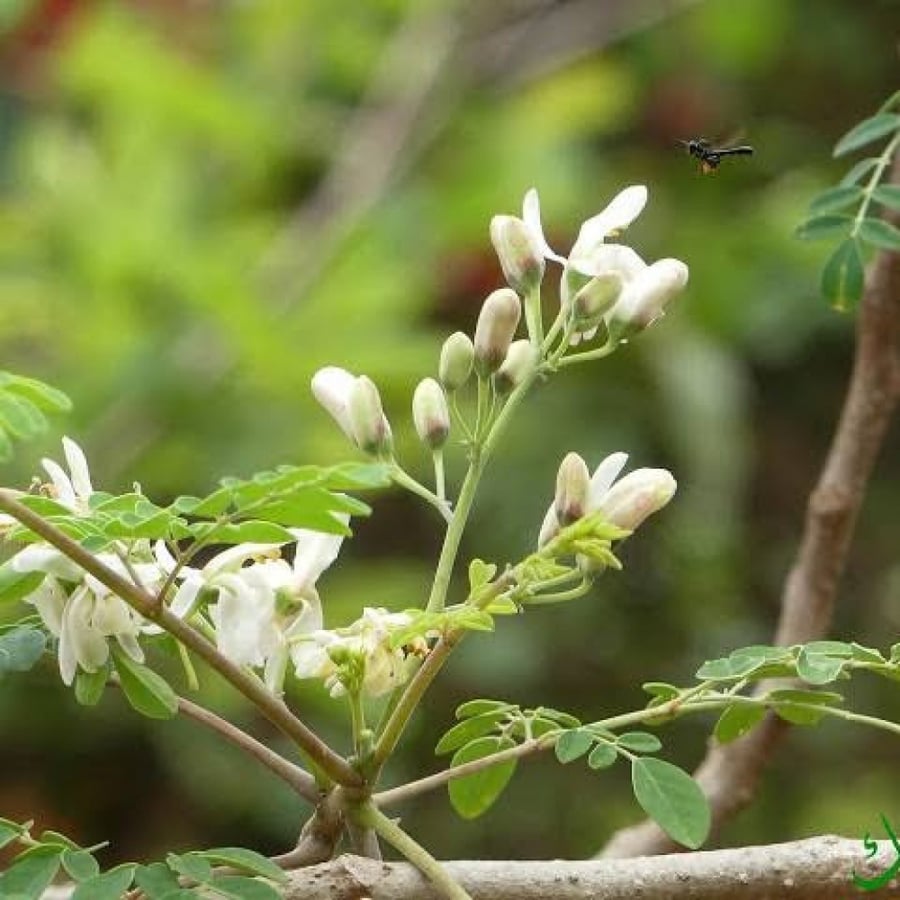

Indian Moringa tree seeds - Moringa oleifera
6ر.س
Product description
Common name: Indian Moringa - Moringa Oleifera
Scientific name: Moringa oleifera
Other names: Shua'a - Oil palm - Alisar - Banan - The precious seed - Wild garlic - Horse radish - Riwaq tree - Drumstick stick
Banan or Yers is a fast-growing upright tree, with open branches that have a graceful appearance, reaching a height of about 10 meters. It has thick bark that is dark gray in color, and beautiful soft, doubly pinnate, feather-like leaves that can reach up to 40 cm in length. The leaflets are spaced out, oval-shaped, green, and borne on short stalks.
• Moringa Oleifera flowers: The flowers are attractive, yellowish-white, with an aromatic scent, about 15 cm in size, blooming from April to September.
• Moringa Oleifera fruit and seeds: The fruit is brown, consisting of pods that vary in length from 15 to 120 cm, and the fruits range from 15 to 90 cm, depending on the type and region. The taste of the fruit is bitter, but it is edible when cooked or fresh, and should be washed before eating. It is not recommended to eat in large quantities. The tree produces between 400 and 600 pods, each containing about 20 to 25 seeds.
• Moringa Oleifera germination season: Moringa Oleifera is planted in late spring or early summer. It can also be cultivated year-round in protected agricultural environments, enclosed or plastic-covered areas where temperature can be controlled, and where adequate lighting for the plant is available.
• Suitable climate and soil for growing Moringa Oleifera: Moringa Oleifera is highly resistant to drought but cannot tolerate cold and frost. It can be successfully cultivated in sandy or clay soils, and requires good drainage.
• How to cultivate Moringa Oleifera: Seeds are germinated in shaded areas, often placed in perforated bags, then planted in the soil. When the seedlings reach three months of age, they can be transplanted to their permanent location. Seeds are planted at a depth of 1-2 cm. Organic fertilizer should be applied at least once, and watering should be regular.
• Its benefits and uses: Shade, decoration, soil improvement, perfumes, cosmetics, food, animal feed, beekeeping, medicinal uses: used to treat cystitis, prostatitis, diarrhea, liver and spleen diseases, skin conditions, and rheumatism.
• Native habitat of Moringa Oleifera: Its original habitat is India, and it is cultivated in Saudi Arabia and Gulf countries.

From Buraydah
Questions you might have