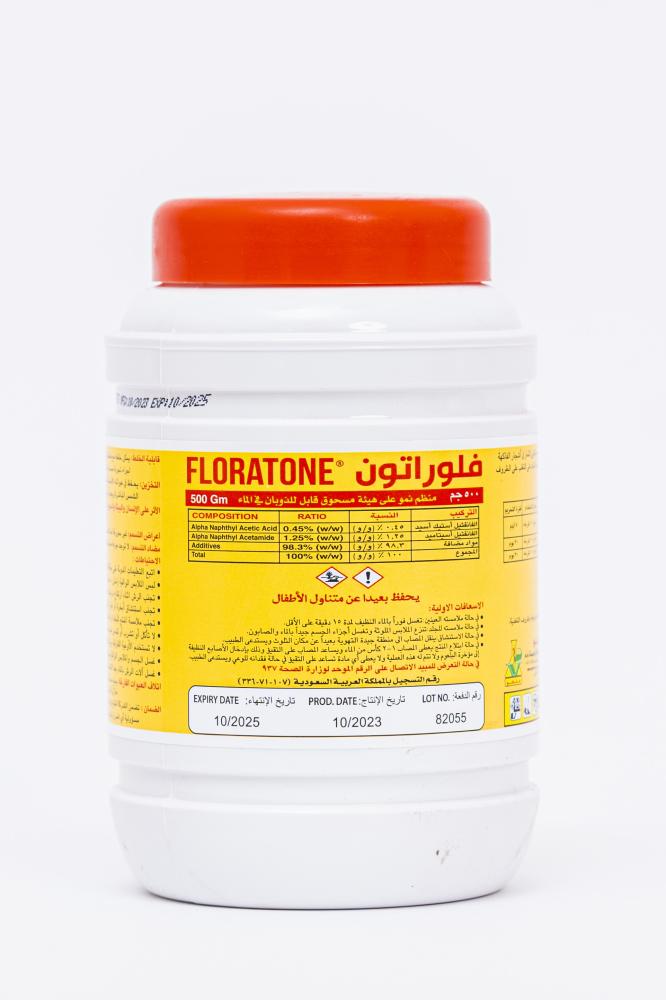
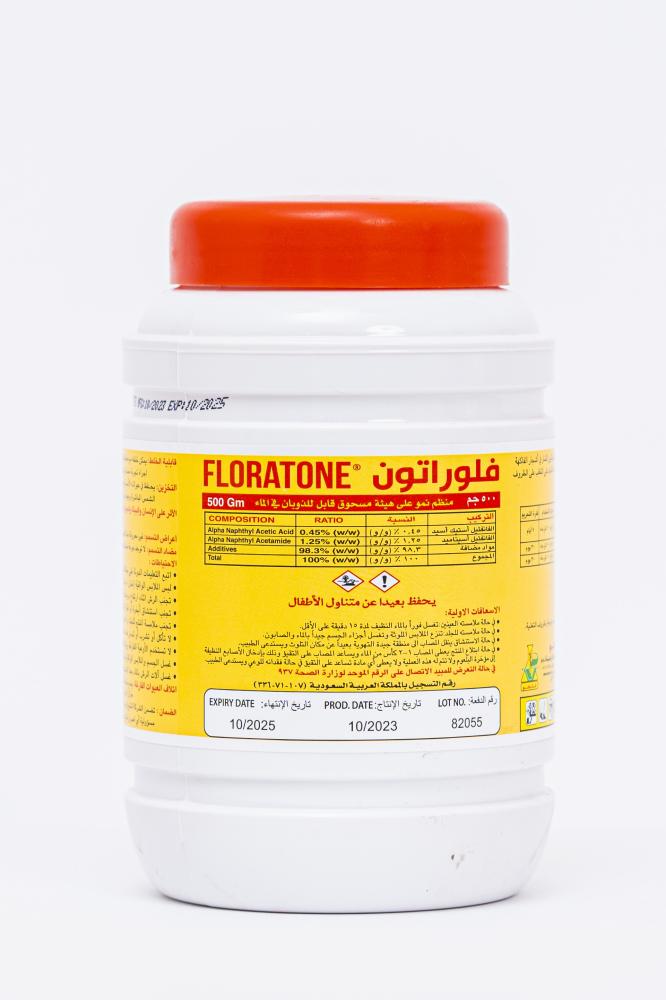
Fluoraton - 500 grams
92ر.س
Product description
Floratone – Plant growth regulator to improve flowering and fruit set Floratone (FLORATONE) artificial hormonal substance stimulates flowering clusters and encourages fruit formation and improves plant growth and increases and activates the process of flowering and fruit set in fruit trees such as peach, apple, pear, apricot, peach, and quince, as well as in many vegetable crops. It also helps the plant overcome difficult conditions (frost, high temperatures, etc.), in the form of a water-soluble powder. Classification and composition Classification: Plant growth regulator – family of auxins Alpha Naphthyl Acetic Acid: 0.45% Alpha Naphthyl Acetamide: 1.25% Additives: 98.3% Crops and usage rates Vegetables (watermelon, cantaloupe, zucchini, eggplant, pepper, peas, beans, tomatoes): 60 g/100 liters of water — spraying begins at the start of flowering and is repeated every 10-12 days in plants that are beginning to open each flowering cluster and are active for growth when the plant has formed two to three leaves or 8-10 days after transplanting — Prohibition period: 7 days Fruit trees (peach, peach, apricot): 60 g/100 liters of water — sprayed at the beginning of flowering and the spray is repeated when the floral buds fall — Prohibition period: 30 days Apples and pears: 60 g/100 liters of water — sprayed two weeks before the start of flowering and the spray is repeated every 10-12 days, stopping when the floral buds fall — Prohibition period: 30 days Mixing compatibility It can be mixed with most pesticides and foliar fertilizers. It should not be mixed with Bordeaux mixture or other growth regulators, and a small-scale test is recommended before large-scale spraying. Notes All parts of the plant should be sprayed with the solution. Do not spray on Dutch cucumber (greenhouse cucumber). Floratone is used on healthy plants that are not suffering from drought or nutrient deficiency. It should not be sprayed when temperatures are very high. The effectiveness of Floratone as a growth regulator depends on several factors such as temperature, humidity, light intensity, plant variety, and nutritional conditions. Do not exceed the recommended rates. Storage It should be stored in its original tightly sealed container in a dry, well-ventilated place at room temperature, away from heat sources, sunlight, children, food, feed, seeds, and fertilizers. ⚠️ Harmful to humans but toxic if ingested or if it contacts skin or eyes. It is non-toxic to bees, honey, animals, and aquatic organisms. Environmental pollution with this substance or its empty containers should be avoided. Production: Veterinary and Agricultural Pharmaceuticals Factories Company (FABCO). Registration number with the Ministry of Environment, Water, and Agriculture: 336-71-107

From Riyadh