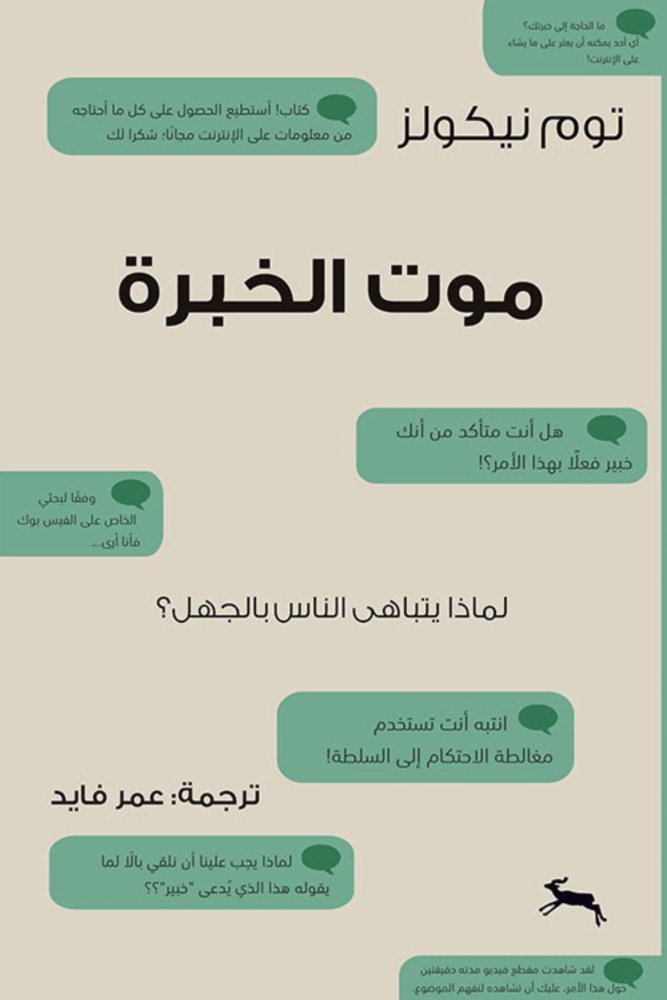
Death of experience: Why do people boast about ignorance?
64ر.س
Out of Stock
Product description
"Excellent book" - Washington Post
"Nicole's perspective is a fundamental perspective if we want to start pulling ourselves out of the hole we have fallen into." - National Public Radio
"A broad indictment of the destructive minimization of the value of knowledge" - Politico
"Buy this book and read it regularly" - Physics World
"This book came at the right time... it is helpful in providing an overview of how we reached that annoying state" - New York Times
It may seem like a cry I have heard before, but Nichols has a special sense of humor and chooses his examples carefully" - Financial Times
"A brilliant guide in the desert of ignorance" - Kirkus
Technology and higher education levels have exposed people to more information than ever before. However, these societal gains have also helped fuel a wave of intellectual equality stemming from a misleading narcissistic mood, which has paralyzed and hindered enlightened discussions on any issues. Today, everyone knows everything; it takes no more than a quick browse on WebMD or Wikipedia for ordinary citizens to believe they are on equal footing with doctors and diplomats. All opinions — even the most absurd — demand to be taken seriously, and any claim otherwise is rejected as undemocratic elitism.
Tom Nichols shows how this rejection of experts happened; the openness caused by the internet, the rise of the customer satisfaction model in higher education, turning the news industry into a 24-hour entertainment machine, and other reasons. Paradoxically, the increasing democratic dissemination of information, instead of producing an educated audience, has created an army of uninformed and angry citizens who denounce intellectual achievement. When ordinary citizens believe everyone is equally knowledgeable, democratic institutions themselves risk falling either into populism or into a miserable technocracy or — in the worst cases — a mixture of both.
