

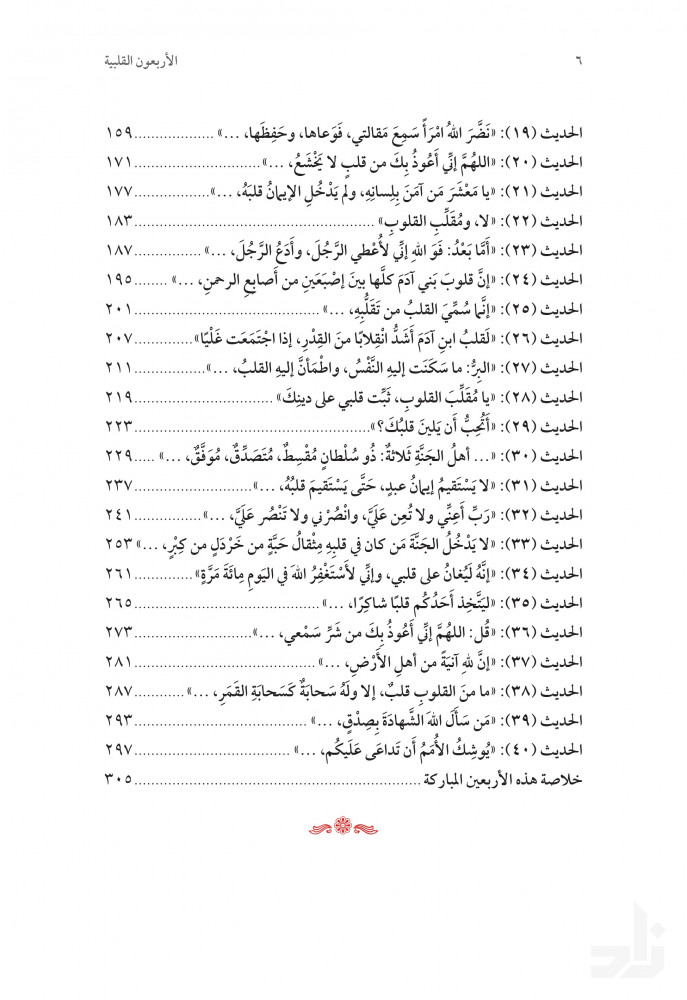


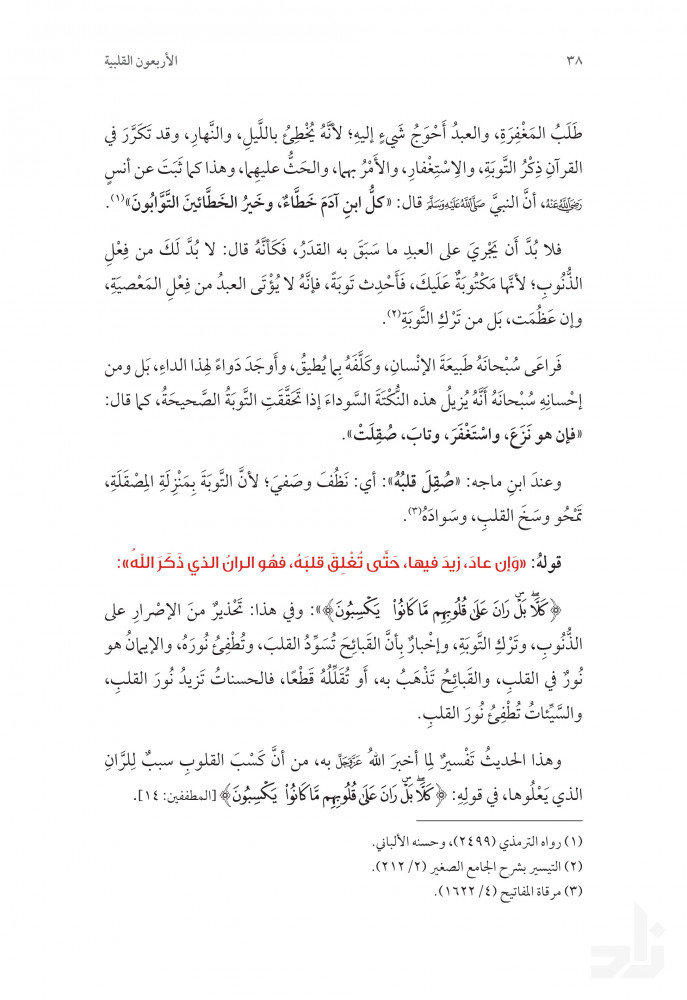

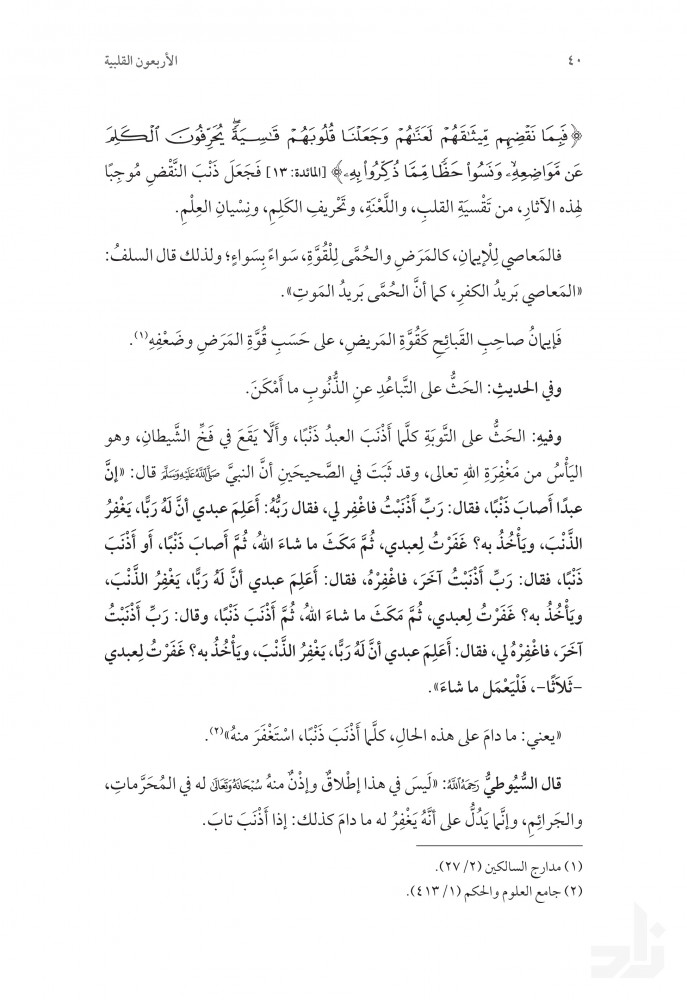

heart forty
30ر.س
Product description
Many scholars of the past and present were keen to collect forty hadiths of the Messenger, may God bless him and grant him peace, and they were creative in collecting them until their topics became diverse and their objectives varied. They wrote countless books on this subject, and their objectives differed in composing, collecting, and arranging them.
Some of them relied on mentioning the hadiths of monotheism in his forty hadiths, or proving the attributes, such as the forty hadiths in the evidence of monotheism, by Abu Ismail al-Harawi - may God have mercy on him - and the forty hadiths in the attributes of the Lord of the Worlds, by Imam al-Dhahabi - may God have mercy on him.
Some of them intended to include rulings in their forty hadiths, as Imam Al-Hafiz Al-Mundhiri - may God have mercy on him - collected forty hadiths on rulings.
Some of them limited themselves to acts of worship, among the rulings, such as the Forty Hadiths on Acts of Worship, by Yusuf bin Abdullah bin Saeed Al-Husayni Al-Armouni Al-Masry Al-Shafi’i, a student of Imam Al-Suyuti - may God have mercy on him.
Some of them chose sermons and spiritual advice.
Some of them chose in his forty to extract what was authentic in its chain of transmission and was free from criticism.
Some of them intended what was higher in its chain of transmission.
Some of them liked to graduate what had a long text, and its beauty appeared to the listener when he heard it, and so on.
Each of these people called his book: The Forty Hadiths on Such-and-such, and the most famous of them is: The Forty Hadiths of Nawawi by Imam al-Nawawi - may God have mercy on him.
Imam al-Nawawi - may God have mercy on him - intended to collect forty hadiths on the foundations and principles of religion, the hadiths on which religion is built, and al-Hafiz Ibn Rajab added to them what he added, and they were explained a lot.
This book, The Forty Heart Hadiths on the Actions of the Heart and Their Reform, is a reference to what scholars have established. A famous hadith has been narrated about this in various narrations from a number of the Companions, such as Ali, Ibn Masoud, Muadh ibn Jabal, Abu al-Darda’, Abu Saeed, Abu Hurairah, Abu Umamah, Ibn Abbas, Ibn Umar, Ibn Amr, Jabir ibn Samurah, Anas, and Buraydah. Imam Ibn al-Jawzi - may God have mercy on him - cited it in the book “The Infinite Ills in Weak Hadiths” and showed its weakness. Among these narrations: Whoever memorizes for my nation forty hadiths on the matter of its religion, God will raise him on the Day of Resurrection as a knowledgeable jurist. [The Infinite Causes: 1/119] .
In another narration: It was said to him: Enter from whichever gate of Paradise you wish [Al-Ilal Al-Mutanahiya: 1/119] .
In another narration: God sent him as a jurist, and I will be an intercessor and witness for him on the Day of Resurrection . [Al-Ilal Al-Mutanahiya: 1/120]
But despite its many narrations, it is not authentic. It was transmitted through many chains of transmission that are not without weakness.
Scholars have made an effort in this regard, and they have recourse to the transmitted hadith and its many chains of transmission.
This collection has benefits, including: creating a summary that makes it easy for the Muslim to understand the fundamentals of an aspect.
Even if the specific merit is not proven, the general merit is in conveying knowledge to people, in creating a summary, collecting texts that cover a topic; summarizing a chapter; in it there is a great educational benefit. Imam al-Nawawi - may God have mercy on him - said in the introduction to the Forty Nawawi Hadiths: “The scholars - may God Almighty be pleased with them - have written countless books on this topic.
This book collects in its chapter hadiths that talk about the matter of the heart and what is related to it.
It is easy to collect, explain and extract benefits from them >>
