
Child of the eraser
35ر.س
Product description
Publisher: Arab Scientific House
Number of pages: 277
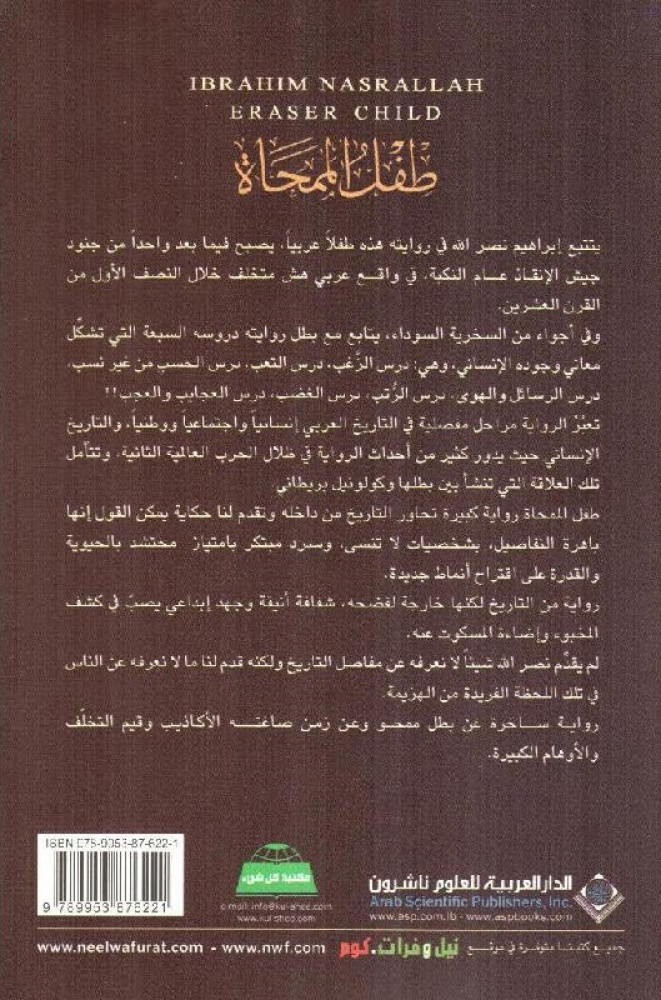
This novel forms one of the six parts of the Palestinian satire that the Palestinian poet and writer issued, which redefines the pulse of Palestinian life to immortalize it and keep it alive in the memory of generations no matter how many years pass.
In a satirical style and through storytelling, the writer weaves his narrative fabric to record the details of daily life in the world before the Palestinian Nakba, and to document its historical events and characters, breathing life into the features of this period, inviting the reader to sense and feel the pulse and spirit of things.
The type of narration followed by the novelist leaves the reader free to draw guided conclusions.
Through the framework of the seven lessons that the child protagonist of the story will learn, which include the basic meanings in his life, and the concepts of prevailing values and duties to be followed, and through the relationship that will develop between him and the British colonel, the worldview during that era, which marked a major turning point in the history of Palestine and the Arab world, becomes clearer and more expansive.
"Soldiers will not know what really happened in the war until they return home," so on the battlefield, priorities differ and the reality becomes the main victor, but the bitter results come afterward.
Many events of the novel revolve around World War II, but it explores its reflections on people, characters, and situations.
It is not a chronicle of political events, the Nakba, or defeat, but a record of what happened to humans and individuals, and of the stories shaped by the interaction between them.
An elegant and well-crafted literary work, it radiates poetry, satire, and emotion from a time before the wound that still bleeds from the Nakba and defeat, and stories that vividly return to the land of a reality on the verge of both.

From Mecca
Questions you might have