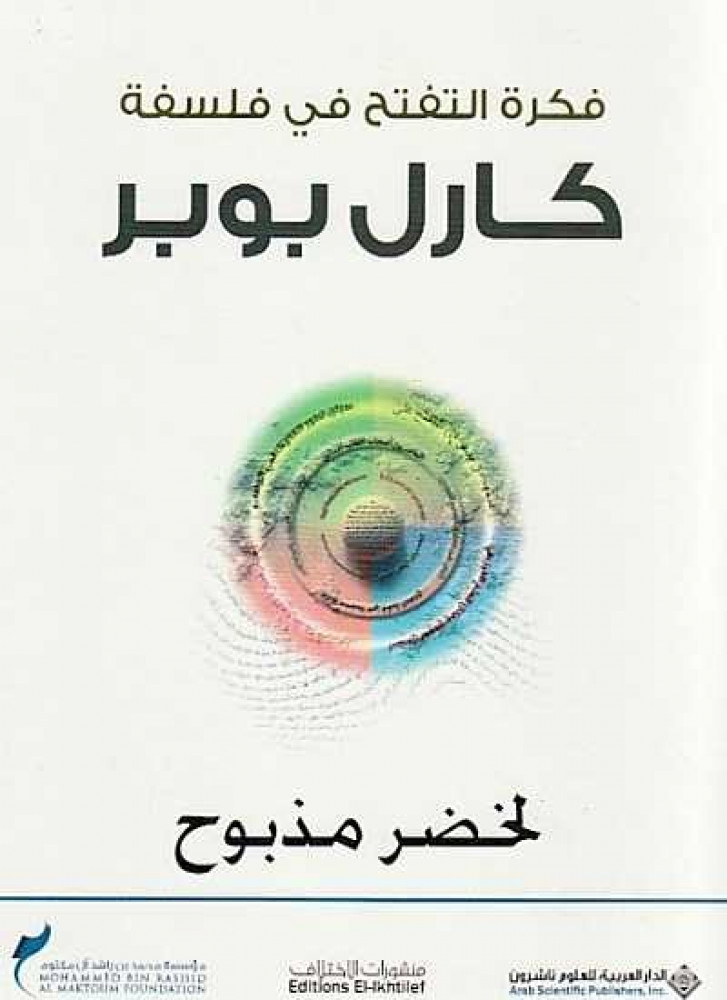
The idea of openness in the philosophy of Karl Popper
68ر.س
Product description
Publication Year: 1430 AH - 2009
Edition: 1
Number of pages: 591 pages
Cover: Paper cover
Publisher: Al-Ikhtilaf Publications
The call for open philosophies is considered a characteristic of the thought and science of the twentieth century; it lies in the degrees and directions that scientists and philosophers of this century advocate. Some call for openness to the irrational more, while others call for openness to metaphysics and rejection of the natural scientific model as advocated by Nietzsche and Heidegger. Some advocate for openness to important psychological, social, and philosophical approaches, and openness to Freudian psychoanalysis, re-reading Hegel and Marx from a contemporary perspective, alongside Heidegger and Nietzsche.
However, it remained a "critical" rationalist "theory" that opened up to reason and rejected irrationality and nihilism, and did not succumb to their temptations. This is the conviction shared with a philosopher of science and contemporary methodologies who established the theory of "Critical Rationality," based on a central idea: the idea of openness.
Karl Popper replaced the model and example of physical science—inductive, deterministic, closed—with the model and example of biological science—hypothetico-deductive, open, non-deterministic.
This distinction is what motivated us to choose the idea of openness in Karl Popper's philosophy as the subject of our thesis, highlighting its importance, uniqueness, and productivity in natural science and social science.
