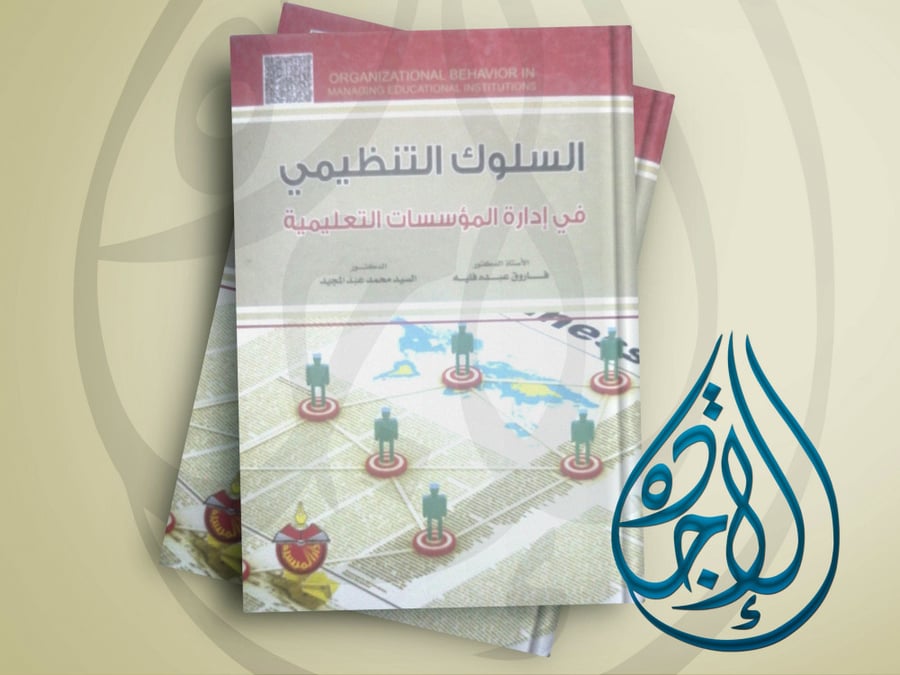
Organizational behavior in the management of educational institutions Professor Dr. Farouk Abdo Faleh Dr. Al-Sayed Muhammad Abdul Majid
86.25ر.س
Product description
Organizational Behavior in the Management of Educational Institutions
Professor Dr. Farouk Abdo Faleh
Dr. Al-Sayed Mohamed Abdel-Megid
Initially, we pose the following question: Who cares about studying behavior?
The general answer to this question is that every individual cares about studying human behavior if they want to increase their understanding of themselves, and if they want to increase their understanding of the reality of their fellow human's behavior, and thus become more capable of understanding, dealing, and cooperating with them to achieve common goals.
However, for a specific answer to the previous question, it can be said that there are categories of people who must care, and exert effort to study human behavior, to learn about the different facts related to this behavior, and to increase their knowledge of its truth in order to understand, control, and predict it.
Modern management: fully relied in its theories, principles, and foundations on studying and understanding human behavior, because the success of administrative work in general depends on the extent of the ability of modern administrative theories to study human behavior.
It is worth noting that there is a stage in the development of management that relied on human relations, because human relations are a web of social interactions of human behavior in a specific organizational form.
The administrative leader: works alongside their various technical functions to motivate the behavior of their subordinates, and cannot do so unless they know much about human behavior, and understand the nature and reality of this behavior.
The administrative leader faces many forms of abnormal or unhealthy behavior, and must investigate the true causes and motives behind it.
The administrative leader must be sensitive to behavioral indicators that indicate low morale among employees in an institution, such as increased absenteeism, rumors, large amounts of waste and damage to production, high work rotation rates, and any establishment now has two sides: the material side and the human side.
The leader cannot neglect either side.
The ability of the administrative leader to deal with both sides of their institution depends on their understanding of the reality and nature of human behavior, its motives, and the factors that move and influence it.
Thus, they can direct this behavior for the good of the individual and the group they lead, and achieve a balance between the needs of the individual and the needs of the organization.
Economists need: a precise and deep understanding of the reality of human behavior and its motives.
While psychologists try to explain why people behave in their own way, as individuals or groups, such explanation is equally important for the economist who wants to know, for example, why people accept a certain commodity more than others? What drives some project owners to fix prices when circumstances allow them to raise them? Why do some people hoard money at certain times more than others? And other such questions.
In fact, the economist is interested in considering people's needs and demands within a system that ensures the satisfaction of the greatest possible number of these needs and demands through available limited resources.
In all their research and studies, they consider the behavior of different groups of people and the motives behind this behavior.
Teachers and educators must have a deep understanding of human behavior, and they must learn about the stages of psychological development that students go through, the demands and needs of each stage, and the prevailing behavior in it.
They also need to understand the motives of behavior among the student body to exploit these motives to achieve various educational goals.
They also need to understand the motives of abnormal behavior so they can confront it scientifically and effectively.
Teachers and educators are usually more interested in behavior because the learning process — which is the primary goal of various educational institutions — is in fact a process of behavior modification resulting from experience.
Since learning is behavior modification through experience, understanding students' mental, motor, and social behavior, and perceiving the changes that occur to it, is considered an essential necessity for anyone involved in education and teaching.
Politicians are interested in understanding the reality of human behavior and its motives.
The more they understand this behavior, the more capable they are of dealing with, directing, controlling, and influencing it.
It is also important for politicians to recognize the drivers, motivators, and incentives of behavior, so they can guide individual behavior in the desired direction and modify their attitudes.
The success of a politician depends on their ability to direct and motivate mass behavior, stimulate their enthusiasm for the issues they present, and the principles they declare.
Undoubtedly, understanding the behavior of the masses, recognizing their needs and demands, and the prevailing thinking pattern enable politicians to deal with, influence, and serve the interests of the masses.
Many groups need to understand human behavior and its nature in their work, including salespeople, advertisers, radio and TV workers, religious leaders, and parents.
In summary, all humans, regardless of their colors, shapes, levels, functions, roles, positions, classes, scientific, professional, ethical, cultural, and social levels, are preoccupied with understanding and knowing human behavior.
1. Human behavior: its concept, nature, and forms
Contents:
Introduction
The nature of human behavior
What do we mean by behavior?
Elements and components of human behavior
Forms and types of human behavior
Human behavior and administrative work
Behavior and social class
Behavior and human nature
The mind-body problem
Distinct features of human nature
2. Organizational behavior (attitude - interpretation)
Introduction
Stages of development of management theories
Stage focusing on production or traditional management
Main influences on management
Traditional management approach
Scientific management theory
Administrative division theories
Fayol's administrative principles
Bureaucracy theories
Critique of management theories at this stage
Impact of the traditional stage on educational and school management
Trend toward human relations in management
Impact of the human relations stage on educational and school management
Trend toward organizational behavior theories in management (behavioral school)
Probabilistic compromise approach
Many modern management theories
Quantitative approach in management
Systems approach in management
Organizing administrative behavior
Organizational behavior: concept
Elements of organizing administrative behavior
Principles of organizing administrative behavior
Types of organizing administrative behavior
Features of organizational behavior
3. Institutions (organizations) and workgroup dynamics
Origin and formation of organizations
Types of organizations
Social responsibility of organizations
Internal environment of organizations
Group dynamics
Definition of group
Characteristics of groups
Factors of group formation
Group cohesion
Types of groups
Work group
Characteristics of work groups
Informal organization
Building a work team
Importance of building a work team
Steps to build a work team
Human relations in workplaces
Definition of human relations
Reasons for interest in human relations within organizations
Morale among workers
Morale, attitudes, and behavior
Concept of morale
Indicators of morale
Continuous evaluation of morale
Negative signs of morale
Signs of interest in human relations
Effective human relations and their impact on behavior and productivity
Constraints in work organizations and their impact on workers' behavior and human relations
Some forms of restrictions and boundaries on workers' behavior and conduct
Impact of restrictions and boundaries on behavior and human relations in organizations
Conflict management in workplaces
Nature of conflict in organizations
Causes of conflict in the workplace
Types of conflict
How to manage conflict
Nature of conflict between workers and management and how to manage it
Practical features of collective bargaining
General principles and foundations of negotiation
Forms and types of negotiations
Key elements of integrative bargaining
Obstacles to negotiation
Collective bargaining as a union concept
4. Analysis of human interaction in light of management and communication concepts
Introduction
Reliance on logic and scientific thinking
Basic logic in management work
Integration in management work
Comprehensive future productivity
Effective management
Effective manager
Pattern of effective administrative work
Fundamentals of contemporary management
Information, goals, means, decision, communication
Goals of communication
Concept of management in light of effective communication
Effective communication in educational and school management
5. The impact of personality, values, and attitudes on organizing administrative behavior
Personality
Values
Attitudes
Psychological and social factors
6. Making educational decisions
Introduction
First: Management theory as a social process
Second: Management as a decision-making process
Third: Management as functions and components
7. Administrative leadership and organizing behavior in educational institutions
Introduction
Administrative leadership
Autocratic style
Personal traits of the manager in the autocratic style
Democratic style
Personal traits of the manager in the democratic style
Tribal (chaotic) style
Personal traits of the manager in the tribal style
Administrative network
Management by objectives
Management styles from an Islamic perspective
Elements of administrative work
Leadership styles
Conservative style
Liberated style
Flexible style
Facing change
Components of administrative success
Administrative leadership skills
8. The role of educational management in achieving job satisfaction
Introduction
Concept of job satisfaction and its importance
Different elements of satisfaction
Performance appraisal: concept and determinants
Performance appraisal: components and requirements
Performance evaluation approaches
Performance evaluation axes
Performance appraisal methods
Methods of individual performance evaluation
Traditional methods of performance appraisal
Trait or characteristic-based evaluation method
General ranking method
Comparison method among workers
Forced distribution method
Modern performance evaluation methods
Mandatory selection method
Critical incident method
Joint evaluation method
Performance appraisal using management by objectives
Closed model for performance evaluation
Open system for performance evaluation
Measuring organizational effectiveness
Performance problems: concept, types, causes
Causes of performance problems
Methods to address low performance
Job commitment
Relationship between organizational commitment and job satisfaction
9. Organizational climate and occupational pressures in educational management
Introduction
First: Concept of organizational climate
Second: Importance of organizational climate in educational institutions
Third: Characteristics of organizational climate
Fourth: Dimensions of organizational climate
Fifth: Methods of measuring organizational climate
Sixth: Concept of occupational pressures
Seventh: Elements and patterns of occupational pressures
Eighth: Effects of occupational pressures
Ninth: Impact of occupational pressures on performance
Tenth: Costs of occupational pressures
Eleventh: Facing occupational pressures
10. The role of delegation in improving administrative skills
Introduction
Concept of delegation
Goals of delegation
Features of delegation
Principles of delegation
Role of delegation in improving administrative practices
First: Legislation of delegation
Second: Obstacles to delegation
Third: Methods of effective delegation
Fourth: Delegation and improvement of administrative processes in educational institutions
Fifth: Delegation and reduction of administrative problems
11. Innovation and change in the management of educational institutions
Introduction
Innovation and change in educational management
Relationship between innovation and change
Characteristics of effective educational innovation and change
Goals of educational innovation and change
Standards for innovation and change
General considerations for standards of educational renewal
Sources of innovation and change in educational institutions
Educational and societal needs and problems
International and global needs and problems
Results and recommendations of scientific research and studies
Summary and conclusions

From Riyadh
Questions you might have