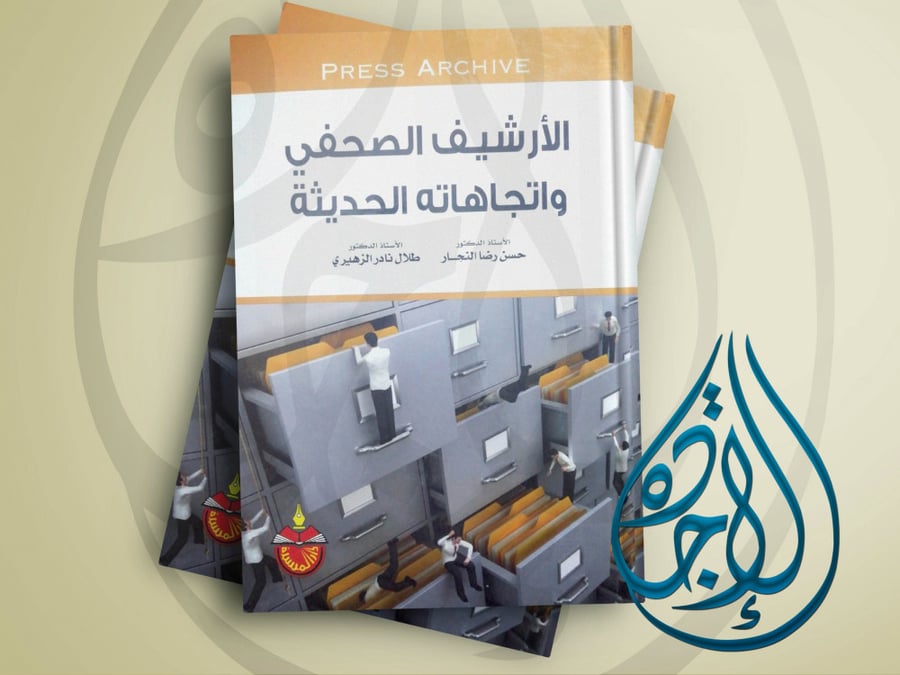
The press archive and its modern trends by Dr. Hassan Rida Al-Najjar and Talal Al-Zuhairi
74ر.س
Product description
The press archive and its modern trends
Professor Dr. Hassan Reda Al-Najjar
Professor Dr. Talal Nadhim Al-Zahiri
Institutions of the press have established departments for preserving their intellectual output and that of other institutions, with the goal of creating an external memory that journalists can refer to when writing about a specific topic to verify or add certain information to a news story or the subject matter they are writing about. They based this on the principle of the laws of scientific development, which help humans apply their knowledge, and science is governed by laws specific to development that must be known for success in any field of knowledge. Among these laws is the (Law of the Continuity of Scientific History), which is one of the important laws in the development of science. For example, if journalists in each media institution relied solely on themselves to gather and rephrase information, writing about this topic would be marginal and would not provide anything new to the reader. The achievements of previous writers constitute the foundation upon which contemporary journalists build their work. Accordingly, contemporary journalists are not only engaged in discovering new scientific data but also in classifying, evaluating, and correcting previously collected data from their colleagues, making it accessible to their fellow journalists and readers. To achieve this, reliance is primarily placed on the method of publishing this information among contemporary journalists and transmitting it to future generations.
On the other hand, press institutions have sought to support these departments by providing storage spaces for this intellectual output, which has been classified using traditional and electronic systems, in addition to providing competent staff to manage and organize their collections of press clippings and other sources of information.
The book contains three main chapters, each including several discussions. The first discussion addressed the topic of press archives, discussing the management of press archive departments and the importance of management in different institutions, given its significant impact on achieving the goals of these institutions. It also detailed the components of administrative functions, which include planning, organizing, verifying the suitability of the workforce, directing, controlling, and coordinating.
The second discussion covered concepts related to press archives, including their definition, the specifications of a good preservation system, the types of materials contained in press archives, criteria for selecting these materials, and the duties they entail. It also highlighted the main signs of backwardness in these departments and ways to improve them.
The third discussion in this chapter focused on encyclopedias as secondary sources of information that journalists need, in addition to their credibility, as their topics are written by specialists in various fields and bear their signatures at the end. This discussion included several topics such as the definition, purpose, and methods of evaluating encyclopedias, Arab contributions to encyclopedic authorship, and the efforts of Arab institutions in this field. It also presented the most important global encyclopedias in both traditional and electronic forms.
In the second chapter, the system of classifying press clippings covering various topics was presented, aiming to reach a unified system applicable in most press institutions through the implementation of the decimal classification system. This system addressed most social, economic, and political issues, as well as activities practiced by all members of society, which newspapers covered through various journalistic arts.
Topics were divided under the geographical locations of countries, starting with the Hashemite Kingdom of Jordan (based on the system being applied there), followed by other Arab countries, the rest of the world, international issues, regional and international organizations, arranged alphabetically.
The second discussion included a subject and country index to facilitate easy access to topics and locations that users wish to retrieve quickly and easily by placing the classification number in front of the desired topic.
The third chapter contained three discussions. The first highlighted the importance of electronic journalism and its impact on the development of the concept of press archiving. The second addressed archiving through content management systems, representing a new attempt to present modern systems for managing the content of topics contained in newspapers more advanced than before.
The third discussion chose the (Joomla) system as the practical model for a content management system, as it is the most widely used system worldwide, in addition to being the most secure and stable. The steps for working on this system and employing it for electronic publishing of newspapers and building their own press archives were explained.

From Riyadh