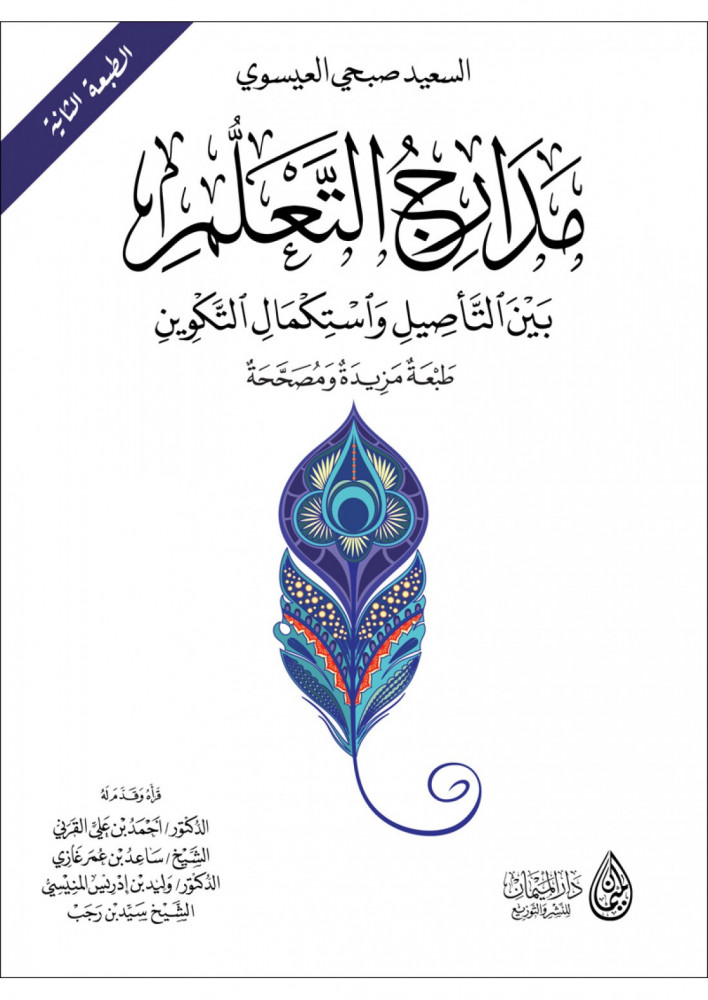
Learning pathways between foundational grounding and completing training for Saeed Sobhi Al-Isawi
40.25ر.س
Product description
The book (Manaraj at-Taalum between Asasal and Completion of Formation) which addresses between its pages the main reason for the weakness of the foundation and scientific delay, which is the dispersion of the initial foundational stage, and the lack of completing scientific formation. And the author divided the book into an introduction and main titles, which are like chapters, some of which follow each other. So he began by mentioning the title of the facts of knowledge, and he stated that the reality of knowledge revolves around two matters: helping to obey Allah and His Messenger, peace be upon him, and avoiding disobedience. Strengthening the servant in front of the flood of fitan and doubts. Then he followed that with four laws, which are: the law of care: which is the law concerned with correcting the intention and purpose, and alerting that (knowledge is for care, not just narration), and that the seeker of knowledge needs two cares: care of acting upon knowledge: in which he mentioned the saying of Ibn Taymiyah: (...worship softens the heart, and if the heart is soft and gentle, its acceptance of knowledge is easy and simple, and knowledge is rooted in it and established and influenced, and if it is hard and rough, its acceptance of knowledge is difficult and hard, and it must be pure, clear, and sound so that knowledge can grow and bear good fruit). Care of using the material of knowledge: in which the author pointed out that using the material of knowledge and its rules with its tools in issues and disputes: is the ultimate goal and purpose of knowledge. The law of personal effort: in which the author emphasized that knowledge is not only obtained by attending gatherings, but it is in dire need of personal effort that the student exerts to grasp and understand knowledge. The law of devotional sense: and he hinted that from the convergence of evidence urging the pursuit of knowledge, commanding it, and praising its seeker, knowledge has become worship, and from this it follows that one of the purposes of seeking knowledge is that it is a means to worship; the ultimate goal of knowledge is to be a sign and guide to worship the Lord of the worlds, glory be to Him. The law of moral sense: in which he mentioned that the first among those who should display good manners and upright character are the students of knowledge, heirs of the knowledge of prophecy. Under the title (Stages of Learning), he explained and clarified the importance of gradual progression in the stages of pursuit, mentioning the importance of each stage: In the first stage (scientific foundation), he stated that the need for it appears through several matters, including: that knowledge is interconnected paths, and the one who walks them without a foundation is like a lost person in a long night without guidance, and that the one who lacks complete foundation ends up with mixing and contradictions. In the second stage (completing scientific formation), he stated that the importance of this stage is evident through matters such as: that the one who dives into a foundational methodology without completing scientific formation is a collector of all arts on the side, so his knowledge is not beneficial when doubts or problems arise. In the third stage (scientific research and classification), he mentioned that its importance for the student of knowledge is that it awakens the mind and perspective of the student, and saves him from rigidity and fanaticism, and exposes him to the details and facts of knowledge. Under the title (Pillars of Learning), he mentioned four matters: the first pillar: pure intention. He pointed out that intention is the beginning, middle, and end of knowledge, and it is an accompanying pillar and a sweet fruit that the sincere one reaps when meeting Allah, the Most High; he indicated that the need for intention intensifies in certain situations: when leaving his house heading to seek knowledge, when acting upon knowledge, and during discussion and debate. The second pillar: high ambition. He mentioned the saying of Ibn Azuz al-Maliki: (The truth-seekers only attain the realities of sciences through longing for them and burning desire, with a fiery passion that gathers the edges of thought towards what they are about to pursue, and it is a burning light, not a burning fire). The third pillar: the honest teacher. He mentioned the saying of Sahnoun: (This knowledge is taken from those trusted in their religion, perceived through their goodness; if they take strictness, it is from knowledge, and if they take concessions, it is from knowledge). The fourth pillar: a well-crafted scientific methodology. He listed the conditions of the scientific methodology, which are: seeking a teacher with a clear and correct methodology, and that the methodology aligns with possibilities rather than lofty hopes, and that it is suitable for the levels of learners and the stages of reception. Under the title: (The Mastery of Books: Pros and Cons), the author pointed to the forms of reception from books, which are: the first form: reliance on books and independence from benefiting from teachers, and he warned that this form is blameworthy; because rarely does one who follows it escape its pitfalls and errors. The second form: taking the foundational stage from teachers, then relying on books, and he stated that this is the approved form, and that is how scholars proceed. The third form: neglecting books and relying solely on listening to teachers, and he indicated that this method does not produce a true student of knowledge in the accepted sense. It is worth noting here the phrase the author directed, which is the famous saying (Whoever his teacher is his book, his errors outweigh his correctness), where he stated that this phrase is an exaggeration and overreach, and that it is safer to apply it to: the beginner in pursuit, or some sciences that require precision and companionship, such as readings. Or what was before the era of printing, when writing was handwritten, and there was much misreading and tampering by copyists, which required more accuracy and care. The author mentioned that books are divided into three categories: books of graduation: which are used to establish the student's scientific foundation through a selected and organized methodology on a well-trodden path. Books of completing formation: which are used by the learner to complete the learning paths to obtain a complete picture of knowledge, such as (Tafsir al-Tabari, Al-Tahrir wa al-Tanwir, the six books and their explanations, Al-Mughni by Ibn Qudamah, Al-Mujtama, Ibn al-Salah’s introduction and its explanations, Tadrib ar-Rawi), and similar books. Books of mental refreshment and knowledge enrichment: which the student uses to enrich his knowledge in areas outside the well-trodden methodology. Under the title (Obstacles and Barriers), he defined them as: what prevents the student from the most important stages of knowledge, or discourages or distracts him. He listed fourteen obstacles, including: boasting with scientific titles: which is one of the phenomena known among students of knowledge in this time, and the reason why boasting is an obstacle to learning is that it diminishes the blessing of knowledge and destroys its goodness, and that its owner often does not get his affairs straight. Arrogance and strong debate: scholars used to avoid engaging in debate unless for benefit, and in the best manner, but the negative effect of this appears in that it deviates from the way of the salaf in acquisition, and causes the student’s fiqh to tremble and lack consensus on issues in his mind, which is a waste of the student’s life and a loss of his scientific project. Scientific arrogance: he mentioned the saying of al-Shafi’i: (Know that the one with knowledge and prudence is not humbled by a high status, nor does he become proud of full honor, like a mountain that does not shake even in strong winds; and the trivial and insignificant among people is humbled by the lowest status he reaches, and the easiest authority he attains, he is like grass moved by the weakest winds). Among the matters he dedicated special titles to are: (mental skills for the student of knowledge), in which he mentioned: the skill of investigation and discovery, the skill of derivation and hypothesis, the skill of induction. He explained and clarified each skill, how to acquire and use it. At the end of the book, the author presented a plan for the two stages of scientific foundation and completing formation. He concluded the book with a closing statement reminding the student that: knowledge is a religion, and its attainment depends on the student’s effort, honesty, and reverence for the dignity of knowledge. That knowledge is what guides the student to the righteousness of himself and others. And that true knowledge is what removes doubts, not what introduces them.

From Riyadh