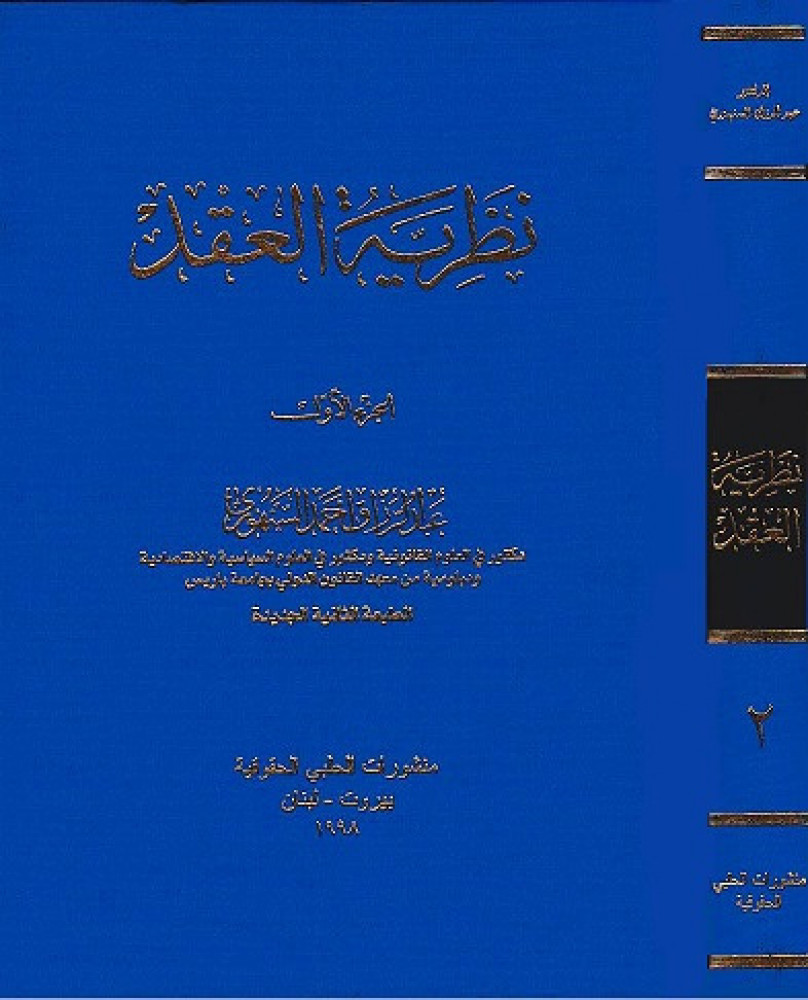
The contract theory two parts by Dr. Abdul Raziq Al-Sanhouri
129ر.س
Product description
Contract Theory 2/1 Dr. Abdul Raziq Al-Sanhouri About the book The author tried in this part of the book to take a step on the path of "consolidating" Egyptian jurisprudence, which he considers a cause of the desired legal renaissance. And his steps, as he says, were not a broad step, and this is due to the nature of the subject he is writing about; because the theory of obligations has a universal character, and it is difficult for the writer to give it a purely Egyptian character. To do so, he relied on two things: moving within this subject within a broader horizon than the French horizon alone, so he did not limit himself in many issues to reviewing French and Latin theories, but he went beyond them to German and English theories. He tried to extract from all that aspects of the view that are more consistent with Egyptian traditions, and he did not overlook Islamic Sharia. He paid attention to Egyptian judiciary, and prioritized it over French judiciary, and took it as a resource to help spread what is purely Egyptian from pages of Egyptian law. In his review of old and new theories, he adopted a moderate stance, and he also avoided complexity in Arabic terminology, preferring simple and easy terms if they are precise in conveying the meaning. He could not avoid lengthy footnotes, and found them helpful in distinguishing between general principles, their place in the main text, detailed issues, and they descend into footnotes; he even distinguished within the general principles themselves between main and non-main principles, so that the reader would not be confused about what deserves detailed consideration and reflection, and what is sufficient with reading and familiarity. All of this led him to gradually develop the theory of obligations in a way that distinguishes it from other legal theories, as it is the foundation upon which the law is built.

From Riyadh