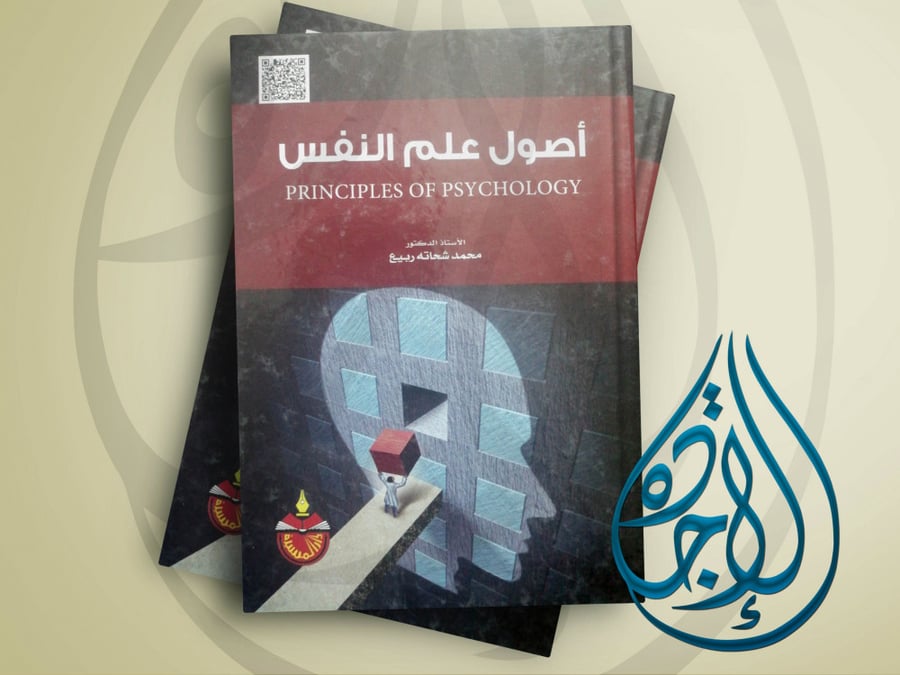
Principles of Psychology for Professor Dr. Mohamed Shahat Rebie
86.25ر.س
Product description
Principles of Psychology
Professor Dr. Mohamed Shahat Rabei
The subject of the first chapter is (Psychology: Its Subject and Branches) and it is a chapter that discusses the definition of psychology based on it being the science that studies behavior — as it explains the characteristics of behavior and its determinants. The chapter also covers the properties of scientific study as well as the goals of psychology, which are based on understanding, interpreting, and predicting behavior. The chapter concludes with a brief presentation of the different branches of psychology.
The subject of the second chapter is (History of Psychology and its Schools), where this chapter presents ancient psychology in Greece, talking about Socrates, Plato, and Aristotle. Then it discusses medieval psychology through Islamists, talking about Al-Farabi, Ibn Sina, and Al-Ghazali. It also covers modern and contemporary schools, mentioning Gestalt, Structuralism, Psychoanalysis, Teleology, Functionalism, and Behaviorism — and this chapter briefly discusses these schools because the book will cover their achievements in upcoming sections.
The third chapter's topic is (Research Methods in Psychology), where the chapter provides an extensive introduction to the proper steps involving hypotheses, samples, tools, results, and their interpretation. It also discusses introspection, explaining its advantages and disadvantages, then talks about observation, followed by the tracing method, and then elaborates on the experimental method, clarifying this method and its limitations. The chapter concludes with a discussion of the clinical method. We preferred the material for this chapter to be light because expanding on research methods in psychology requires a scientific background and an information base that is not available to the beginner student.
The fourth chapter's topic is (Motivation), where the chapter begins with an introductory definition of motivation. It then discusses motivation theories, choosing two theories: (McDougall) and (Maslow). The chapter also presents some basic motives, such as the principle of maintaining balance, the drive to seek food, the drive to seek water, and the drive for sex. It elaborates on the topic of the aggression drive, discussing types of aggression, theories of aggression, and factors that help trigger aggression. The chapter also covers the achievement drive and concludes with a discussion of the sensory alertness drive.
The fifth chapter's topic is (Emotions), where the chapter begins with an introductory overview of emotion, then discusses the perception and expression of emotions, highlighting the universality of expression methods, which indicates the genetic origin of emotions. The chapter also discusses the positives and negatives of emotion. Then it explores the old and renewed topic of the relationship between motives and emotions, explaining that it is a circular relationship. It studies some emotions such as anger, fear, and jealousy. The chapter also reviews some theories of emotion, such as (James), (Lange), (Canon), (Schachter), and (Scherer). The last point of this chapter is the physiology of emotion, discussing its relationship with the heart, blood vessels, endocrine glands, and glandular organs, linking psychology with physiology.
The sixth chapter's topic is (Attention and Feeling), beginning with a general introduction to the subject. It then defines attention and discusses external and internal determinants of attention, as well as types of attention. The discussion then moves to feeling, presenting definitions of feeling, then discussing some emotional states such as imagination and daydreaming. The chapter also covers a very important topic: the effect of drugs and alcohol on feeling, and briefly discusses a very interesting subject: hypnotism. The last point in this chapter is sleep and its disorders, such as insomnia and sleepwalking.
The seventh chapter's topic is (Sensory Perception), starting with a definition of sensory perception, then discussing the conditions and factors of perception. It then discusses principles of perceptual grouping, such as similarity, proximity, connection, closure, and figure-ground. The chapter also presents some perceptual phenomena, such as the aftereffect, and discusses perceptual illusions, including (Ames room), (Ponzo illusion), (context illusion), (perspective illusion), and others. The chapter concludes with an interesting topic: the perception of time.
The eighth chapter's topic is (Learning), where it explains and clarifies the meaning of learning and related concepts such as natural maturity, practice, and reinforcement. It then presents the main learning theories, including the associative theory, discussing (Ebbinghaus), (Pavlov), and (Thorndike). It also discusses the achievements of the Gestalt school, then explains and comments on the behavioral theory, talking about (Watson), (Tolman), (Guthrie), and (Skinner). Finally, it covers the Russian school, discussing (Shchennov) and (Bekhterev). The last point in this chapter is applications of learning, discussing the holistic method versus the partial method, receptive learning, active learning, and others.
The ninth chapter's topic is (Memory), beginning with a general introduction to memory, then discussing sensory memory. It then covers short-term and long-term memory, explaining encoding, storage, and retrieval processes. The chapter also discusses vivid memories, recall, and forgetting, and reviews theories of forgetting, such as decay, interference, repression, and suppression. It concludes with ways to improve memory and presents a well-known model explaining the recall process.
The tenth chapter's topic is (Thinking and Problem Solving), where it explains and clarifies the meaning of thinking, related concepts, issues, and mental images. It also discusses reasoning, decision-making, problem-solving, and creativity. The chapter also covers language, how language is acquired, and its relationship with meaning. It ends with an interesting topic about animal communication, presenting examples from the Quranic mention of this subject.
The eleventh chapter's topic is (Intelligence), presenting definitions of intelligence, its meanings, and how to measure it, relying on examples from the (Stanford-Binet) test, (Wechsler-Bellevue) tests. The chapter also reviews several intelligence theories, such as (Sternberg), (Thurstone), (Thurndike), (Cattell), (Gardner), and (Sternberg). It then discusses two vital topics related to intelligence: mental deficiency and mental superiority. The chapter also studies psychological differences in intelligence and finally addresses some controversial issues about intelligence, such as the roles of heredity and environment, racial and ethnic differences, and the strange relationship between intelligence and poverty.
The twelfth chapter's topic is (Personality and Its Theories), where it presents definitions of personality, discusses personality traits, and provides examples of these traits. It also explains biological determinants of personality, talking about heredity, biochemical composition, and endocrine glands. The chapter then discusses social determinants of personality, focusing on culture, personality, and the roles of family and school. The rest of the chapter covers personality theories, presenting psychoanalytic school through (Freud), (Jung), and (Adler). It then discusses the behavioral school through (Watson) and (Skinner), followed by Bandura's social learning theory. The chapter concludes with the trait theory, discussing (Gordon Allport) and (Kretschmer).
The thirteenth chapter's topic is (Mental Health) and (Psychological Disorders), where the chapter discusses health, both mental health and mental illness, starting with the definition of mental health and its main signs. It then discusses psychological crises and defense mechanisms such as repression, projection, rationalization, isolation, and daydreaming. The chapter then moves to neurotic disorders, discussing inferiority complex, guilt complex, and Oedipus complex. It concludes with a discussion of mental disorders and their causes, mentioning anxiety, obsessive-compulsive disorder, hysteria, schizophrenia, and mania.

From Riyadh
Questions you might have