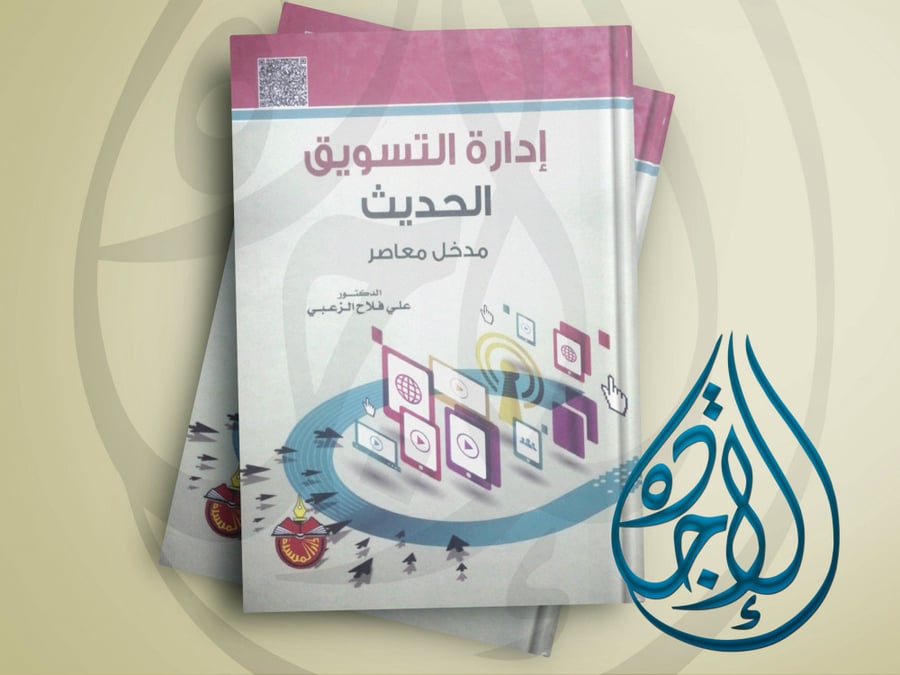
Modern marketing management by Dr. Ali Falah Al-Zoghbi
92ر.س
Product description
Modern Marketing Management by Dr. Ali Falah Al-Zughbi
The marketing revolution has worked to change everything so that the customer is the focus of creativity, development, excellence, and the subject of interest, attraction, and strategy building. This has imposed on business organizations to be close to the customer, identify their needs, desires, interests, preferences, and tastes if they want to surpass competitors and achieve their goals of staying and growing in the market. This can only be achieved with a modern and contemporary marketing management.
The speed of change has made marketing management in business organizations find itself forced to deal well with the future, or else failure will be its end. If this is the case today, then how will it be tomorrow? The changing nature of the future, with its uncertainty, unpredictability, and doubt, has made marketing management in companies one of three types: marketing management that creates the future, marketing management that finds itself forced to adapt to the changes around it, and marketing management that does not know or realize what is happening around it.
The current state of companies did not happen by chance but by deliberate forces that create change and direct today towards the future. This conscious action must be in the right place, or it will become a burden on the companies. This emphasizes the concepts of efficiency and effectiveness; the former means the ability to perform correctly, and the latter means the ability to do what is correct.
This indicates that marketing planning in companies is directed toward identifying the correct goals and choosing the appropriate means to achieve them. We must ensure that what we do is what we should do. If the manager is weak, he will focus on solving yesterday’s problems. The strong manager solves today’s problems, but the strongest manager focuses on working to solve tomorrow’s problems. We do not believe anyone claims to know what will happen tomorrow, but we can predict in the short and very short term based on data and guesses about change trends.
Modern marketing management is not just an art but a science, relying on scientific methods and research to achieve production efficiently. It also depends on principles from many sciences directly to solve problems. Some may consider modern marketing management a profession in itself. Marketing management is capable of achievement and is the correct way to reach goals. Wise marketing management is an effective means of success, and it opposes chaos, improvisation, and condemns them.
We can imagine any aspect of life if it is not covered by "marketing planning, organization, guidance, follow-up, control, and coordination" through wise and conscious capabilities, it will not succeed because it will be killed in its infancy, become negative, and cannot achieve its goals.
Modern marketing management is defined as a continuous and interactive process aimed at directing individual and collective efforts toward achieving common marketing goals using available resources with the highest degree of effectiveness and efficiency. From this definition, we see that the terms effectiveness and efficiency are related to marketing management and other departments; the more effectiveness and efficiency increase, the more successful marketing management becomes.
Effectiveness is simply defined as: performing the right things (Right Things To Do). Therefore, we need to know, identify, and define the right actions to perform them. Efficiency is defined as: performing tasks in the right way (To Do Things Right). Thus, effectiveness is doing the right things correctly, related to leadership, while efficiency relates to marketing management.
Effectiveness is achieved when there is a clear vision, specific goals, strategies, principles, values, development, and other leadership qualities. Efficiency is achieved through planning, organizing, managing time, control, and follow-up. When there is effectiveness without efficiency, visions and goals are not properly realized; when there is efficiency without effectiveness, tasks are completed but without clear objectives.
Efficiency means the ability to achieve specific goals within a set time while considering the quality of outputs, and it is one of the measures of success for all types and forms of institutions.
This systematic book, with its chapters, comes as a roadmap for modern management of marketing, aiming to clarify the important and vital role and to highlight the basic concepts, intellectual frameworks, and main functions in an earnest attempt to build a coherent, integrated structure that enables researchers and specialists to grasp the content of this contemporary scientific and intellectual subject. It is the fundamental basis for efficiency and effectiveness in all organizations, small or large, national or global, profit or non-profit, to achieve success and prosperity, ensure survival and continuity, build competitive advantage, reputation, fame, and reach leadership and pioneering in the market.
In line with these objectives, and because this book is not just a means but much more, it is an integrated contemporary applied approach to marketing management. Its structure consists of twelve chapters.

From Riyadh
Questions you might have