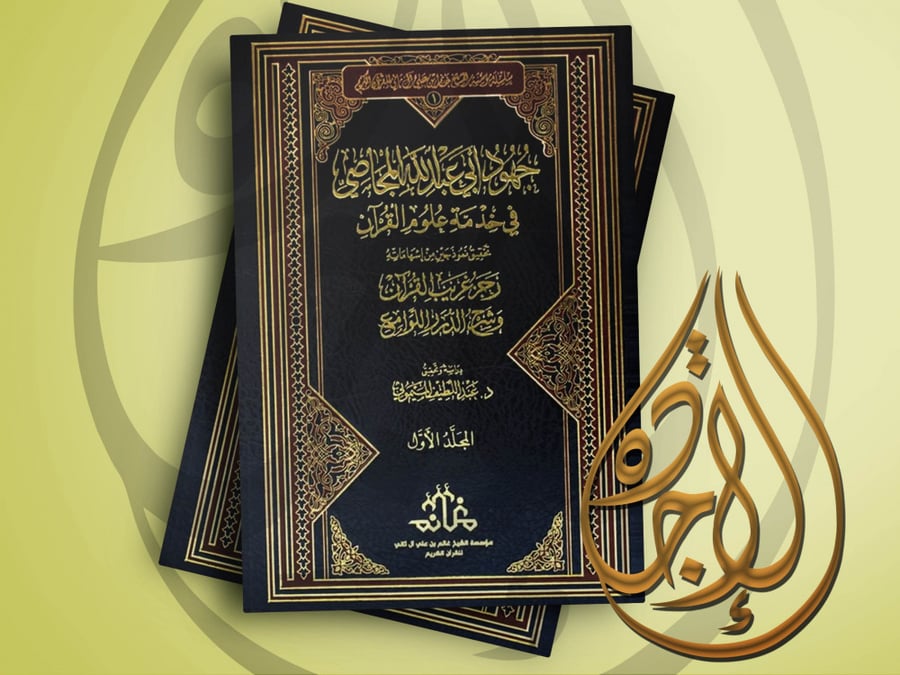
The efforts of Abu Abdullah Al-Majassi in serving the sciences of the Quran, verifying two models of his contributions: "Ghazr Gharib Al-Quran" and "Sharh Al-Durar Al-Lawa'em"
86.25ر.س
Out of Stock
Product description
A scientific Andalusian thesis, included two آثار (works) of an unknown Andalusian scholar from the 8th century AH, with efforts in the sciences of the Great Qur'an and what revolves around its orbit. These two آثار are: (Gharib Qur'an Rhyme) in which he followed the method of early interpreters who used to preface their works with discussions from the sciences of the Qur'an that the learner needs, and (Explanation of the Diamonds of the Luminous) in which he explained the pearls of the linguistic scholar Ibn Biree, which he heard from his sheikh, and he used to visit him to ask about what was unclear and clarify what was ambiguous, so it came as a valuable scientific explanation.
Book
International Standard Book Number ISBN 987-603-8100-43-9
Language
Arabic
Binding
Cardboard
Type of Paper
Japanese paper
Number of Pages
1013
Size
17 × 24 cm
Number of Volumes
2
Weight
1900 grams
First Edition
2012 AD
Introduction
Praise be to Allah who taught man what he did not know, and prayers and peace be upon the most complete and perfect, on whom his Lord said: "Recite what has been revealed to you of the Book and establish prayer," so he conveyed the message of his Lord as He commanded him: "O Messenger, convey what has been sent down to you from your Lord, and if you do not, then you have not conveyed His message. And Allah will protect you from the people." And He taught His noble companions – may Allah be pleased with them – how to recite the Book truly, obeying Allah’s command: "And recite the Qur'an with measured recitation." It was from Allah’s mercy to His nation that He asked His Lord to allow His nation to recite the Qur'an on more than one letter, as in the hadith of Abu al-Darda, may Allah be pleased with him: that the Prophet ﷺ was at the dwellings of Banu Ghaffar, then Gabriel came to him and said: Allah commands you to recite your nation the Qur'an on one letter. He said: "I ask Allah for His pardon and forgiveness, and my nation cannot bear that." Then he came to him and said: Allah commands you to recite your nation the Qur'an on two letters. He said: "I ask Allah for His pardon and forgiveness, and my nation cannot bear that." Then he came the third time and said: Allah commands you to recite your nation the Qur'an on three letters. He said: "I ask Allah for His pardon and forgiveness, and my nation cannot bear that." Then he came the fourth time and said: Allah commands you to recite your nation the Qur'an on seven letters, and whichever letter they recite upon, they will have succeeded.
And so the noble companions received it as revealed, memorized it, and transmitted it to those after them, generation after generation, until it reached us by continuous transmission, preserved in hearts and recorded in books, and its preservation was fulfilled by Allah’s promise that He would protect it: "Indeed, it is We who have sent down the Reminder and indeed, We are its guardian." And in the sacred Hadith: Allah said to the Prophet ﷺ: "...and I have revealed to you a Book that water cannot wash away." This characteristic is exclusive to the Qur'an, as Allah says: "Rather, it is verses clear in the breasts of those given knowledge."
And from speaking of Allah’s blessing, Allah favored me with memorizing His Noble Book from a young age, and it was Allah’s will that I join the authentic education, then the College of Fundamentals of Religion, and the Dar al-Hadith al-Hassania, where I was happy when I registered in the unit "The Writings of the Qur'an and Hadith in the Western Islamic." My eye fell on the نظم (poetry) of "Gharib Qur'an" by Abu Abdullah al-Majassi, so I consulted my two professors, Dr. Ahmed Al-Yazidi – may Allah have mercy on him – and Dr. Muhammad Al-Rawandi – may Allah preserve him – to give their opinion on the following title: "Gharib Qur'an in the Western Islamic World, with Study and Investigation of Abu Abdullah al-Majassi’s Rhymed Poem and its Explanation of the Diamonds of the Luminous," and the topic was accepted with this title.
For years, I have dedicated my time to this subject ("Gharib Qur'an in the Western Islamic World, with investigation of the rhyme and explanation of the Diamonds") and collected all possible information in this regard. When Allah decreed the death of Professor Al-Yazidi, I requested to re-register with the Dar al-Hadith al-Hassania, after the approval of Professor Muhammad Al-Rawandi and Professor Abdul Razaq Harmas, who suggested I modify the title to: "The efforts of Abu Abdullah al-Majassi in serving the sciences of the Qur'an, with an investigation of two models of his contributions: 'Gharib Qur'an Rhymed Poem' and 'Explanation of the Diamonds of the Luminous,' to be more appropriate, as both نظم (poetry) of al-Majassi (in Gharib Qur'an) and his explanation of the Diamonds of the Luminous (in readings) are by the same author. It was necessary that the title include al-Majassi’s efforts in serving the sciences of the Qur'an.
When I searched in Moroccan public and private libraries, Allah made it easy for me to find sufficient copies of both books: "Gharib Qur'an" and "Explanation of the Diamonds of the Luminous."
Motivations for choosing the topic:
A – My prior acquaintance with al-Majassi’s poem in "Gharib Qur'an" years ago, before joining Dar al-Hadith al-Hassania. When I was a student at the College of Fundamentals of Religion in Tetouan, Sheikh Muhammad Bukhbiza gifted it to me, and I was impressed by its importance.
B – When I wanted to contribute to reviving our beloved country’s heritage, especially in this era where interest in the sciences of the Qur'an has become rare, extracting such treasures from shelves, investigating, and serving them are deeds rewarded in this world and the Hereafter, God willing.
C – To complete my formation in researching part of the heritage that the unit I registered with is concerned with: "Writings of Tafsir and Hadith in the Western Islamic World." I ask Allah for success and correctness.
Main difficulties encountered:
It is impossible for the work of investigating manuscripts—especially those before the eighth century AH—to be easy and straightforward unless Allah makes it easy for the researcher. This became clear to me through my work over the past years (since 1997). The difficulties were twofold:
One part can be considered normal, such as traveling to distant places to meet a scholar or photograph a manuscript, and the related expenses in pursuit of knowledge. These difficulties are faced by every researcher and student of knowledge.
The second part caused me hardship, which I endured reluctantly due to its severity! I even considered asking the supervisor to abandon part of the research, namely investigating the explanation of the Diamonds of the Luminous! But he insisted and patiently endured until the "crisis" passed, and praise be to Allah. I was certain that "ease follows hardship."
One example of these difficulties:
A – I was searching for handwritten copies of the explanation of the Diamonds of the Luminous, and I read the master’s thesis of Professor Hassan Al-Azoozi, which mentioned a copy preserved in the General Library in Rabat, number 994 Q, and the professor confirmed it was available and unnumbered, consisting of 159 pages. When I checked the number, it turned out to be a book on Qur'anic grammar, with no trace of al-Majassi’s explanation on the Diamonds in that library at all.
B – Professor Abdul Hadi Hamitu told me by phone that a good copy of "Explanation of the Diamonds of the Luminous" exists in the library of the late Mr. Ibrahim Abu Darar in the village of Jemaâ Aït Daoud, in the Sidi Ifni region. I traveled there in June 2002, met the esteemed Mr. Muhammad Abu Darar, son of the late Sheikh and owner of the rich library, who was kind and generous to me – may Allah reward him. That night, we searched for the copy (al-Majassi’s explanation on the Diamonds), but found nothing. The next morning, he remembered that his father’s friend had borrowed the book, who is an imam in one of the mosques in Sidi Ifni. I asked him to travel to him, he agreed, but after meeting and talking with the scholar, it turned out the book was lost, as he admitted he stole it from the mosque’s corner—Allah’s affairs are many!
C – When I started working after registering for a year without finding any copy of "al-Majassi’s explanation on the Diamonds," except the one I initially relied on, the book of Professor Al-Monni, "The Library of the Zawiya Al-Hamzawiya," directed me to the existence of a copy in the Al-Ayashiya Zawiya in the Rissani region. I traveled immediately to request it.
D – In terms of study, I was unable to find information about the scholar "al-Majassi" except for brief words here and there, and until now, I have not found a date of death for him! This is in addition to the scarcity of sources and references that document the period he lived in, except for some studies presented by contemporary historians.
E – I did not find some sources and references relied upon by al-Majassi in his writing, which are very important, such as "Ijāz al-Bayān" by the Hafidh Abu Amr Al-Dani, which is a summary of his major book "Jāmi’ al-Bayān," forcing me to quote from the latter, which was made available to me by the late Dr. Al-Yazidi. I began working according to the following plan:
Preface, including:
A – Briefly discussing the topic of the thesis, focusing on the linguistic aspect.
B – Motivations for choosing the topic and the reason behind selecting "Gharib Qur'an" and "Explanation of the Diamonds of the Luminous" specifically for investigation.
C – The emergence of the science of "Gharib Qur'an."
Work plan
My work in this thesis is divided into two parts:
First part: Study:
Chapter One: The era of Abu Abdullah al-Majassi and his environment:
- First section: The political situation.
- Second section: The intellectual situation.
- Third section: The social situation.
Chapter Two: The life of Abu Abdullah al-Majassi and his آثار (works):
- First section: His name, lineage, and upbringing.
- Second section: His teachers, students, and scientific status.
- Third section: His efforts in serving the sciences of the Qur'an and his death.
Chapter Three: Study of his two books "Gharib Qur'an" and "Explanation of the Diamonds of the Luminous":
- First section: Gharib Qur'an by Abu Abdullah al-Majassi:
- First requirement: The concept of Gharib Qur'an and reasons for its compilation.
- Second requirement: The subject of al-Majassi’s Gharib Qur'an and his method of organization.
- Third requirement: al-Majassi’s sources and methodology.
- Second section: Explanation of the Diamonds of the Luminous:
- First requirement: The subject of the book and its purpose.
- Second requirement: Abu Abdullah al-Majassi’s approach:
A – His handling of different readings.
B – His interest in grammar.
C – His clarification of rhetorical aspects.
D – His citations from the Qur'an, Hadith, and poetry.
E – His critiques of his teacher Ibn Biree.
- Third requirement: al-Majassi’s sources in explaining the Diamonds:
A – Books of readings and tafsir.
B – Books of orthography.
Second part: Investigation:
First: The rhyme book of Gharib Qur'an:
1 – Attribution of the book to the author.
2 – Description of the handwritten copies.
3 – Method of investigation.
Second: The explanation of the Diamonds of the Luminous:
1 – Attribution of the book to the author.
2 – Description of the handwritten copies.
3 – Method of investigation.
Then, this introduction was followed by the investigation of both books.
The thesis was concluded with a set of scientific indexes, as explained in the methodology of investigation.
In the end, I pray to Allah the Almighty that I have succeeded in serving and publishing the two books in a manner befitting their status, and that I have contributed with some effort to revive part of the heritage that the unit I registered with is concerned with: "Writings of Tafsir and Hadith in the Western Islamic World." I ask Allah to make this work purely for His face, forgive any slips and errors, for human nature is prone to error. He is the best Protector and Helper.

From Riyadh