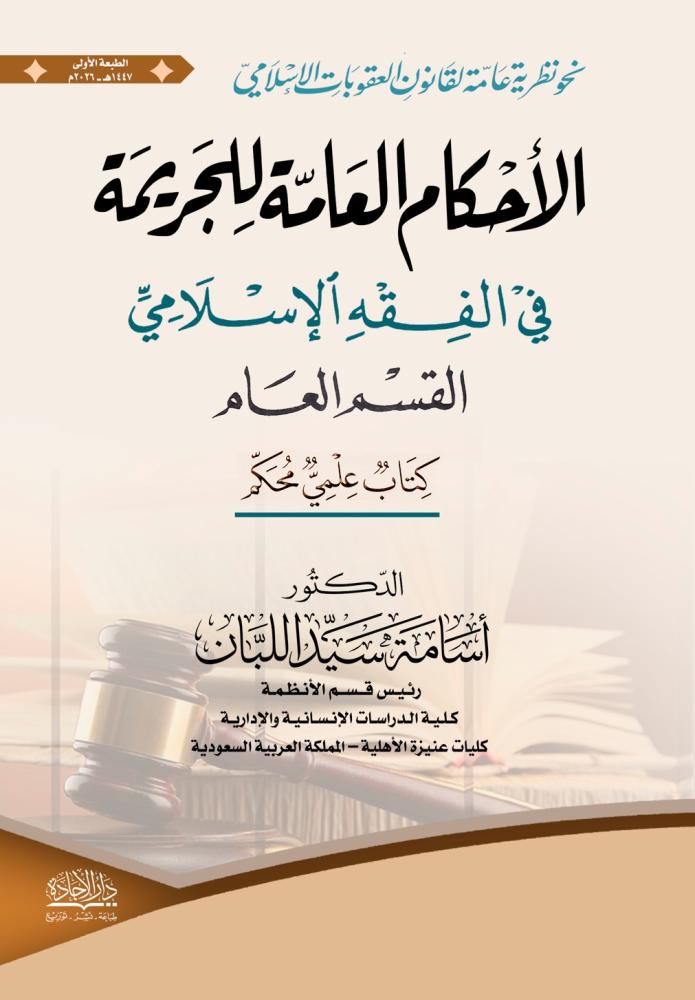
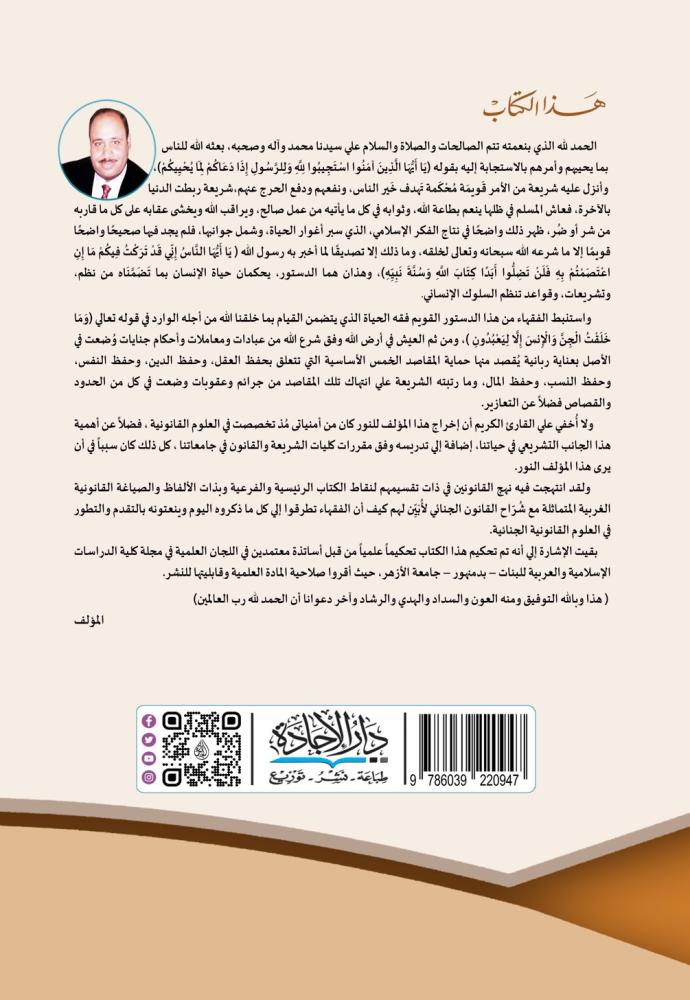
The general rulings of crime in Islamic jurisprudence the general section of Dr. Osama Al-Sayed Al-Laban
92ر.س
Product description
The General Provisions of Crime in Islamic Jurisprudence, General Section
Author: Dr. Osama Al-Sayed Al-Lubn
First Edition: 1447 AH — 2026 AD
Table of Contents
Subject | Page
Introduction |
Preliminary Chapter |
Section One: Definition of both Positive Law and Islamic Sharia |
First Requirement: The nature of positive law and its origin |
Second Requirement: The meaning of Sharia and legislation |
Section Two: The difference between Islamic Sharia and positive laws |
Section Three: The universality of Islamic Sharia without other divine laws |
Section Four: The concept of Islamic jurisprudence and its difference from Islamic Sharia |
The difference between jurisprudence and Sharia in their general terminological meanings |
Types of rulings contained in Islamic jurisprudence |
Section Five: Definition of Islamic criminal legislation and its distinction from Islamic criminal jurisprudence |
Branches of Islamic criminal legislation |
First Part: Fundamentals of Islamic criminal jurisprudence |
Chapter One: Definition of crime and its classifications in Islamic jurisprudence |
First Section: Definition of crime and its cause |
First Subsection: Definition of crime |
Second Subsection: The cause of criminalization in Islamic jurisprudence |
Chapter Two: Classifications of crimes in Islamic jurisprudence |
First Subsection: Classification based on the severity of the crime — "Hudood crimes, Qisas and Diyat crimes, Tazir crimes" |
Second Subsection: Classification based on the interests affected by the crime — "Crimes against necessities, crimes against needs, crimes against enhancements" |
Third Subsection: Classification based on the right — "The victim's right" |
Fourth Subsection: Classification based on the attempt — "Complete and incomplete crimes" |
Fifth Subsection: Classification based on the method of commission — "Positive and negative crimes" |
Sixth Subsection: Classification based on the intent of the offender — "Intended crimes and unintentional crimes" |
Seventh Subsection: Classification based on the nature of the crime — "Crimes against the community and crimes against individuals" |
Eighth Subsection: Political crimes and ordinary crimes |
Ninth Subsection: Oppression (Bugh) |
Tenth Subsection: Classification of crimes according to how they are committed — "Simple crimes and habitual crimes" |
Chapter Two: Criminal Legislation in Islamic Jurisprudence |
First Section: Hudood (limits) |
Second Section: Qisas (retribution) |
Third Section: Tazir (discretionary punishment) |
First Subsection: Definition of Tazir and its distinction from Hudood and Qisas |
Second Subsection: Legitimacy of Tazir |
Third Subsection: Ruling on Tazir |
Fourth Subsection: Rules of Tazir |
Fifth Subsection: Crimes of Tazir |
Chapter Three: Sources of Islamic Criminal Legislation in Islamic Jurisprudence |
First Section: Sources of Islamic criminal legislation |
First Subsection: The Holy Quran |
Second Subsection: The Prophetic Sunnah |
Third Subsection: Consensus (Ijma) |
Fourth Subsection: Analogy (Qiyas) |
First Requirement: Definition of Qiyas, its evidentiary basis, and its pillars |
Second Requirement: The role of Qiyas in criminalization and punishment |
Fifth Subsection: Istihsan (juridical preference) |
Sixth Subsection: Maslahah Mursalah (public interest) |
Seventh Subsection: Blocking the means (Sadd al-Dhari'a) and opening them |
Eighth Subsection: Custom (Uruf) |
Ninth Subsection: Presumption of continuity (Istishab) |
Tenth Subsection: Legislation of previous nations |
Eleventh Subsection: Saying of the Companion |
Chapter Two: Interpretation of texts |
First Subsection: The first rule — linguistic interpretation of words |
First Requirement: Clear meanings of words |
Second Requirement: Unclear meanings of words |
Second Rule: The second rule — indications of texts |
Third Rule: The third rule — in the concept of contradiction |
Fourth Rule: The fourth rule — in generality and its indication |
Fifth Rule: The fifth rule — in specificity and its indication |
Chapter Four: Authority to implement Islamic criminal legislation in Islamic jurisprudence |
First Section: Scope of application of criminal law in Islamic jurisprudence in terms of time |
The criterion for determining the authority of the legal text regarding time |
Exceptions to the rule of non-retroactivity of criminal texts |
First: In the crime of highway robbery (Hirabah) |
Second: In the crime of defamation (Qazf) |
Third: In the case of Lian (mutual cursing) |
In Zihar (a form of pre-Islamic divorce) |
Second Section: Scope of application of criminal law in Islamic jurisprudence in terms of place |
First Subsection: Dividing the world according to Islamic criminal jurisprudence |
First Requirement: Dar al-Islam (House of Islam) |
Second Requirement: Dar al-Harb (House of War) |
Third Requirement: Dar al-'Ahd (House of Pledge) |
Second Subsection: Extent of applying Islamic law inside and outside Dar al-Islam |
First Requirement: Applying Islamic law within Dar al-Islam |
Second Requirement: Applying Islamic law within Dar al-Harb |
Third Subsection: Extradition and deportation of criminals |
First Requirement: Extradition of criminals to an Islamic state |
Second Requirement: Extradition of criminals to a non-Islamic state |
Third Section: Scope of application of criminal law in Islamic jurisprudence concerning persons |
First Subsection: Obligation to apply criminal law to everyone without discrimination in Islamic jurisprudence |
Second Subsection: Issues debated regarding its application to everyone without discrimination in Islamic jurisprudence |
First Requirement: Applicability of texts to the head of state |
Second Requirement: Applicability of texts to Muslims and Dhimmis (protected non-Muslims) |
Branch One: Equality in Qisas (retribution) — "killing a Muslim by a Dhimmi" |
Branch Two: Equality in Hudood — "cutting a Muslim by the Dhimmi's property" |
Branch Three: Equality in Hudood — "accusing a Muslim by a Dhimmi" |
Branch Four: Equality in Hudood — "adultery of the married (muhsan)" |
Second Part: Material aspects of Islamic criminal legislation (crimes' material elements) |
First Section: The material element of the crime in Islamic jurisprudence |
First Subsection: Criminal conduct |
First Requirement: Positive act |
Second Requirement: Abstention |
Second Section: Attempt in Islamic jurisprudence |
First Section: Definition of attempt and stages of the crime |
First Subsection: The nature of attempt |
Second Subsection: Stages of the crime |
First: The intention to commit the crime, thinking about it, and planning |
Second: Preparatory acts for the crime |
Third: Beginning execution |
Second Section: Pillars of attempt |
First Subsection: The physical pillar of attempt — "beginning execution" |
Second Subsection: The moral pillar of attempt — "criminal intent" |
Third: Non-completion of the crime |
First Requirement: The suspended and failed crime |
Second Requirement: The impossible crime |
Third Requirement: Withdrawal from the crime |
Third Section: Punishment for attempt |
Third Part: Criminal participation in Islamic jurisprudence |
First Section: Basic principles of criminal participation |
First Subsection: Juridical terms for participation in crime — among Islamic jurists |
Second Subsection: Elements of participation in Islamic jurisprudence |
Third Subsection: Distinguishing between direct and causative (indirect) participation |
Second Section: Original participation (direct involvement) |
First Subsection: The direct perpetrator — "the primary offender" — "the case of the direct or primary offender committing the crime alone" |
Second Subsection: Participation in the crime — "the case of the direct or primary offender with others" |
First: Multiple offenders |
Second: The offender's involvement in the crime |
Expanded view on defining direct participation:
Imam Abu Hanifa's theory — "Narrowing the scope of direct participation to those who commit part of the physical element of the crime" |
Imam Malik's theory — "Considering every participant present at the scene during the crime as a direct accomplice" |
Third Subsection: The theory of the direct "agent" — the moral perpetrator of the crime — in Islamic jurisprudence |
Fourth Subsection: Punishment for the direct perpetrator and the partner in direct commission |
First Requirement: Punishment for the direct perpetrator |
First: Punishment in Qisas |
Second: Punishment in Hudood |
Third: Punishment in Tazir |
Second Requirement: The effect of circumstances on the punishment of the direct perpetrator |
Third Section: Secondary participation (indirect involvement — causative participation) |
First Subsection: Pillars of causative participation |
First Requirement: The legal pillar of causative participation |
Second Requirement: The material pillar of causative participation |
First Branch: Incitement |
Second Branch: Conspiracy or agreement |
Third Branch: Assistance or aid |
Third Requirement: The moral pillar of causative participation |
Second Subsection: Punishment for causative participation |
Fourth Part: Causes of permissibility in Islamic jurisprudence |
First Section: General rules of causes of permissibility |
Second Section: Use of rights |
First Subsection: General rules for using rights |
Second Subsection: Applications of rights usage |
First Requirement: Disciplining |
First Branch: Disciplining the wife |
Second Branch: Disciplining minors |
Second Requirement: Medical treatment |
Third Requirement: Practicing equestrian sports and other athletic games |
Fourth Section: Performing duties |
First Subsection: The public servant |
Second Subsection: Legitimate act |
Third Subsection: Illegitimate act |
Fourth Section: Consent of the right-holder |
First Subsection: Effect of the victim's consent in murder crimes |
Second Subsection: Effect of the victim's consent in injury crimes |
Third Subsection: Criminalization of suicide and dueling by Sharia |
First: Criminalization of suicide |
Second: Criminalization of dueling |
Fourth Subsection: Impact of consent on the pillars and conditions of some crimes |
First: Impact of consent on pillars of some crimes (such as theft and kidnapping) |
Second: Conditions of consent |
Fifth Section: Violating the sanctity of certain persons |
Sixth Section: Resisting the aggressor (Legitimate self-defense) |
First Subsection: Definition of resisting the aggressor, its legal ruling, and distinguishing it from similar acts and its legal classification |
First Requirement: Definition of resisting the aggressor and its legal ruling |
First: Definition of resisting the aggressor |
Second: Ruling on resisting the aggressor in Islamic law |
Second Requirement: Differentiating it from similar acts |
First: Distinguishing between lawful self-defense and necessity |
Second: Distinguishing between lawful self-defense and coercion |
Third Requirement: Legal classification of resisting the aggressor |
Second Subsection: Conditions for the aggressor |
Third Subsection: Conditions for the act of resistance |
First Requirement: The nature of the act of resistance |
Second Requirement: Necessity of the act of resistance |
Third Requirement: Proportionality of the act of resistance |
Fourth Subsection: Proof of resisting the aggressor |
Fifth Subsection: Impact of resisting the aggressor and exceeding limits |
First: Effect of resisting the aggressor |
Second: Exceeding the limits of resisting the aggressor |
Seventh Section: Legitimate self-defense in general — enjoining good and forbidding evil |
First Subsection: Definition of legitimate self-defense — enjoining good and forbidding evil and its legal evidence |
Second Subsection: Legal classification of enjoining good and forbidding evil |
Third Subsection: Conditions for enjoining good and forbidding evil |
First Requirement: Conditions for forbidding evil |
Second Requirement: Conditions for the evil to be forbidden |
Fourth Subsection: Methods and means of resisting evil and enjoining good |
Fifth Subsection: Restrictions on enjoining good and forbidding evil and their ruling |
Third Section: Moral meanings of Islamic criminal legislation (meanings of crime) |
First Chapter: The moral pillar in Islamic jurisprudence |
First Section: The basis of criminal responsibility |
First Subsection: Definition of criminal responsibility, its cause, and conditions |
Second Subsection: Who is criminally responsible |
First Requirement: Who is criminally responsible |
Second Requirement: Criminal responsibility of legal persons — in Islamic jurisprudence |
Third Subsection: The basis of criminal responsibility |
First Requirement: The doctrine of free will — "Mu'tazila or Qadarite doctrine" |
Second Requirement: The doctrine of compulsion — "Jabr" |
Third Requirement: The middle doctrine — "Ash'ari" — between free will and compulsion |
Fourth Requirement: Our view on the matter is free will |
Second Section: Intentional crime (criminal intent) |
First Subsection: The nature of criminal intent |
Second Subsection: Elements of criminal intent |
First Requirement: Will (desire) |
Second Requirement: Knowledge |
Third: Time of the realization of criminal intent |
Fourth: Types of criminal intent |
First: General intent and specific intent |
Second: Determined intent and undetermined intent |
Third: Simple intent and premeditated |
Fourth: Direct intent and indirect or probabilistic intent |
Second Subsection: What exceeds intentionality — crimes beyond the offender's intent |
Third Subsection: Causes of ignorance of legal rulings — "the effect of ignorance of Sharia rulings" |
Third Section: Unintentional error |
First Subsection: The nature of unintentional error and its types |
First Requirement: The nature of unintentional error |
Second Requirement: Types of unintentional error |
Second Subsection: Its effect and forms |
Third Subsection: Causes that nullify unintentional error |
First Part: Causes that nullify responsibility in Islamic jurisprudence |
First Section: Causes related to lack of awareness or perception |
First Subsection: Youth |
Second Subsection: Insanity and mental disability |
First Requirement: Insanity |
Second Requirement: Mental disability |
Third Subsection: Intoxication (forced drunkenness) |
Second Section: Causes related to lack of free will |
First Subsection: The influence of environment and its effect on action and will |
Second Subsection: Coercion |
First Requirement: Meaning of coercion and its types |
Second Requirement: Conditions of coercion |
Third Requirement: Rulings on coercion |
Third Subsection: State of necessity |
First Requirement: Definition of necessity and its legal basis |
Second Requirement: Conditions of the state of necessity |
Third Requirement: Effect of the state of necessity |
Fourth Section: Criminal penalties in Islamic jurisprudence |
First Section: Punishments and preventive measures, their types, and characteristics in Islamic jurisprudence |
First Chapter: Definition of punishment and preventive measures, their characteristics, and objectives |
First Subsection: Definition of punishment, its characteristics, and goals |
First Requirement: Definition of punishment |
Second Requirement: Characteristics of punishment |
First: Legality of punishment |
Second: Judicial nature of punishment |
Third: Equality in applying punishment |
Fourth: Personalization of punishment |
Fifth: Humanity in punishment |
Third Subsection: Purposes and aims of punishment |
First Branch: Purposes of punishment |
Second Branch: Aims of punishment |
First: The moral function of punishment — expiation of sin, achieving justice, and mercy |
Second: The utilitarian function of punishment — deterrence and reform of the offender |
Second Section: Definition of preventive measures, their characteristics, and aims |
First Requirement: Definition of preventive measures and their legitimacy |
First Branch: Definition of preventive measures |
Second Branch: Legitimacy of preventive measures |
Second Requirement: Characteristics of preventive measures |
Principle of legality of measures |
Principle of personal responsibility |
Principle of judicial authority |
Principle of non-penalization of measures and their continuous review |
Third Requirement: Purposes and means of preventive measures |
First: Preventive measures and combating crime within the soul |
Second: Preventive measures that achieve reward when the crime is not committed |
Third: Preventive measures that involve discipline and reform |
Fourth: Preventive measures that ensure mercy, bring benefit, and ward off harm |
Fourth Requirement: Conditions for applying preventive measures |
First Condition: Committing a prior crime |
Second Condition: Criminal danger |
Fifth Section: Types of preventive measures |
First Branch: Spiritual preventive measures |
Second Branch: Blocking the means — a basis for preventive measures preventing sins |
Third Branch: Preventive and protective measures related to the offender before and after committing the crime |
First: Personal measures before committing the crime |
Second: Personal measures after committing the crime |
Fourth Branch: Financial preventive measures |
Fifth Branch: Educational and therapeutic preventive measures |
Sixth Requirement: Combining punishment and preventive measures |
Second Chapter: Types of punishments and how to apply them |
First Subsection: Hereafter punishments and worldly punishments |
Second Subsection: Divisions of worldly punishments |
First Requirement: Specific division of punishments based on the right of the victim |
Second Requirement: Specific division of punishments based on the intrinsic nature of the punishment |
Third Requirement: Specific division based on material and type of punishment |
First: Capital punishments (death penalty) |
Branch One: Retribution in deliberate homicide |
Branch Two: Stoning for the married adulterer |
Second: Punishments involving deprivation of limbs (cutting and wounding) |
First: Qisas in wounds |
Second: Cutting off the hand in theft |
Third: Whipping |
Fourth: Crucifixion |
Second Part: Penalties involving deprivation of liberty and restrictions |
First: Imprisonment |
Second: Alternatives to imprisonment |
Third: Financial penalties |
First: Diyat (blood money) |
Second: Expiation (Kaffara) |
Chapter Two: Causes for reducing, increasing, or terminating the punishment in Islamic jurisprudence |
First Section: Applying the punishment |
First Subsection: The discretionary authority of the judge in applying punishment |
Second Subsection: Rules governing the judge's discretionary authority |
Second Section: Causes for reducing or canceling punishment — doubt |
First Subsection: Definition of doubt and its types |
Second Subsection: Effects of doubt |
Third Section: Causes for increasing punishment — "aggravating circumstances" |
First Subsection: Multiple crimes |
Second Subsection: "Recidivism" |
Fourth Section: Causes for the termination of punishment |
First Subsection: Execution or impossibility of execution |
Second Subsection: Repentance of the offender |
Third Subsection: Pardon |
Fourth Subsection: Reconciliation |

From Riyadh
Questions you might have