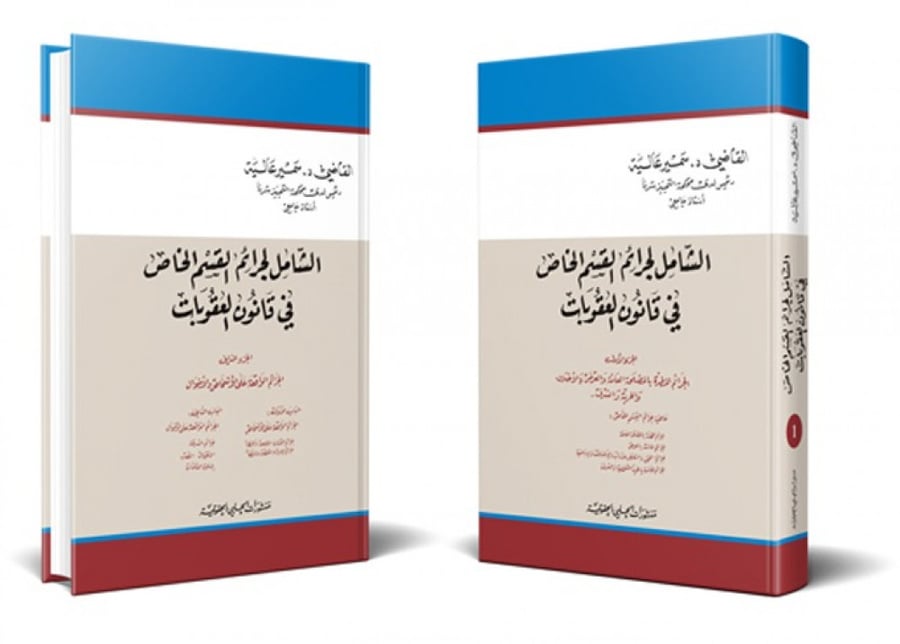
The comprehensive on crimes of the private oath in the Penal Code, two volumes, by Dr. Samir Alia
258.75ر.س
Product description
The comprehensive crimes of the special oath in the Penal Code
Author: Samir Alia
Classification: Criminal
Year of issuance: 2022
ISBN: 9786144014882
Book details
Number of volumes: 2
Edition number: 1
Binding type: Hard cover
Number of pages: 1128
Size: 17*24
Paper type: White
Printing colors: Black and white
Book content
- Part One -
Crimes harmful to public interest, honor, morals, ethics, freedom, and dignity
Introduction: The nature of crimes of the special oath
Part One: Crimes harmful to public interest
Chapter One: Crimes that violate duties of office
Section One: Crimes of bribery in the public and private sectors
Subsection One: Bribery crimes in the public sector
First requirement: The crime of complete bribery in the public sector (Articles 351/352 of the Penal Code)
First branch: The nature of the crime
Second branch: Presumptions of bribery in the public sector
First presumption: The prerequisite for bribery is the presence of the public official character in the briber
Second presumption: The physical element of bribery
Element One: The criminal conduct
Element Two: The subject of the bribe (benefit or promise thereof)
Element Three: The cause of the bribe (performing a job action)
Third presumption: The moral element of bribery (general intent)
Third branch: Penalty for bribery in the public sector in its two forms
Second requirement: The crime of offering a failed bribe (Article 355 of the Penal Code)
First branch: The elements of the crime of offering a bribe
Second branch: Penalty for offering a failed bribe
Third requirement: The crime of accepting a reward for previous work (Article 356 of the Penal Code)
Subsection Two: Bribery in the private sector
Chapter Two: Crime of influence peddling (Articles 357/358 of the Penal Code) - Influence peddling - Peddling from a person or lawyer
Chapter Three: Embezzlement of public money and exploitation of office
First subsection: Embezzlement of entrusted money (simple and aggravated forms)
Second subsection: Exploitation of public office
First requirement: Forcing others to pay unjust taxes or to be exempted from them (Articles 361/362 of the Penal Code)
Second requirement: Exploiting contractors of state projects (Article 363 of the Penal Code)
First branch: Contractors' breach of obligations (Articles 363/1)
Second branch: Obstruction in implementing state projects (Articles 363/2)
Third branch: Collusion to corrupt the tender process (Articles 363/3)
Fourth branch: Employee's consideration of a team in the bid or neglect of duty (Article 363/4)
Fifth branch: Providing contractors with rotten or unfit materials (Article 363/5)
Third requirement: Benefiting from the office and trading in essential needs
First branch: Personal benefit from the office (Articles 364)
Second branch: Public authority officials trading in essential needs
Part Two: Crimes affecting trust and morals
Chapter One: Forgery of seals, marks, currency, public documents, and stamps
First subsection: Forgery of state seals, marks, and stamps and use of the forger
First requirement: The content of the texts
Second requirement: Presumptions of crimes
Second subsection: Counterfeiting currency and public documents and related crimes
First: Counterfeiting currency and bank documents, their forgery, promotion, and introduction
First precondition: The subject is currency or a public bank document
Second: The physical and moral elements of forgery, counterfeiting, promotion, and introduction
Third: Penalties for these forms and exemption from them
Second: Crimes related to counterfeiting and forgery of currency and bank documents
Chapter Two: Forgery of documents and their use (forgery in documents and their use)
First subsection: Forgery in documents
First requirement: The nature of forgery and the damage involved
Second requirement: Presumptions and elements of forgery
First: The prerequisite that the subject is a document
Second: The physical element of forgery
First: Criminal conduct of altering the truth
Second: Means of forgery (methods of forgery)
First paragraph: Physical forgery and its methods
Second paragraph: Moral forgery and its methods
Third branch: The moral element of forgery
Third requirement: Types of forgery
First: Criminal forgery in official documents by an employee or others
First: Forgery by the authorized employee
Second: Forgery in official documents by individuals
Second: Misdemeanor forgery in private documents
Third: Forgery of electronically processed information
Fourth: Forms of mitigated forgery
Second subsection: Crime of using forged documents
Part Two: Crimes affecting honor, morals, and public decency
Introduction and division: Chapter One: Crimes of honor and morals
Introduction and division
First section: Crimes of dishonor (illegal sexual conduct) (first)
- Meaning of dishonor (a) - linguistic meaning (b) - legal meaning (second) - List of assault crimes on honor
First subsection: Crimes of rape of females
First requirement: Definition of rape (first) - Definition and forms of rape (second) - Rationale for criminalization
Second requirement: Elements and penalties of rape crimes
Introduction and division
First: Common general elements in rape crimes
Introduction (first) - The prerequisite: sexual contact between a man and a woman (second) - The physical element and attempt in the crime (a) - The complete physical element: Forced sexual intercourse with a woman unlawfully (1) - Meaning of the act of intercourse (2) - Illegality of intercourse (3) - Lack of consent (3/1) - Its nature (3/2) - Cases of lack of consent
First: Lack of consent by coercion (Article 503 of the Penal Code)
Second: Lack of consent due to illness and deception (Article 504)
Third: Lack of consent among minors (Article 505)
Fourth: Lack of consent of the minor subject to the perpetrator's authority or influence (Article 506)
(b): Attempt in rape (attempt) (third)
- The moral element in rape
Second: Penalties for forms of rape (first)
- Penalties for ordinary rape (1)
- Forcible rape of a non-spouse (2)
- Rape of a patient or through deception (3)
- Rape of minors (4)
- Rape of relatives and those with authority (second)
- Aggravating circumstances of rape
Second section: Immorality with females and males (indecent assault) (first)
- Definition of immorality and its forms (second)
- Division of the subsection
Requirement one: Common elements of immorality forms
First branch: The common physical element of immorality
- Introduction (first) - The act of indecency (a) - Forms of indecency (1) - Extending to the body (2) - Gross violation of modesty (second) - The second element: Illegality of the act (third) - The third element: Lack of consent (a) - Its nature (b) - Forms of lack of consent (1) - Coercion by violence and threats (2) - Physical and mental illness and trickery (3) - Lack of discrimination among minors (4) - Subjection of the minor to influence, authority, or service (c) - Attempt in immorality (attempt)
Second: The moral element in immorality (first)
- Availability of general criminal intent (second)
- Lack of regard for motives
Requirement two: Penalties for forms of immorality (first)
- Ordinary penalties (second)
- Aggravating circumstances
Requirement three: Justifications and defenses in immorality
Third: Kidnapping for marriage or fornication
Introduction and division
First requirement: Common rules for kidnapping forms
Introduction
First branch: The nature of the crime of kidnapping affecting honor (first)
- Definition of kidnapping in general (second)
- Rationale for criminalization (third)
- Nature of the crime
Second branch: The physical element of the two forms of kidnapping: forced and normal (first)
- The act of kidnapping (second)
- Committing kidnapping of an adult and minor (a) - Kidnapping of an adult through deception and violence (b) - Kidnapping of a minor without requiring a means
- The general criminal intent (first)
- The motives for kidnapping
- The mitigating circumstances of kidnapping
Requirement two: Specific rules for kidnapping forms
Introduction (first): Different subject matter of the crime (second)
- Different status of the victim (third)
- Different specific intent (fourth)
- Penalties for kidnapping forms
Fourth: Enticement and indecency and breaking into women’s places
Introduction and division
First requirement: Enticement by promise of marriage
First: The nature of the crime (first)
- Definition of the crime (second)
- Rationale for criminalization
Second: Elements of the crime of enticement
Introduction (first) - The prerequisite: The victim's character: a virgin female (a) - Meaning of female (b) - Meaning of virgin (second) - The physical element of the crime (a) - Enticement coinciding with acceptance (1) - Enticement by promise of marriage (2) - Acceptance of cohabitation (b) - Breaking the virginity (third) - The moral element of the crime of enticement (fourth) - Proof of the crime (fifth) - Penalties and suspension of prosecution and judgment
Second requirement: Indecency (the act that violates private modesty)
Introduction (first) - The nature of the crime (second)
- Presumptions of the crime (a) - The prerequisite: Public indecency acts (b) - The physical and moral elements (1) - The physical act of indecency (a) - The act of indecency (second) - The moral element: general intent (third) - Justifications and defenses in the crime (fourth) - Penalty
Third requirement: Breaking into women’s places by disguise (first)
- The nature of the crime (second)
- Presumptions of the crime (a) - The prerequisite: Disguise in a woman’s attire (b) - The physical and moral elements (third) - Penalty
Chapter Two: Crimes of immorality and exposure to morals and indecency
Introduction and division: First subsection: Crimes of immorality
Introduction and division
First requirement: Inciting immorality and clandestine prostitution
First: The nature of the crime (first)
- Definition of the crime (second)
- Rationale for criminalization
Second: Promoting the crime of inciting immorality
Introduction (first) - The prerequisites: The victim's character: a minor (a) - Meaning of minor (b) - The physical element of the crime (a) - Incitement coinciding with acceptance (1) - Incitement by promise of marriage (2) - Acceptance of cohabitation (b) - Breaking the virginity (third) - The moral element of incitement (fourth) - Proof of the crime (fifth) - Penalties and suspension of prosecution and judgment
Second requirement: Facilitating prostitution secretly
The first subsection: The nature of the crime (first)
- Definition of the crime (second)
- Presumptions of the crime (a) - The prerequisite: Woman as the perpetrator (b) - The physical and moral elements (1) - The physical act of facilitating prostitution (a) - Facilitating prostitution (second) - Making it easier for prostitution (b) - Making it easier for prostitution (second) - The penalties
Second subsection: Crimes related to committing immorality and prostitution
First: Inducing others to immorality (first)
- List of related crimes
Second: Penalties for related crimes
Third: Common rules for crimes of immorality and prostitution
First: Penalties for attempted crimes under Articles 522 to 525
Second: Aggravating circumstances of penalties
Third: Judgments involving precautionary measures
Chapter Two: Public exposure to morals and indecency (the act that violates public decency)
Introduction and division
First requirement: Public exposure to morals by shameful acts (first)
- The nature of the crime (second)
- Presumptions of the crime (a) - The prerequisite: Public acts of indecency (b) - The physical and moral elements (1) - The act of indecency (a) - The act of indecency (second) - The moral element: general intent (third) - Justifications and defenses in the crime (fourth) - Penalty (fifth) - Multiple moral aspects with the crime
Second requirement: Public exposure to morals by words, writings, and shameful images (first)
- The nature of the crime (second)
- Presumptions of the crime (a) - The prerequisite: Publicity of words, writings, and images (b) - The physical and moral elements (1) - The physical act (a) - The act of indecency (second) - The moral element: general intent (third) - Penalty
Third requirement: Dealing with indecent objects (first)
- The nature of the crime (second)
- Presumptions of the crime (a) - The prerequisite: Indecent objects (b) - The physical and moral elements (1) - The physical object (a) - The act of indecency (second) - The moral element: general intent (third) - Penalty
Chapter Three: Exploiting minors in pornographic materials
First requirement: Definition of crimes of exploiting minors pornographically
- The nature of the crime (second)
- Presumptions of these crimes in general (a) - The prerequisite (b) - Pornographic material
Second: Forms of crimes of exploiting minors pornographically
- Producing pornographic materials for minors (second)
- Dealing with pornographic materials for minors (third)
- Habitual collection, display, or possession of pornographic materials for minors
Chapter Four: Engaging in unnatural sexual acts (homosexuality) (first)
- The nature of the crime (second)
- Presumptions of the crime (a) - The prerequisite: Homosexuality between two persons of the same sex (b) - The physical and moral elements (third) - Penalty
Part Two: Crimes affecting personal freedom and honor
Introduction and division: First section: Deprivation of personal freedom (detention and kidnapping)
First subsection: The nature of the crime of deprivation of freedom
First requirement: Definition of the crime (first) - The definition of the crime (second) - Presumptions of the crime (a) - The prerequisite: Personal freedom (b) - The physical element (c) - The moral element (third) - Penalty
Second: Aggravating and mitigating circumstances in deprivation of freedom
First: Aggravating circumstances (second)
Second: Mitigating circumstances
Chapter Two: Breaking into homes (violating the sanctity of residence and private property)
Introduction and division
First prerequisite: Common prerequisite: the residence and private place
Content of the text (first) - Sanctity of the home and its annexes and private places (second) - The residence or private place is in the possession of others
Second: Common elements of the crimes of breaking into sanctuaries (first)
- The physical element: entering or remaining without consent (a) - Entering or remaining (b) - Lack of consent (second) - The moral element (third) - Penalty for each form and prosecution (a) - Penalty for Article 571 crimes and aggravating circumstances (b) - Penalty for Article 572 crimes and prosecution
Chapter Three: Threatening
Introduction and division
First subsection: Common rules for threats
First requirement: Unified prerequisite: intimidation by evil (first)
- The meaning of threat (second) - Rationale for criminalization
Second: Unified moral element (first)
- Sufficient to have general intent (second)
- No effect of motives
Second: Forms of the crime of threat
First: Threatening with a weapon and using it (first)
- The nature of the crime (second)
- Presumptions of the crime (a) - Threatening with a weapon (b) - Using a firearm (third) - Penalty
Second: Threatening to commit a crime (first)
- Threatening to commit a serious crime (Article 574) (a) - The nature of the crime (b) - Presumptions of the crime (1) - Threatening to commit a serious felony (2) - Threatening in writing or through a third party (3) - Coupling threat with command to act or abstain (c) - Penalty (second) - Threatening to commit a serious crime without command or verbally (Article 575) (a) - The nature of the crime (b) - Presumptions of the crime (c) - Penalty (third) - Threatening to commit a medium-risk felony (Article 576) (fourth) - Threatening to commit a misdemeanor (Article 577) (fifth) - Verbal or public threat of harm (Article 578)
Chapter Four: Crime of revealing official or professional secrets
First requirement: The nature of the crime (first) - Content of the text and rationale for criminalization (second) - Presumptions of the crime (a) - The prerequisite: Official or professional secret and the trusted persons (b) - The physical and moral elements
Second: Forms of revealing secrets (first)
- Revealing by postal and communication employees (second) - Revealing secrets obtained through deception
Third: Justifications for revealing secrets
Introduction (first) - Obligation to keep secrets outweighs testimony (second) - Legitimate defense and necessity justify revealing (third) - Law enforcement and authority orders justify revealing (fourth) - Victim’s consent to reveal the secret (fifth) - Defense before the judiciary justifies revealing
Chapter Five: Defamation, slander, and contempt (insulting honor / crimes of opinion)
First subsection: Unpublicized defamation (defamation) (first)
- The nature of the crime (second) - Presumptions of the crime (a) - The prerequisite: Public defamation (1) - The meaning of publicity (2) - Means and methods of expressing publicly (2/1) - The perpetrator’s use of public means (2/2) - Resorting to public expression
a - Acts and movements
b - Speech or shouting
c - Writing, drawings, images, and related media
d - Radio, television, and electronic broadcasting
e - Reporting and complaints
Second: The physical element of defamation (first)
- Attributing or ascribing a specific defect to a person (second)
- The subject of defamation: identifying the defect and the person (second/1)
- The importance of identification (second/2)
- If the attribution is true, it warrants punishment or contempt (third)
- The moral element of defamation (third)
- Penalty for defamation (first)
- Penalty for ordinary defamation (second)
- Penalty for defamation against persons with public attributes (third)
Fourth: Justifications and defenses for defamation
Second subsection: Public slander (insult) (first)
- The nature of the crime (second)
- Presumptions of the crime (a) - The prerequisite: Public insult (1) - The meaning of publicity (2) - Means and methods of expressing publicly (2/1) - The perpetrator’s use of public means (2/2) - Resorting to public expression
a - Acts and movements
b - Speech or shouting
c - Writing, drawings, images, and related media
d - Radio, television, and electronic broadcasting
e - Reporting and complaints
Second: The physical element of insult (first)
- Attributing or ascribing a specific defect to a person (second)
- The subject of insult: identifying the defect and the person (second/1)
- The importance of identification (second/2)
- If the attribution is true, it warrants punishment or contempt (third)
- The moral element of insult (third)
- Penalty for insult (first)
- Penalty for ordinary insult (second)
- Penalty for insult against persons with public attributes (third)
Fourth: Justifications and defenses for insult
Third subsection: Disrespecting officials and persons with public attributes (insulting officials)
- The nature of the crime (first)
- Presumptions of the crime (a) - The prerequisite: The person’s official or public attribute (b) - The physical and moral elements
Fourth: Causes of justification and responsibility barriers
- The obligation to keep secrets outweighs testimony (first)
- Legitimate defense and necessity justify revealing (second)
- Law enforcement and authority orders justify revealing (third)
- Victim’s consent to reveal the secret (fourth)
- Defense before the judiciary justifies revealing
Part Two - Crimes against persons and property
Introduction and division:
First Chapter: Crimes against persons
Section One: Crimes of homicide (intentional and accidental)
First subsection: General rules in homicide crimes
Branch One: Definition of homicide
Second branch: Common rules in homicide crimes (subject of the crime and physical element)
First: The subject of homicide (a) - Being a living human as a presumed element (a) - The necessity of the victim being alive and different from the perpetrator (1) - Protection of the right to life: its beginning and end (2) - The necessity of the victim being different from the perpetrator
Second: The physical element of homicide (a) - The concept of the lethal physical element (b) - Elements of the physical element in homicide (1) - The criminal conduct (1/1) - Active killing (act) (1/2) - Omitting or leaving (2) - The criminal result: causing death (3) - Causal link
Second subsection: Types of intentional and accidental homicide (based on the form of the moral element)
Introduction
First: Intentional homicide
First: The nature of intent in homicide (a) - Definition of criminal intent and its elements (b) - Types of intent in homicide (c) - Proving intent in homicide (d) - Penalty and attempt
Second: The two categories of intentional homicide (a) - Penalties for aggravated ordinary homicide (1) - Cases of life imprisonment
1 - Killing for a vile reason
2 - Killing to obtain a benefit from a misdemeanor
3 - Killing with mutilation of the corpse
4 - Killing a minor under fifteen
5 - Killing two or more persons
(2) - Cases of capital punishment
1 - Premeditated murder
2 - Murder as a means of committing a felony or misdemeanor or enabling escape
3 - Killing of an ancestor or descendant
4 - Killing through torture or brutality
5 - Killing a public official
6 - Killing for sectarian reasons
7 - Killing using explosives
8 - Killing to conceal or escape from a felony or misdemeanor
Second: Aggravated murder (lesser penalties)
1 - Causing death by beating
2 - Killing a mother to avoid shame
3 - Killing by mercy upon insistence of the victim
4 - Killing during a quarrel
5 - Killing due to multiple causes
Third: Justifications and reasons for exemption from criminal responsibility in homicide (first)
- Legal justifications for killing
(a) - Excluding the victim’s consent from justification
(b) - Enforcing law and government orders
(c) - Self-defense
(d) - Killing during wartime with another state
Second: Barriers to criminal responsibility in homicide
1 - Material mistake in the act
2 - Force majeure
a - Killing by coercion of others
b - Necessity requiring killing
c - Committing murder by a lunatic
d - Killing under the influence of alcohol or drugs (accidental or coercive)
e - Killing by a child under seven years old
Second subsection: Unintentional homicide
First: Causing death by mistake (ordinary)
Second: Causing death by mistake with reduced penalty
Third: Causing death by mistake with increased penalty
Chapter Two: Crimes of assault
First subsection: Common rules in assault crimes
Branch One: Subject and physical element
Branch Two: Moral element of assault in general
Branch Three: Completion of assault
Second subsection: Types of assault crimes (intentional and accidental)
First: Penalties for intentional assault
(a) - Simple assault (up to ten days)
(b) - Aggravated assault
(1) - Assault with increased penalty for result
(2) - Assault with serious disfigurement or permanent disability
(c) - Assault causing severe injury or permanent disability
(d) - Assault causing miscarriage
(e) - Assault during a quarrel
(f) - Assault resulting from multiple causes
Second: Causes for justification and responsibility barriers in assault
First: Legal justifications
(a) - Right to discipline non-violently
(b) - Doctor’s right to perform surgeries and prescribe treatments
(c) - Acts of violence during sports
(d) - Victim’s consent to minor injury
(e) - Self-defense
(f) - Defense of public authority officials
Second: Responsibility barriers
(a) - Material mistake
(b) - Force majeure
(c) - Necessity
(d) - Insanity
(e) - Accidental intoxication
Third: Types of accidental assault
First: Simple accidental assault
Second: Aggravated accidental assault with increased penalty
Third: Reduced penalty for accidental assault

From Riyadh
Questions you might have