
Exide 77 WP Copper Fungicide & Bactericide 1 kg – Copper Hydroxide 77% for Leaf Spots and Downy Mildew
99ر.س
Product description
Exide 77 WP is a fungicide and bactericide containing copper hydroxide 77%, used to protect crops from a range of fungal and bacterial diseases, most notably leaf spots, downy mildew, anthracnose and bacterial cankers. It works by contact, releasing copper ions on the plant surface that disrupt the vital processes of pathogens and limit spore germination and new infections. Its multi-site protective action makes it suitable for disease-management programs and reduces the risk of resistance. It is used on vegetables, grapes, citrus, fruit trees and ornamentals according to registered uses, and comes as a wettable powder (WP); uniform coverage of susceptible plant parts is essential.
Key Features
- Fungal and bacterial control: helps control copper-sensitive pathogens, including leaf spots, downy mildew and registered bacterial cankers.
- Protective contact action: works on treated surfaces to limit spore germination and new infections before pathogens penetrate plant tissue.
- Multi-site mode of action: copper ions affect several vital processes in pathogens, reducing the risk of resistance compared with single-site fungicides.
- Limits bacterial diseases: used against registered diseases such as angular leaf spot, bacterial cankers and black rot on target crops.
- Multiple uses: suitable for registered disease-prevention programs on vegetables, grapes, citrus, fruit trees and ornamentals.
- Wettable powder formulation: mixes with water for spraying; keep the tank agitated for even distribution.
Specifications
- Trade name: Exide 77 WP
- Product type: agricultural fungicide and bactericide
- Active ingredient: copper hydroxide
- Concentration: 77% w/w
- Formulation: wettable powder (WP)
- Mode of action: protective, contact, non-systemic
- Resistance group: FRAC M01
- Country of origin: China
- Manufacturer: Sino Agro Chemical
- Pack size: 1 kg (1000 g)
Directions for Use
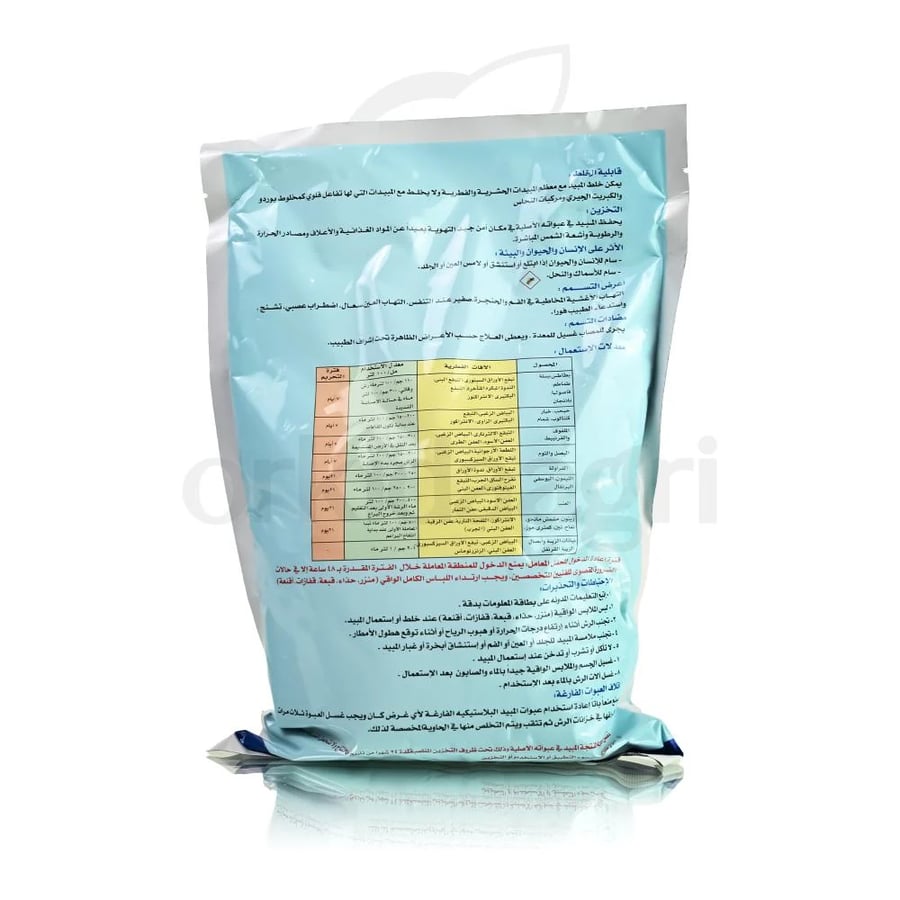
- Potato, peas, tomato, beans and eggplant: for leaf spots, early and late blight, bacterial spot and anthracnose, use 1.1 g per liter of water (110 g per 100 L) as a preventive spray; the rate may go up to 3 g per liter (300 g per 100 L) under severe infection, according to the label.
- Cucumber, cantaloupe and melon: for downy mildew, angular leaf spot and anthracnose, use 1.5–2 g per liter (150–200 g per 100 L) when lesions start to form.
- Cabbage and cauliflower: for Alternaria leaf spot, downy mildew, black rot and soft rot, use 1.5–3 g per liter (150–300 g per 100 L) after transplanting to the permanent field.
- Onion and garlic: for purple blotch, downy mildew and Septoria leaf spot, use 1.5–3 g per liter (150–300 g per 100 L) as soon as infection appears.
- Strawberry: for leaf spot and leaf blight, use 2.5–3 g per liter (250–300 g per 100 L).
- Lemon, mandarin and orange: for stem canker, scab, Phytophthora spot and brown rot, use 2–2.5 g per liter (200–250 g per 100 L).
- Grapes: for black rot, downy mildew and other registered diseases, use 2–4 g per liter (200–400 g per 100 L). Apply the first spray after pruning, then repeat after bud break according to the label.
- Olive, apricot, mango, apple, fig, pear and banana: for registered diseases such as anthracnose, fire blight, neck rot and scab, use 5 g per liter (500 g per 100 L); start at bud swell according to the label.
- Ornamentals, ornamental bulbs and carnation: for downy mildew, Septoria leaf spot, brown rot and Rhizoctonia, use 2–4 g per liter (200–400 g per 100 L).
Pre-Harvest Interval (PHI)
- Potato, peas, tomato, beans and eggplant: 7 days.
- Cucumber, cantaloupe and melon: 7 days.
- Cabbage and cauliflower: 7 days.
- Onion and garlic: 7 days.
- Strawberry: 21 days.
- Lemon, mandarin and orange: 21 days.
- Grapes: 21 days.
- Olive, apricot, mango, apple, fig, pear and banana: 21 days.
- Non-edible ornamentals: no harvest interval applies.
Precautions
- This is a protective, non-systemic contact product: ensure good coverage of susceptible parts and do not rely on it to cure advanced infections inside plant tissue.
- Do not mix with lime sulfur, strongly alkaline materials or incompatible products; follow the mixing instructions on the pack.
- Do not exceed registered rates – copper compounds can injure some sensitive crops and varieties, especially in unfavorable weather.
- Avoid spraying in high temperatures, wind, or when rain is expected.
- Harmful if swallowed, inhaled or in contact with skin and eyes; toxic to fish and bees – wear suitable protective equipment and keep away from water sources.
- Re-entry interval: no unprotected persons in treated areas for 48 hours; follow the protection requirements on the label.
- Store in the original closed container in a dry, well-ventilated place away from food, feed, moisture, direct sunlight and children.
Orkida Tip
- Because Exide 77 WP is a protective copper fungicide, apply it before disease spreads or at the very first signs, making sure to cover both sides of the leaves, especially in dense crops. When preparing the spray, first mix the powder with a little water to form a smooth slurry, then add it to the tank with constant agitation to prevent settling. Stick to the right rate for each crop – good coverage and correct timing matter more than a higher concentration.
