
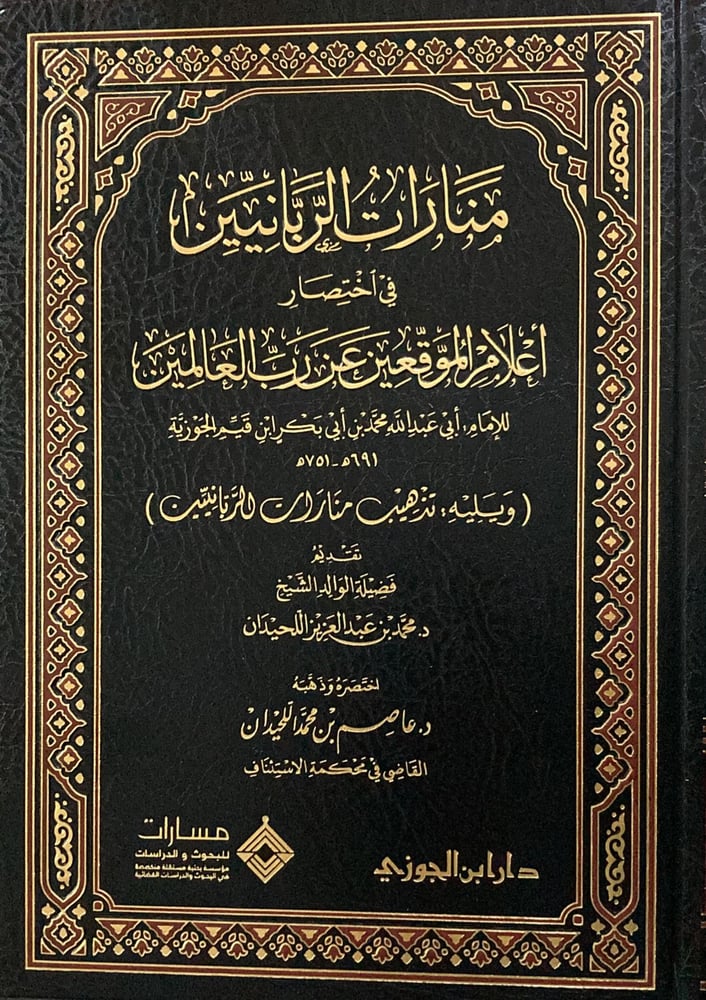



Minarets of the divine in brief, the scholars of the muwatta
37.95ر.س
Product description
In the name of Allah, the Most Gracious, the Most Merciful
Praise be to Allah, Lord of the worlds, and prayers and peace be upon the most honorable of prophets and messengers, our Prophet Muhammad, and upon his family and companions all together.
Praise be to Allah who has placed in every era remnants of scholars after the prophets; they call those who have strayed to guidance, and they endure harm from them. They revive the dead with the Book of Allah, and they enlighten the blind with the light of Allah. How many of Satan’s killed ones they have revived, and how many misguided and lost they have guided. How beautiful their impact on people, and how ugly the impact of people on them. They remove from the Book of Allah the distortions of the extremists, the false claimants, and the misinterpretations of the ignorant; those who have established the banners of innovation and unleashed the reins of fitnah. They differ in the Book, oppose the Book, and are united in abandoning the Book. They speak falsely about Allah and the Book of Allah without knowledge, and they speak about the ambiguous from speech, deceiving the ignorant with what appears similar to them. We seek refuge in Allah from the trials of the misguiders.
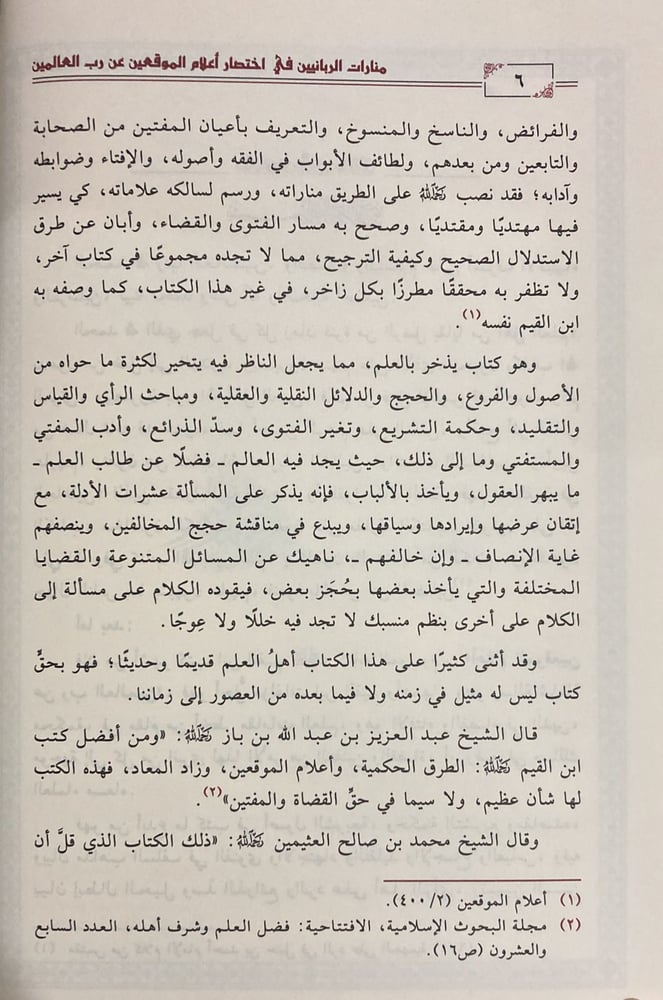
As for what follows: Among the most famous of Ibn al-Qayyim’s books is his work titled "The Signs of the Muftis from the Lord of the Worlds." It is his greatest and most important work, a comprehensive and sound treatise in the critical field of Islamic jurisprudence, namely fatwa and judgment in religion. It is directed to every who takes on this matter, whether a mufti or a judge, or those who seek knowledge in the paths of scholars. It is one of the most brilliant writings on the roots of Sharia, the wisdom of legislation, its objectives, and the doctrines of the Salaf in fatwa, ijtihad, taqlid, consensus, and analogy. It includes refutations of tricks, closing the means, and responses to the people of opinion, clarifies the Sunnah, obligations, the abrogating and abrogated, and introduces the personalities of the muftis from the Companions, the Followers, and those after them. It also discusses subtle matters in jurisprudence and its roots, fatwa and its etiquettes, and its conditions. Allah has set guiding beacons on the way and drawn signs for the traveler to follow, so he walks guided and imitated, correcting the course of fatwa and judgment, and clarifying the proper methods of reasoning and how to prefer between opinions—something not found altogether in any other book, nor achieved by a researcher with all its richness outside of this book, as Ibn al-Qayyim himself described it.
It is a book full of knowledge, which makes the reader bewildered by the abundance of its principles, branches, proofs, and evidences—both textual and rational—discussions of opinion, analogy, and taqlid, wisdom of legislation, changing fatwas, closing the means, and manners of the mufti and the asker. It contains what astounds minds and captures hearts: it mentions the mastery of presenting and citing issues, discusses the arguments of opponents fairly, and even if he disagrees with them, he does so with utmost fairness. The book also covers various issues and different cases, sometimes leading from one topic to another in a well-structured manner without flaw or deviation.
Many scholars, past and present, have praised this book; it is truly a unique work in its time and beyond. Sheikh Abdul Aziz bin Abdullah bin Baz said: "Among the best of Ibn al-Qayyim’s books are 'The Wise Paths,' 'The Signs of the Muftis,' and 'Zad al-Ma’ad.' These books are of great importance, especially for judges and muftis." Sheikh Muhammad bin Salih al-Uthaymeen said: "That book is rarely found among Islamic books." Sheikh Bakr Abu Zaid said: "If only his book 'Zad al-Ma’ad in the Guidance of the Best of Servants' and his comprehensive book on the fundamentals of rulings, the truths of jurisprudence, and the wisdom and secrets of legislation, called 'The Signs of the Muftis,' were nothing but these two books, it would suffice."
All scholars of different schools have benefited from this book, including Ibn Hajar, Ibn Abd al-Hadi, Ibn Muflih, al-Mardawi, al-Hajjawi, Muhammad ibn Abd al-Wahhab, al-Shawkani, and many others.
It seems as if its author—Ibn al-Qayyim—poured his pen into this book, and springs of benefits flowed from it, and eyes of insights burst forth, expanding its branches. Then he entrusted the pen to our son, Dr. / Asim bin Muhammad al-Luhaydan, may Allah preserve him, to compile and gather its contents in a concise, pleasant manner that does not diminish from the original, whether in brevity or detail, and preserves its core issues and precious insights. He benefited, excelled, and achieved the purpose and intent. He named it: "Guiding Beacons of the Righteous in Briefing the Signs of the Muftis from the Lord of the Worlds," followed by "Golden Highlights" (Tadhih al-Manarat), which is a distilled summary of the main points.
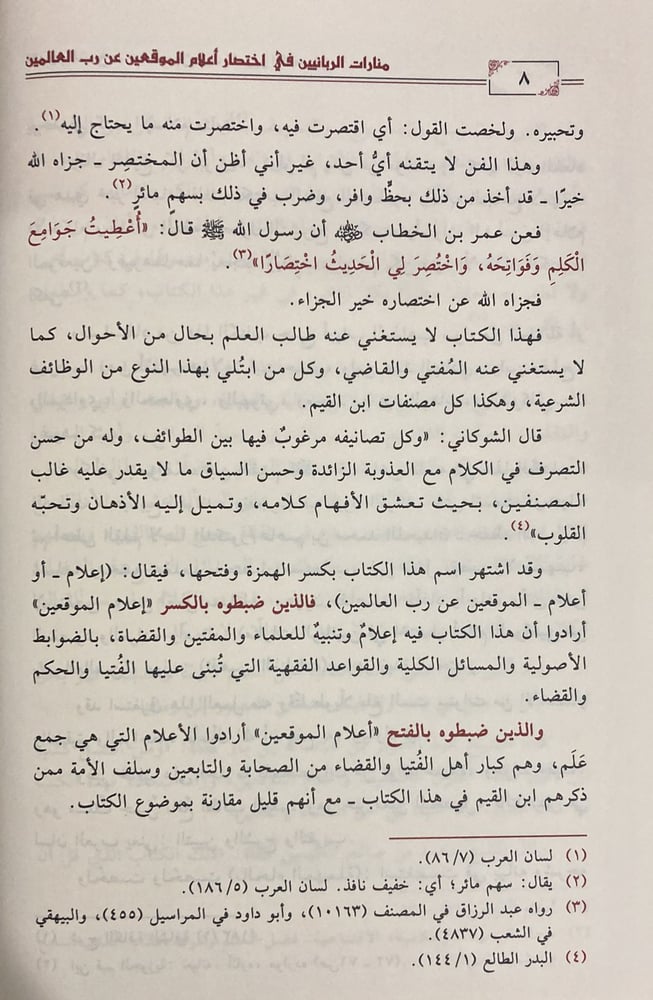
This work took him a long time—six years of summarizing, refining, and reviewing. I ask Allah to benefit from it and bless it. It is clear to everyone the many benefits and useful outcomes of summaries, which are a beautiful and beneficial approach for students of knowledge. It is the best aid for acquiring knowledge. In the Arabic language, "takhsees" means clarification, explanation, and approximation. I summarized and condensed, thoroughly explaining and clarifying.

From Dammam