


Legislative issues
31.05ر.س
Product description
By Dr. Nasser Abdullah Al-Miman
In the name of Allah, the Most Gracious, the Most Merciful
Introduction
Praise be to Allah, who guided us to praise Him as a continuation of His blessings, and made gratitude a shield for seeking more of His grace. I praise Him with the true praise by which His favor is sustained and His virtue and glory are increased. I bear witness that there is no deity but Allah alone, with no partner, and I bear witness that our master and prophet Muhammad is His servant and Messenger, whom He sent with the clear light and the straight path. May Allah's peace and blessings be upon him, his family, and his companions, and may He grant them peace until the Day of Judgment.
As for what follows...
In the midst of the rapid growth in contemporary human life and the resulting developments in economic, social, and other fields, we see — and all praise is due to Allah — the abundance of effort by scholars of the present era in confronting these emerging issues to find Islamic legal rulings that are consistent with the clear texts of Sharia and the demands of the age.
We now see these efforts emerging collectively through various Islamic legal councils and collective fatwa councils, aiming to be closer to correctness and more accurate, especially after becoming subject to discussion and analysis by a number of scholars and experts in specialized fields before the results of these efforts are presented to the public. This is one of the important features of contemporary ijtihad.
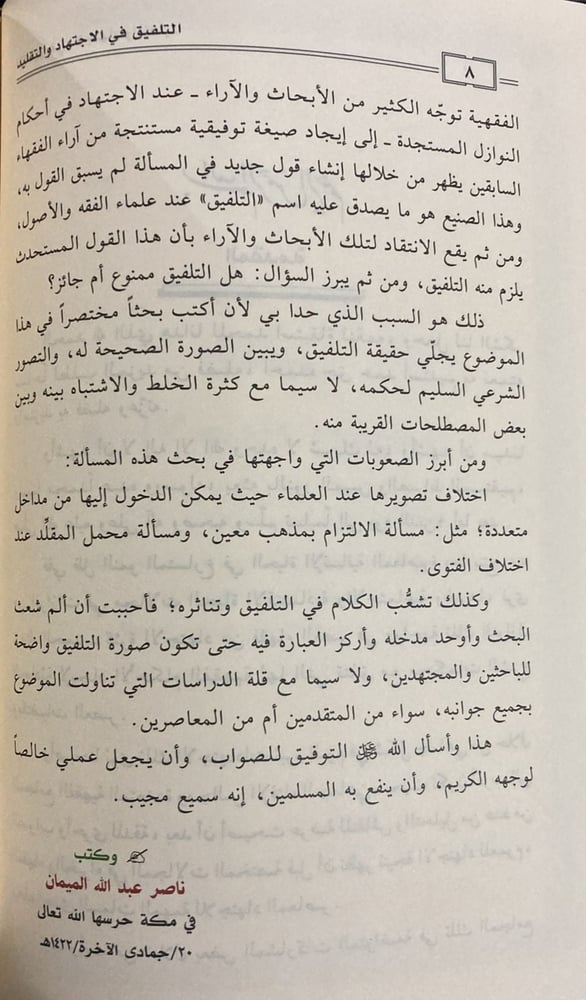
From my modest participation in some of these Islamic councils, I have observed that many research efforts and opinions — when deriving rulings on new issues — tend to seek a conciliatory formula derived from the opinions of the scholars involved, which has not been previously stated. Through this, a new opinion is established, and this act is what is called “talfīq” (combination or mixing) among scholars of fiqh and usul (principles).
Therefore, criticism is directed at such research and opinions, claiming that this newly introduced opinion necessarily involves talfīq, leading to the question: Is talfīq forbidden or permissible?
This is the reason that prompted me to write a brief study on this topic, clarifying the reality of talfīq, illustrating its correct image, and presenting the ruling on it — especially given the frequent confusion and misunderstanding between it and the sound Islamic law, along with some related terminologies.
One of the main difficulties I faced in researching this issue was the differing descriptions of it among scholars, as it can be approached from multiple angles, such as: the issue of adhering to a specific madhhab (school of thought), and the issue of the extent of the muqallid (follower) when there is a difference of fatwa.
Additionally, the discussion about talfīq is extensive and scattered. I wanted to gather the research and unify its approach and focus the discussion so that the concept of talfīq becomes clear to researchers and mujtahids, especially given the scarcity of studies that address all its aspects, whether from earlier scholars or contemporary ones.
I ask Allah for success in what is correct, to make my work sincerely for His Face, and to benefit Muslims through it. Indeed, He is the Hearing, the Responding.
Written by Nasser Abdullah Al-Miman
In Mecca, may Allah protect it
20th Jumada al-Akhirah, 1422 AH

From Dammam