


The gift of the Creator with an explanation of the Abuari system in the shared parts of the Qur'an
25.30ر.س
Product description
Explanation of Dr. Yusuf Abdulaziz Al-Shibl
Introduction
All praise be to Allah, we praise Him, seek His help, ask for His forgiveness, and seek His guidance. We seek refuge in Allah from the evil of ourselves and from the bad of our deeds. Whomsoever Allah guides, there is none to misguide him; and whomsoever He misguides, there is none to guide him. I bear witness that there is no deity but Allah alone, with no partner, and I bear witness that Muhammad is His servant and Messenger.
As for what follows:
Engaging with the Book of Allah is among the best acts of worship, the finest acts of devotion, and the best pursuit of efforts and the most exhausting of thoughts. It is the most deserving of dedicating lifetimes to, occupying time with, and it is the most worthy of being the focus of our lives. As it is better than all speech, and its sciences are among the best and most noble of sciences.
The Holy Qur'an is the straight path, the wise remembrance, and the rope that Allah has laid down as the foundation of Islamic sciences and the core of human rulings. It is firm because its ultimate goal is to cling to the most secure bond that has no breakage. For this reason, the Companions, the Followers, and those who came after them paid great attention to the Qur'an, reciting it, interpreting it, and extracting its sciences. They dedicated themselves to explaining its words, detailing its topics, and extracting its diverse sciences, to the extent that they authored many works that encompass many of its sciences. For example, Al-Zarkashi (d. 794 AH) in his book "Al-Burhan fi Ulum al-Qur'an" listed forty-seven types of Qur'anic sciences. Al-Balqini (d. 824 AH) in his book "Mawaqi al-Ulum fi Mawaqi al-Nujoom" listed fifty-five types. Al-Suyuti (d. 911 AH) in his "Itqan fi Ulum al-Qur'an" listed over eighty types. Numerous poetic compositions have also been made about it, including the Al-Abyari poem (d. 1305 AH) on the shared sciences of the Qur'an, which relate to its words that indicate its rhetorical miracle—specifically, the single word that can imply more than one meaning, as will be explained later.
When I examined this poem and reflected upon it, I found it to be a rare composition in its field—solid in its structure, rich in its knowledge, and comprehensive of most of the shared words found in the Book of Allah. This motivated me to explain it, clarify what is unclear, unravel what is difficult, comment on what needs explanation, and correct what the poet may have overlooked—all as a service to the Book of Allah and its noble people. I named this explanation: [The Gift of the Creator in Explaining the Abyari Poem on the Shared Sciences of the Qur'an].
I divided my work into two parts:
First Part:
- Introducing the poet and his poem.
- The first section pertains to the poet, including his introduction, background, and scholarly life.
- The second section pertains to the poem itself, including its name and description.
Second Part:
- Explaining the poem.
My approach in this work was as follows:
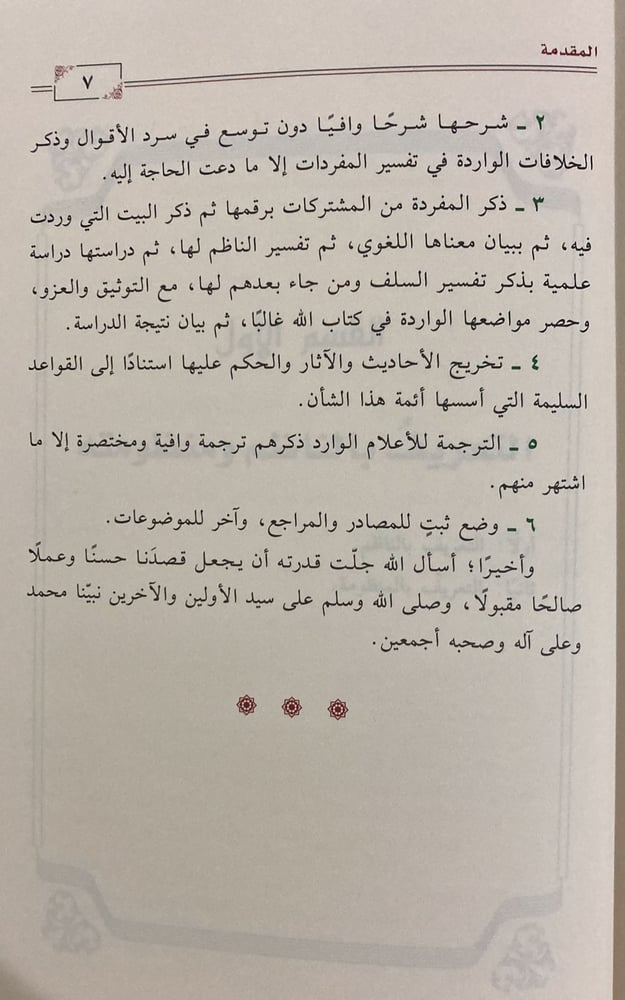
1. Writing the entire poem in its original order.
2. Providing a comprehensive explanation without excessive detail, except when necessary to clarify interpretations or resolve differences in understanding individual words.
3. Mentioning each shared word by its number, then the verse in which it appears, followed by its linguistic meaning, the poet’s explanation, and a scientific study that includes the interpretations of the Salaf (early scholars) and those who came after them, with proper references and citations. This also involves identifying where these words occur in the Qur'an, and concluding with the results of the study.
4. Extracting and authenticating Hadiths, sayings, and judgments based on the sound principles established by the imams of this field.
5. Providing a thorough and concise translation of the notable figures mentioned, except for those well-known.
6. Creating a record of sources and references, as well as a section for topics.
Finally, I ask Allah, the Almighty, to make our intention good and our deeds accepted. May Allah send peace and blessings upon the Master of the First and the Last, our Prophet Muhammad, and upon his family and companions all.

From Dammam