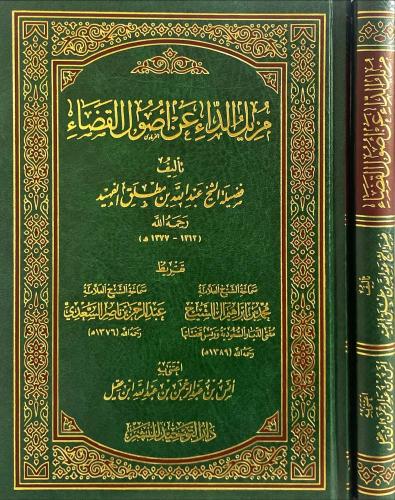
Explanation of the system of jurisprudential rules
23ر.س
Product description
Forward, Abdul Rahman Al-Saadi, complete Al-Kuwari
All praise be to Allah, we praise Him, seek His help, and ask for His forgiveness. We seek refuge in Allah from the evil of ourselves and from the bad consequences of our deeds. Whom Allah guides, there is no misleader for him, and whom He misguides, there is no guide for him. I bear witness that there is no deity but Allah alone, with no partner, and I bear witness that Muhammad is His servant and Messenger.
Then: Before us is a beneficial message from Sheikh, the scholar, Abdul Rahman bin Nasser Al-Saadi, who passed away in the year 1376 AH (1956 CE). Sheikh, may Allah have mercy on him, has many writings in which he elaborated on knowledge, brought it closer to his students with strong verification. He combined the elaboration of knowledge, its clarification, and verification, so it is appropriate for the student of knowledge to pay attention to Sheikh’s writings, may Allah have mercy on him, with wide mercy.
And before us is this poem (mandooma) by Sheikh, may Allah have mercy on him, in which he collected what was easy from the foundational rules of jurisprudence. He mentioned many beneficial jurisprudential rules that a student of knowledge should understand well, so that he can comprehend the science of jurisprudence, which is based on understanding these rules.
We need to distinguish between jurisprudential rules, foundational rules, doctrinal rules, and principles. When we say: this is a jurisprudential rule, or we say this is a principle, or we say this is a foundational rule, or we say: this is a rule in the Hanbali school, or a rule in the Shafi’i school, or a rule in the Maliki school, or in the Hanafi school, we need to differentiate between these rules.
Linguistically, the rule is the foundation on which something is built. So, the rule of a house is its foundation, made of cement and iron placed inside the ground.
The jurisprudential rule is what is intended in these lessons. We have a foundational rule, a principle, and a doctrinal rule.

Questions you might have