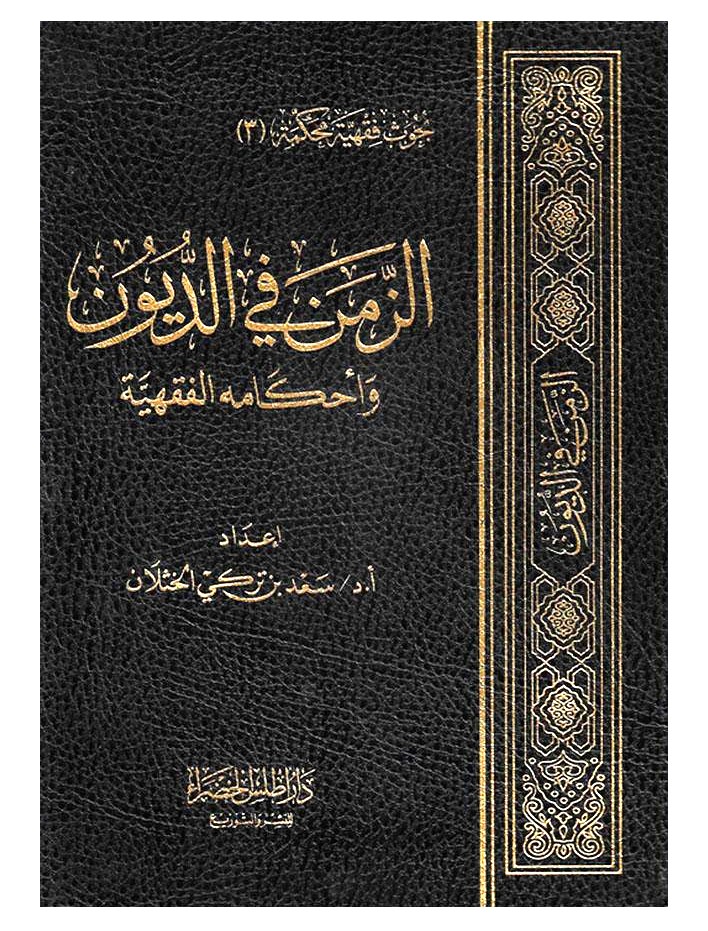
Time in debts and its jurisprudential rulings
20.70ر.س
Product description
The time in debts and its jurisprudential rulings
The time in debts and its jurisprudential rulings by the author Dr. Saad bin Turki Al-Khathlan, addresses an important topic in Islamic jurisprudence, which is the effect of time on debts and the jurisprudential rulings related to it.
The book was published in 1438 AH / 2017 AD and is issued by Dar Atlas Al-Khadra in Riyadh.
Content of the time in debts and its jurisprudential rulings
Definition of debts and the importance of time in them: The author begins the book by defining debts and the importance of time in determining their rulings.
Rulings of time in debts: The book discusses in detail the jurisprudential rulings related to time in debts, citing jurisprudential sources.
Delaying and its impact on debts: The book explores the effect of delay on debts and how to deal with it jurisprudentially.
Installments and compensations in debts: The book discusses the topic of installments and compensations and how to calculate them within the framework of debts.
This book is considered an important reference for jurists and researchers in the field of Islamic jurisprudence, providing a valuable contribution to understanding the jurisprudential rulings related to debts and the impact of time on them.
In conclusion, regarding the book “The Time in Debts and its Jurisprudential Rulings,” it can be said that Dr. Saad bin Turki Al-Khathlan has presented a solid jurisprudential research that analyzes and studies one of the important and contemporary jurisprudential topics. The book highlights the influence of time on debts and offers a jurisprudential framework for dealing with various issues related to this aspect. Through extensive discussion and based on Shariah evidence, the book is a valuable addition to the Islamic jurisprudential library and an important reference for scholars, researchers, and those interested in the jurisprudence of financial transactions.
One of the most important needs of humans in their daily lives is exchanging benefits with others, which may result in debts owed. This has been a reality in people's lives since ancient times, but nowadays it has become more frequent and prominent. Many people today are either creditors or debtors, and there are institutions that are fundamentally based on dealing with debts. Many banks, financial institutions, and companies conduct many of their dealings involving debts. This expansion in dealing with debts has led to new issues that require clarification and elucidation of the Islamic legal ruling by scholars.
Therefore, the author wrote about one aspect related to debts: “The time in debts and its jurisprudential rulings.”
This highlights the importance of the topic and its connection to contemporary reality, especially given the expansion of borrowing and the rulings that follow. Neglecting these rulings could lead to falling into usury (riba) of debts, which was widespread in pre-Islamic times, and many banks and financial institutions have returned to it in various forms and diverse shapes.
To accurately address the issues of this topic, a deep understanding of the objectives of Shariah in general, and its objectives concerning riba and its branches in particular, is necessary. The author clarified these precise issues, distinguishing between the different types, and what is prohibited and what is permissible.
Additionally, new issues related to time in debts have emerged that were not prominent before, such as compensation for the harm caused by delay, which some Islamic banks and financial institutions practice extensively. This is one of the major issues where contemporary scholars have differed between approval and prohibition.
Furthermore, many banks and companies currently aim to legitimize their dealings by adhering to Shariah rulings and avoiding forbidden transactions. Since many of these dealings involve debts, this research covers an important aspect of debts, which is the time involved and related issues and rulings.
The author adopted a method in this book that depicts the issue requiring clarification with precise description before stating its ruling, to clarify the intended meaning. The book also presents opinions on the issues, attributing each opinion to its proponents from the schools of thought, scientific bodies, and contemporary jurisprudential councils.
It discusses the evidence for the weaker opinion, explaining the reason for preference, and mentions the verse numbers and the names of the surahs in which they are found, as well as extracting hadiths from their sources.
The book includes an introduction, a preamble, five sections, and a conclusion, as follows:
- Preamble: Definition of time and debt
- First section: The increase related to time in debt
- Second section: Compensation for harm caused by delay
- Third section: Reconciliation for deferred debt with some of it paid immediately
- Fourth section: The condition of the remaining installments being due upon delay in payment
- Fifth section: The effect of the debtor’s death on the maturity of the debt
The conclusion includes the most important results of the research.

From Dammam