



A footnote on the abridgment of the sciences of Hadith (Saafi)
33.35ر.س
Product description
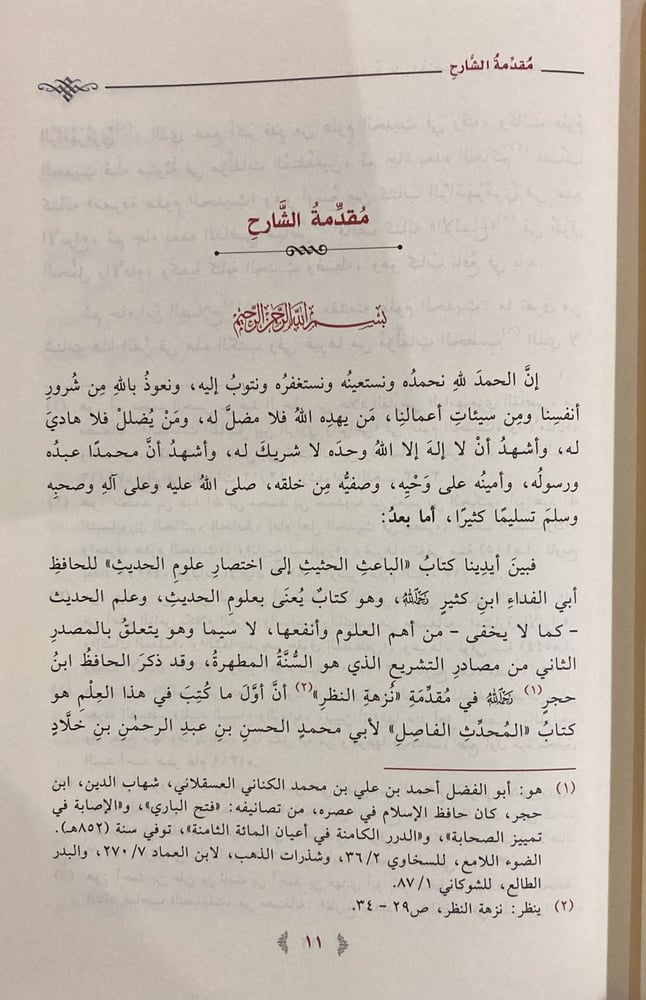
To the virtue of Sheikh Dr. Abdul Karim Al-Khudair - Introduction of the sharh
In the name of Allah, the Most Gracious, the Most Merciful
All praise is due to Allah, we praise Him, seek His help, ask for His forgiveness, and turn to Him in repentance. We seek refuge in Allah from the evil of ourselves and from our bad deeds. Whomever Allah guides, there is no misleader for him, and whomever He misguides, there is no guide for him. I bear witness that there is no deity but Allah alone, with no partner, and I bear witness that Muhammad is His servant and Messenger, His trustworthy on His revelation, His chosen one among His creation. May Allah send peace and blessings upon him, his family, and his companions, and grant them abundant peace.
Then:
Before us is the book "Al-Ba'ith Al-Hatheeth" (The Urgent Motivator) to summarize the sciences of Hadith by the Hafiz Abu Al-Fida Ibn Kathir. It is a book concerned with the sciences of Hadith, and as is well known, the science of Hadith is among the most important and beneficial sciences, especially since it relates to the second source of legislation, which is the pure Sunnah.
The Hafiz Ibn Kathir mentioned in the introduction of "Nuzhat Al-Nazar" (The Delight of the Gaze) that the first written work in this science was the book "Al-Muhaddith Al-Fasil" (The Discerning Hadith Scholar) by Abu Muhammad Al-Hassan Ibn Abdul Rahman Ibn Khalad, may Allah have mercy on him, which compiled the greatest amount of Hadith sciences at his time. Before that, Hadith was scattered across the writings of earlier scholars.
Then came Al-Hakim (2), who authored his book "Ma'rifat 'Uloom Al-Hadith" (Knowledge of the Sciences of Hadith), which is broader than the book of Al-Ramahruni in the number of types. After him, Al-Qadi Iyad (3) wrote his book "Al-Ilam" (The Indication) on the methods of transmission and performance, and how to write and verify Hadith. It is a beneficial book in its field.
Then Ibn As-Salah (4) collected in his introduction the sciences of Hadith: what was scattered in these books and other writings of Al-Khatib (6), who scarcely left any science or type of Hadith sciences except that he wrote an independent book about it. Ibn Nujayt (5) said: "There is no doubt for every wise person that the late scholars of Hadith are dependent on Abu Bakr Al-Khatib."
Those who came after Ibn As-Salah paid attention to his book, so Al-Hafiz Ibn Hajar (3) said: "It cannot be counted how many have composed, summarized, added to, and defended it," and so on.
Al-Nawawi (4) summarized it in his book "Al-Irshad," then he summarized "Al-Irshad" into "Al-Taqreeb," and the Hafiz Ibn Kathir also summarized it in the book I am explaining, which is "Ikhtisar 'Uloom Al-Hadith" (Concise Sciences of Hadith). Al-Hafiz Al-Iraqi (6) organized it in his famous "Alfiyyah" (The Hundred), and Khuwai (7) also composed a poem of about 1,500 lines, but it did not reach the level of the Iraqi Alfiyyah nor did it surpass it. As-Suyuti (2) also has an Alfiyyah in this field, based on the "Iraqi Alfiyyah," many of whose half-lines are taken from it. That is why he says in it: "Read a book from which you learn terminology like this and its origin," referring to Ibn As-Salah's "Alfiyyah."
The writing and classification in the sciences of Hadith continue to this day. Jamal ad-Din Al-Qasimi (4) wrote a good book in this field called "Qawa'id At-Tahdith" (Rules of Hadith). Sheikh Tahir Al-Jazairi (5) also wrote a valuable book that summarized many of the books related to this science, called "Tawjih An-Nazar" (Guidance of the Gaze).
The explanation of the concise sciences of Hadith became famous under the name "Al-Ba'ith Al-Hatheeth," although Sadiq Hassan Khan pointed in his book "Abjad Al-‘Uloom" in two places to attributing the book to the Hafiz Ibn Kathir as "Al-Ba'ith Al-Hatheeth."

From Dammam