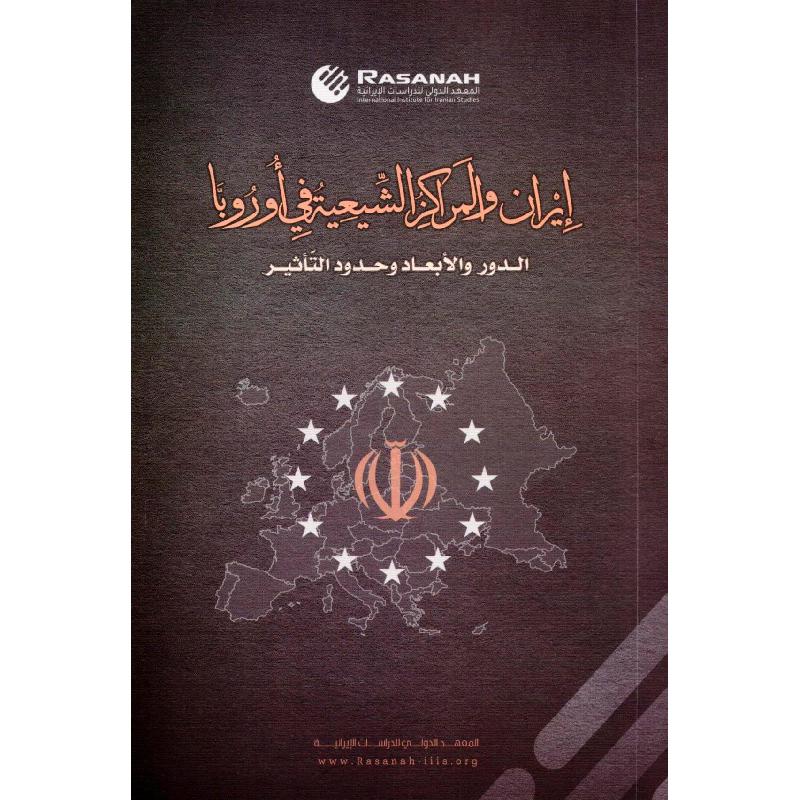
Iran and the Shia centers in Europe
57.50ر.س
Product description
Iran and Shiite centers in Europe
The International Institute for Iranian Studies issued by the International Institute for Iranian Studies "Rasaneh," a book titled "Iran and Shiite centers in Europe... the role, dimensions, and limits of influence." The book, totaling 154 pages, is divided into five chapters. The first chapter (The importance and position of Europe in Iranian strategy) starts from historical significance, as Europe has formed a strategic and political equivalent relied upon by Iran in its regional and international conflicts with competing powers. The geopolitical importance of the European circle is also emphasized, given its great importance to decision-makers in Iran, as it falls within the three vital areas of Iranian strategy. The political importance is due to the significant weight that European countries hold in the international arena. The economic importance is also noted, as relations between Europe and Iran date back thousands of years, despite experiencing some fluctuations depending on political circumstances. The religious perspective is based on the principles of the Wilayat al-Faqih theory, according to Khomeini’s interpretation, expanding the authority to include all Muslims worldwide.
The second chapter (The presence of Shiites in Europe: the distribution map and opportunities available to Iran) monitored the Shiite presence in Western European countries (the United Kingdom, Germany, France, Italy, the Netherlands, Belgium, Spain, Greece, and Austria), then moved on to Shiite presence in Scandinavian countries (Sweden, Denmark, Norway). It also covered Shiite presence in Eastern Europe, formed by Iranian communities resulting from border changes, as a route for Iranian migration to Western Europe, Iranian presence during the Balkan wars, and the transfer of the Iranian opposition People's Mojahedin Organization camp from Iraq to Albania.
The third chapter (Shiite centers and Iranian policies towards Shiites in Europe) started from the philosophy of establishment and its objectives based on ideological reasons, believing that the Wilayat al-Faqih government should someday be a global government. It also documented the institutional relationship between Iran and the Shiite centers under the influence and guidance of Iranian security and intelligence institutions, including the Iranian Revolutionary Guard and the Quds Force. The chapter also outlined the limits of Iranian support for these centers, relying on financial sources from annual budgets, religious and endowment entities under the supervision of the Supreme Leader.
The fourth chapter (Shiite centers and the Iranian agenda in Europe) revealed the role of these centers, their activities, their connection to the Iranian regime, and how they enable Iran to achieve its agenda in the European arena through their presence in Germany, the United Kingdom, France, Norway, Greece, Sweden, Ukraine, Austria, Spain, Italy, Belgium, and Poland.
The fifth and final chapter (Politicization of Shiite centers: results, implications, and reflections on Iran) discussed the outcomes of Iran’s utilization of Shiite centers through several elements. It also addressed European reactions from a geo-security perspective, the stance on the role of these Shiite centers, and the repercussions on Iran.
In conclusion, the publication of this book at this precise timing highlights the international concern over Iran’s infiltration and penetration into societies to serve its project. Despite increasing European awareness of the danger, providing a space for Shiite centers in Europe may enable Iran to employ them to serve its project and expand its influence into other arenas. From this perspective, the book is rich in detailed illustrative information, offers guiding material, and fills an important scientific gap for researchers and interested parties. It also leaves room for the reader to develop a contemporary vision. The book is a collective work involving researchers from the Center for Studies and Research at Rasaneh Institute, edited by Dr. Mohammed bin Saqr Al-Sulami and Professor Mahmoud Hamdi Abu Al-Qasim.

From Dammam
Questions you might have