



Endowments' issues
27.60ر.س
Product description
Authored by Dr. Nasser Abdullah Al-Maiman
Introduction
Praise be to Allah, Lord of the worlds, and peace and blessings be upon our Prophet Muhammad, and upon his family and companions all together; to proceed:
Indeed, Waqf (endowment) is a prominent feature of social solidarity in our noble religion. The Waqf institution has continuously played its tangible role in various aspects of Muslim life from the era of Prophethood until today.
The jurists have extensively discussed the rules of Waqf, and they have established them in ways suitable to their times, ensuring the permanence and continuity of this blessed institution. However, due to the significant changes in methods of investing and managing funds, scholars and practitioners of Islamic jurisprudence must select rulings for Waqf that suit the present era, as it is undeniable that rulings change with the passage of time, especially considering that most Waqf rulings are based on ijtihad, grounded in considering the interest of the Waqf and its rightful beneficiaries within the framework of Sharia.
Among the recent developments in the modern economy are some types of monetary investment, as well as joint-stock companies and financial instruments that occupy a sensitive position in current financial transactions.
Since the nature of Waqf necessitates preserving the original endowment and ensuring its ongoing benefit, which can only be achieved through exploiting and investing the Waqf funds, it became necessary to clarify the Sharia perspective on how to invest Waqf assets using contemporary methods and techniques. Therefore, I have endeavored to explore this field with modest effort, represented in this research.
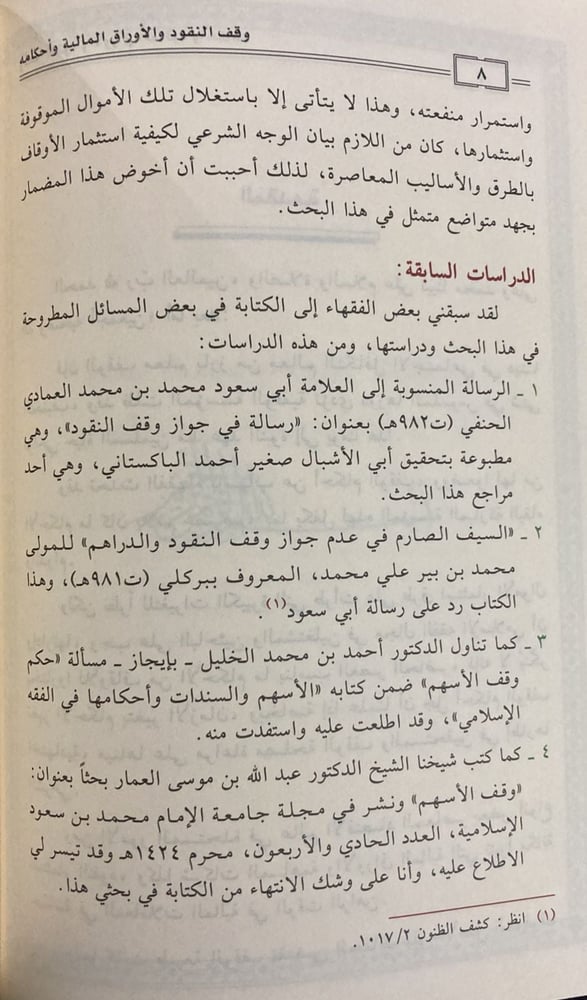
Previous Studies:
Some jurists have preceded me in writing about some issues addressed in this research and studying them. Among these studies are:
1. The treatise attributed to the scholar Abu Saoud Muhammad bin Muhammad Al-Hanafi (d. 982 AH) titled: "A Treatise on the Permissibility of Waqf of Money," published with the verification of Abu Al-Ashbal Saghir Ahmed Al-Pakistani, which is one of the references for this research.
2. "Al-Sayf Al-Sarim in the Prohibition of Waqf of Money and Dirhams for the Lord Muhammad bin Bir Ali Muhammad, known as Barkli" (d. 981 AH). This book responds to Abu Saoud’s treatise.
3. Dr. Ahmed bin Muhammad Al-Khalil briefly discussed the issue of "The Ruling on Waqf of Shares" in his book "Shares, Bonds, and Their Rulings in Islamic Jurisprudence," which I have reviewed and benefited from.
4. Our Sheikh, Dr. Abdullah Al-Ammar, also wrote a research titled: "Ibn Musa Waqf of Shares," published in the Journal of Imam Muhammad bin Saud Islamic University, Issue 41, Muharram 1424 AH. I had the opportunity to review it, and I am close to completing my own research.
Since these studies have addressed some aspects of the topic of Waqf of Money and Financial Securities but did not cover others, I aimed to compile in this research some issues related to Waqf of Money and Financial Securities and their details. I structured it into an introduction, two chapters—each containing six sections—and a conclusion. I also included indices of references and sources, a subject index, and named it "Waqf of Money and Financial Securities and Its Rulings."
May Allah grant success, and reliance is upon Him.
Written by Nasser bin Abdullah Al-Maiman, authored in Mecca, may Allah protect it.

From Dammam