


Studies in the science of rhyme (pure)
37.95ر.س
Out of Stock
Product description
Authored by Dr. Wafa Abdulhafiz Breik
In the name of Allah, the Most Gracious, the Most Merciful.
Praise be to Allah, to whom belongs whatever is in the heavens and whatever is on the earth, and to Him is all praise in the Hereafter. He is the Wise, the Expert.
Peace and blessings be upon the master of the first and the last, our master Muhammad, and upon his family and companions altogether.
Afterwards,
The rhyme (Qafiya) is an important pillar of Arabic poetry, indeed it is the musical peak of the meters of this poetry. Therefore, studying it is very important, even obligatory for anyone dealing with poetic work, whether in composition, analysis, or criticism.
Studying it is no less important than studying the poetry itself, which is the treasury of the Arabs, beyond other arts of speech. The Qafiya will remain prominent, of utmost importance, regardless of the passage of time and despite calls for liberation from it or rebellion against it.
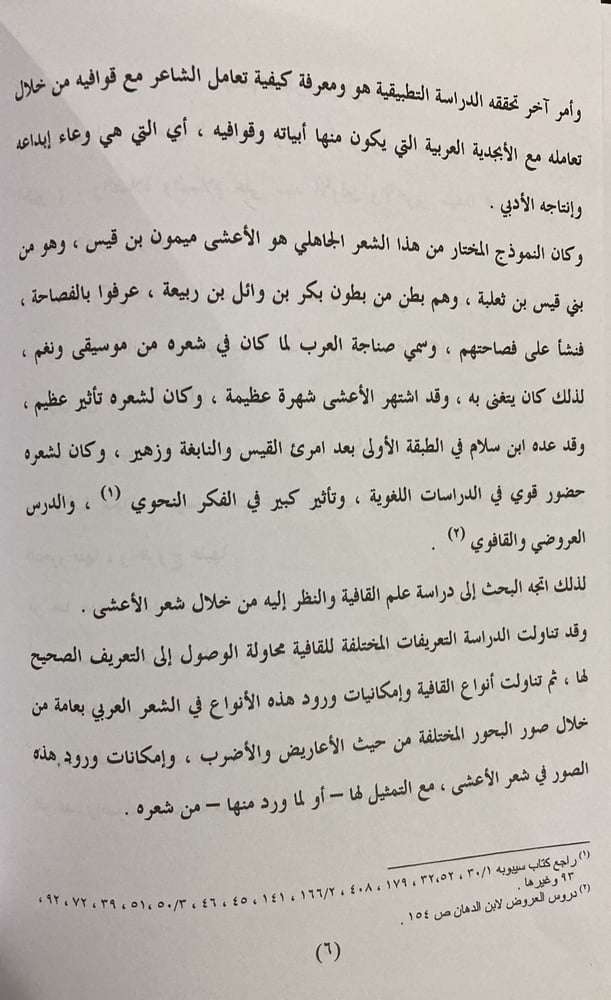
Hence, this applied study of the Qafiya is based on Arabic poetry from one of its most glorious eras, the Pre-Islamic era, the first era of this poetry, to apply the rules of this science — the science of Qafiya.
This Pre-Islamic poetry was before scholars, foremost among them Al-Khalil ibn Ahmad Al-Farahidi — may Allah have mercy on him — during their extraction of issues, formulation of rules, and foundations, and understanding how these rules applied to that poetry.
Another purpose of this applied study is to understand how the poet dealt with his Qafiyas through his interaction with the Arabic alphabet, from which his verses and Qafiyas are formed, i.e., the vessel of his creativity and literary production.
The selected model from this Pre-Islamic poetry is Al-Asha Maimoon ibn Qais, from the Banu Qais ibn Thalabah, a branch of Banu Bakr ibn Wa'il ibn Rabi'ah. They were known for their eloquence, and he grew up with their eloquence. He was called the "Singers of the Arabs" because of the musicality and melody in his poetry, so he used to sing it.
Al-Asha gained great fame, and his poetry had a profound impact. Ibn Salama ranked him in the first tier after Imru' al-Qais, Al-Nabigha, and Zuhayr. His poetry had a strong presence in linguistic studies and a significant influence on grammatical thought.
The study of prosody and Qafiya led to examining the science of Qafiya and viewing it through Al-Asha’s poetry. The study included various definitions of Qafiya, attempting to reach the correct definition. It then discussed types of Qafiya and the possibilities of these types appearing in Arabic poetry in general, through different meter patterns in terms of arud (prosody) and azdah (patterns), and the potential for these patterns to appear in Al-Asha’s poetry, with examples from his poetry or what has been reported of it.
Next, the study covered the letters of Qafiya and their movements, then discussed deviations from the rules of Qafiya, known as "Qafiya defects."
The application area in all this was Al-Asha’s poetry. I used explanatory tables and statistical ratios to demonstrate the abundance or rarity of what appeared in Al-Asha’s poetry, supporting the rules from the prosody scholars, whether in terms of prevalence or the opposite.
The conclusion summarized the research findings.
With this, I hope I have provided a clear picture of Qafiya in Al-Asha’s poetry, laying a foundation for this lofty structure, and affirming the uniqueness of the Qafiya in Arabic poetry, which is based on authentic Arabic poetry from its first era. It also takes a step toward bringing this science closer to its students, lovers of Arabic poetry, and enthusiasts of our beautiful language, Arabic.
"And my success is only by Allah; upon Him I rely, and to Him I turn."
Dr. Wafa Breik

From Dammam
Questions you might have