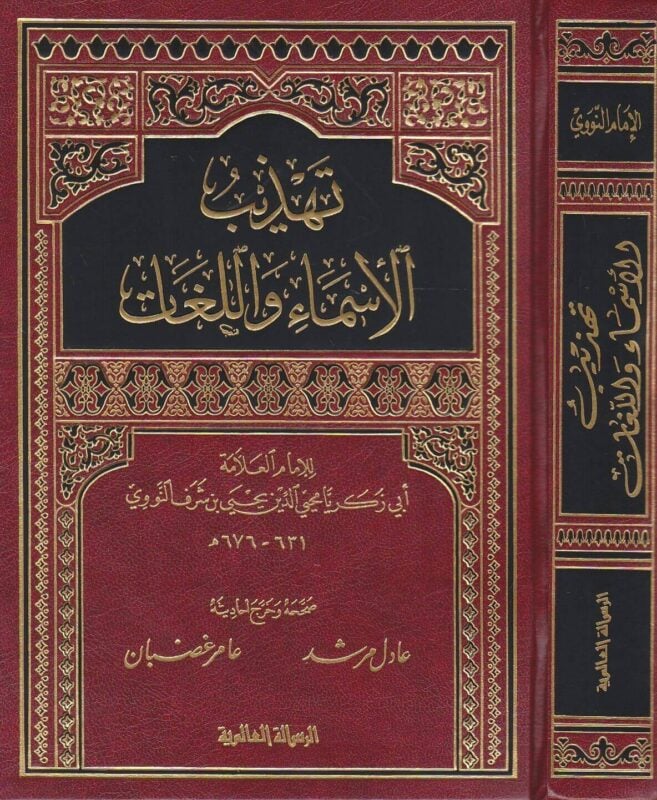

Manners of names and languages
57.50ر.س
Product description
Corrected and output his hadiths.
Adil Murshid General Amr.
Correction of names and languages | Abi Zakariya Mahyiddin Yahya ibn Sharf Al-Nawawi.
Correction of names and languages, a book in language and biographies, and jurisprudence language, authored by Yahya ibn Sharf Al-Nawawi (631 AH - 676 AH).
It discusses expressions and linguistic discussions and biographies of notable figures in the abridgment of Abu Ibrahim Al-Muzani, Al-Muhtadh, Al-Tanbih, Al-Waseet, Al-Wajeer, and Al-Rawdah, an abridgment of the explanation of Al-Wajeer.
It mentions the names of the biographee: males, and it contains eight chapters; for females, it contains seven chapters, and all are arranged alphabetically.
Languages: arranged alphabetically, when translating a person, it mentions their location in the six books and the number of narrations if they have a narration, and the number in Al-Bukhari and Muslim, and the rare issues narrated from him, especially in jurisprudence.
The book includes expressions found in: Abu Ibrahim Al-Muzani's abridgment, Al-Muhtadh, Al-Tanbih, Al-Waseet, Al-Wajeer, and Al-Rawdah.
The author divided the book into two sections: the first on names, and the second on languages.
Then, the names are divided into two types: the first on men, and the second on women.
The first section has eight types.
Types of the first section:
Correct names such as Muhammad, Ibrahim, Ismail, Ishaq.
Nicknames: like Abu Al-Qasim and Abu Bakr.
Lineages, titles, and tribes, such as Al-Zuhri, Quraish, and Khuza'a.
What is said about him: Ibn Fulan or Fulanah or his brother, or his sister, or his uncle or his maternal uncle.
What is said about him: Fulan from his father or grandfather.
What is said about him: the wife of Fulan or the husband of Fulan.
Ambiguous terms like man, sheikh, some scholars, and similar.
Mistakes in names and lineages.
Types of the second section:
The second section is about women, and it has seven types, in the order mentioned for men after excluding the fifth type, as the books on which the book is based do not include Fulan from her mother or grandmother, or from her father or grandfather.
Arrangement of names:
The author arranged the names alphabetically, starting with those named Muhammad, saying: "Founded on Abu Abdullah Al-Bukhari and the scholars after him, may Allah be pleased with them, for the honor of the name of the Prophet Muhammad, peace be upon him," then returning to the usual alphabetical order.
Within each letter, the arrangement also considers the order, so in the letter Al-Hamza, Adam is placed before Ibrahim because, although both start with Al-Hamza, Adam's Hamza is followed by another Hamza, whereas Ibrahim's Hamza is followed by Baa, and the Hamza is prioritized over the Baa.
As for ambiguous terms and errors, it is mentioned that they are presented according to their occurrence in the books related to the book's subject.
Languages:
Arrange languages alphabetically, considering the first and second letters and beyond, prioritizing the original letters without considering added ones, sometimes mentioning some additions in the heading and noting if a letter is extra.
Verification of names and languages:
Verifying names of people, languages, places, and everything needing verification by restricting with vowels, lightening, and emphasis, and noting whether the letter is with a dot or the Arabic Ghayn or similar.
It is indicated that all this will be transferred accurately and refined from its trusted sources and the works of scholars known for their authority in this matter, such as: the history of Al-Bukhari, Ibn Abi Khaythama, Khalifa ibn Khayyat known as Shabab, the large and small biographical dictionaries by Muhammad ibn Sa'd and Al-Waqidi, and others.
Jurisdiction language:
In the introduction to his collection, he states: "And I clarify in it what occurred in the book of expressions of languages, and the names of companions and others from scholars, narrators, and transmitters, in detail at times, and briefly at times according to the circumstances and need.
I compiled in this category a book called Tahrib Al-Asma' wal-Lughat, which includes what relates to the abridgment of Al-Muzani, Al-Muhtadh, Al-Waseet, Al-Tanbih, Al-Wajeer, and Al-Rawdah, which I summarized from the explanation of Al-Wajeer by Imam Abi Al-Qasim Al-Rafi'i, may Allah have mercy on him, from Arabic and non-Arabic expressions, names, terms, labels, rules, and other matters mentioned in these six books.
I also clarify some of what was denied by Imam Abi Ibrahim Ismail ibn Yahya Al-Muzani in his abridgment, and by Imam Abi Hamid Al-Ghazali in Al-Waseet, and by the compiler in Al-Tanbih, with responses if possible, as the need for them is as great as the need for Al-Muhtadh.

From Dammam