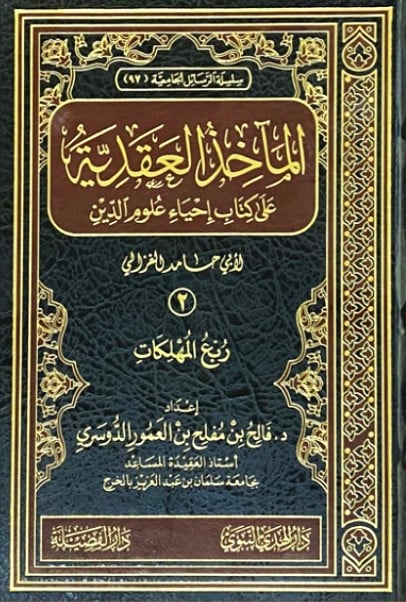

The doctrinal criticisms on the book Revival of Religious Sciences 2
59.80ر.س
Out of Stock
Product description
Preparation by Dr. Fahad bin Mufleh bin Al-Amour Al-Dosari
The doctrinal flaws in the book "Reviving the Sciences of Religion" - Quarter of the destructive
The title of the book: The doctrinal flaws on the book "Reviving the Sciences of Religion" - Quarter of the destructive
Type: Master's thesis - Umm Al-Qura University (1429 AH)
Publisher: Dar Al-Hadith Al-Nabawi – Dar Al-Fadila
Year of printing: 1436 AH – 2015 AD
Number of pages: 353
Introduction to the subject of the book:
Among the most famous books of Abu Hamid Al-Ghazali and the most important is the book "Reviving the Sciences of Religion," which is among the last writings of his pen, and it contains what his knowledge and understanding have reached. In it, he reviews issues of creed in the manner of theologians—Ash'aris— which is contrary to the way of the Salaf, who were not experts in their method and approach in the fundamentals of religion. Al-Ghazali divided the book (Reviving) into four sections: a quarter of acts of worship, a quarter of customs, a quarter of destructions, and a quarter of salvation.
The quarter of destructions includes ten books: the book of explaining the wonders of the heart, the book of disciplining the soul, the book of the afflictions of lusts: the lust of the stomach and the lust of the private parts, the book of the afflictions of the tongue, the book of the afflictions of anger, hatred, and envy, the book of the blame of the world, the book of the blame of money and stinginess, the book of the blame of status and showing off, the book of the blame of arrogance and pride, the book of the blame of vanity.
This week's book is one of the books that documented the errors and transgressions of Al-Ghazali in this quarter of his book "Reviving the Sciences of Religion."
The author divided the book into an introduction, a preface, two chapters, and a conclusion.
In the introduction, he mentioned the importance of the subject, the reasons for choosing it, and the methodology he followed in his research, which can be summarized as follows:
- Observing the division of the book's chapters and their correspondence with Al-Ghazali's sections in the quarter of destructions to facilitate access and research.
- Analyzing the book, then collecting the doctrinal flaws according to the order of the book, and discussing them in light of the Qur'an, Sunnah, and the sayings of the imams of the Salaf.
- Introducing the sects, schools, and notable figures mentioned in the research, among other familiar matters in such studies.
The author pointed out that he relied on the printed copy of "Reviving the Sciences of Religion," published in five volumes by Dar Al-Hadith in Cairo.
In the preface, he clarified that responding to the opponent is from kindness, not from aggression; he also noted that when printing the thesis, the first chapter about the translation of Al-Ghazali and the speech of scholars about him and his book "Reviving the Sciences of Religion" was omitted, relying instead on what Dr. Abdullah Al-Otaibi mentioned in his book "The Doctrinal Flaws on the Book Reviving the Sciences of Religion—Quarter of Acts of Worship and Quarter of Customs."
Thus, the beginning of the published part of the thesis was from the section on the general stance of the Salaf regarding Al-Ghazali's words in the quarter of destructions, emphasizing the importance of purifying the souls among the Salaf and highlighting the characteristics of their approach to purification, including:
- Their source of guidance in behavior and morals is the Book of Allah and the Sunnah of His Messenger (peace be upon him).
- Their consideration of the state of the Prophet (peace be upon him) and his noble companions (may Allah be pleased with them).
- Understanding the legal terms in their true sense without exaggeration or negligence, among other traits.
Then he discussed the criticism of the Salaf of the methodology of Sufis in purifying the souls, ending this section with general flaws documented against Al-Ghazali in the quarter of destructions, including:
- His interpretation of Qur'anic verses through Sufi symbolic interpretation, and that his knowledge of Hadith is mixed.
- His frequent citing of Israeli narrations.
- His reliance on the states of worshippers, giving them precedence over prophetic Hadiths.
- His influence by philosophy and Kalam.
- His disdain for knowledge and scholars.
As for the second chapter, the author dedicated it to mentioning the doctrinal flaws in the section of the quarter of destructions from "Reviving the Sciences of Religion," which came in four sections:
The first section discussed the doctrinal flaws in Al-Ghazali's words about the states of hearts and the discipline of the soul, talking about the doctrinal flaws in his words about the heart and the spirit.
He then discussed the doctrinal flaws in his words about faith, stating that faith has three levels, and that anyone whose faith exceeds a certain weight will not enter the fire, among other issues he criticized in Al-Ghazali.
The author also mentioned the doctrinal flaws in Al-Ghazali's words about the attributes of Allah, discussing Al-Ghazali's statement (that Allah loves and is loved), and refuted it by saying that loving Allah سبحانه is love of glorification, reverence, worship, and exaltation. Anyone who reaches the level of mad love has exceeded bounds and disrespected his Lord.
He also critiqued Al-Ghazali's interpretation of the attribute of the fingers of the Most Merciful and his words that suggest union and subsistence.
He addressed Al-Ghazali's reliance on inspiration and revelation, clarifying that in Sufi terminology, revelation means perceiving what is beyond the veil of the unseen and the true matters of existence and witnessing. He discussed the reality of revelation according to Al-Ghazali, how it occurs, and examined Al-Ghazali's evidences for it.
The author also criticized Al-Ghazali's support for solitude and seclusion, and his call for silence and speaking only when necessary, arguing that absolute silence is not commanded, nor is speech entirely forbidden; the Prophet (peace be upon him) said: "Whoever believes in Allah and the Last Day, let him speak good or remain silent," among other issues.
The second section was dedicated to mentioning the doctrinal flaws in the books of the flaws of the tongue, and the blame of anger, hatred, and envy, starting with the doctrinal flaws in the book of the flaws of the tongue, mentioning issues such as: exaggeration in condemning speech about what does not concern, and exaggeration in condemning laughter, among other issues.
Then he followed with the doctrinal flaws in the books of blame of anger, hatred, and envy.
In the third section, he discussed the doctrinal flaws in the book of blame of the world, and the book of blame of stinginess and love of money, criticizing Al-Ghazali's statements about the blame of the world as an enemy of Allah, and criticizing the strange and contradictory stories about Owais Al-Qarani and Hurm bin Hiyan, which Sufis have turned into legends to attach everything to them, claiming miracles, visions, and strange phenomena, with no evidence except fabricated hadiths.
He also criticized Al-Ghazali's doctrinal flaws in the book of blame of stinginess and love of money, including his narrow view that hidden shirk is only minor, clarifying that hidden shirk can sometimes be major, and some major shirk is hidden. He supported this with evidence and then discussed what Al-Ghazali mentioned about the hadith of the Awliya (Friends of Allah), responding that the hadiths of the Awliya, despite their diversity, are weak, some are fabricated and false.
The author also criticized Al-Ghazali's acceptance of Sufi corners and other issues.
The fourth and final section was about the doctrinal flaws in the book of blame of arrogance, showing off, pride, and vanity. It started with the doctrinal flaws in the book of blame of arrogance and showing off, mentioning issues such as: criticizing what Al-Ghazali mentioned about the Sufis' shouting, yelling, listening to music, and dancing, and his approval of that. The author responded that these matters were not known among the Companions (may Allah be pleased with them), nor was this the state of the Prophet (peace be upon him).
He then discussed the doctrinal flaws in Al-Ghazali's views on pride, arrogance, vanity, and self-conceit, criticizing the story of Prophet David (peace be upon him) and the falsehoods it contains, including: violating neighbors' rights and Prophet David's assault on a foreign woman. The author responded that the verified scholars of Tafsir reject this story and judge it to be false and corrupted, citing their opinions on that, among other issues.
The conclusion presents the most important results of the research, including:
- That Al-Ghazali's biography and his shifting between philosophy, Kalam, and Sufism clearly indicate his confusion and the possibility of error in his writings and books; therefore, there is no need to object to his fanatic followers and exaggerators.
- That most of Al-Ghazali's apparent deviations are due to his lack of knowledge of the Salaf's interpretation of Allah's Book; he interprets verses and uses them to support Sufi principles and behavioral violations.
The book is good in its field.

Questions you might have


