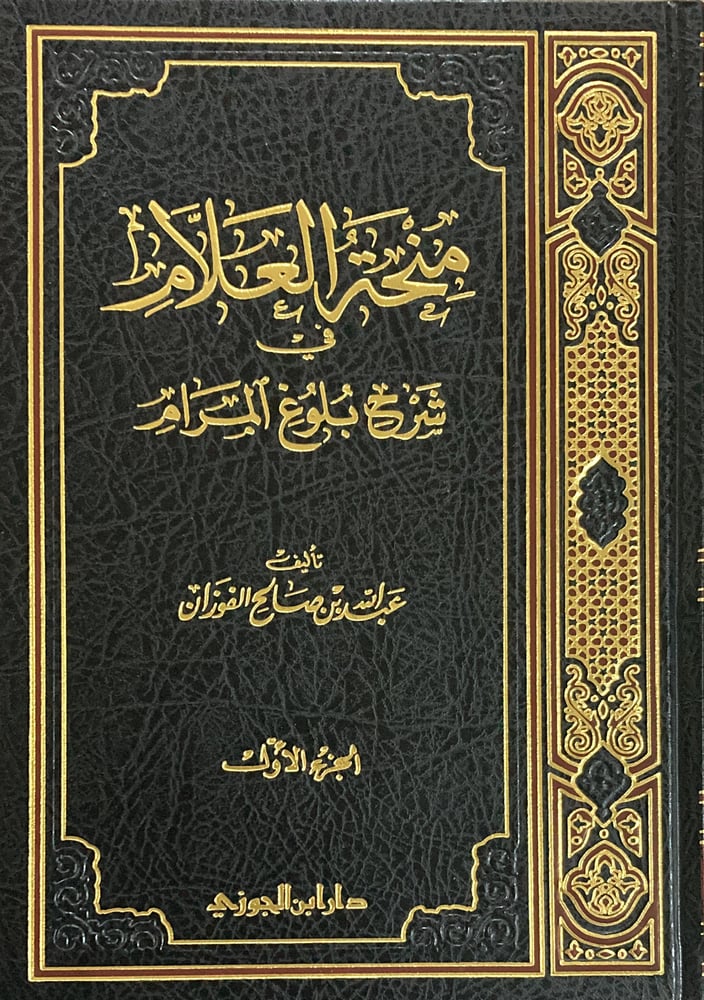
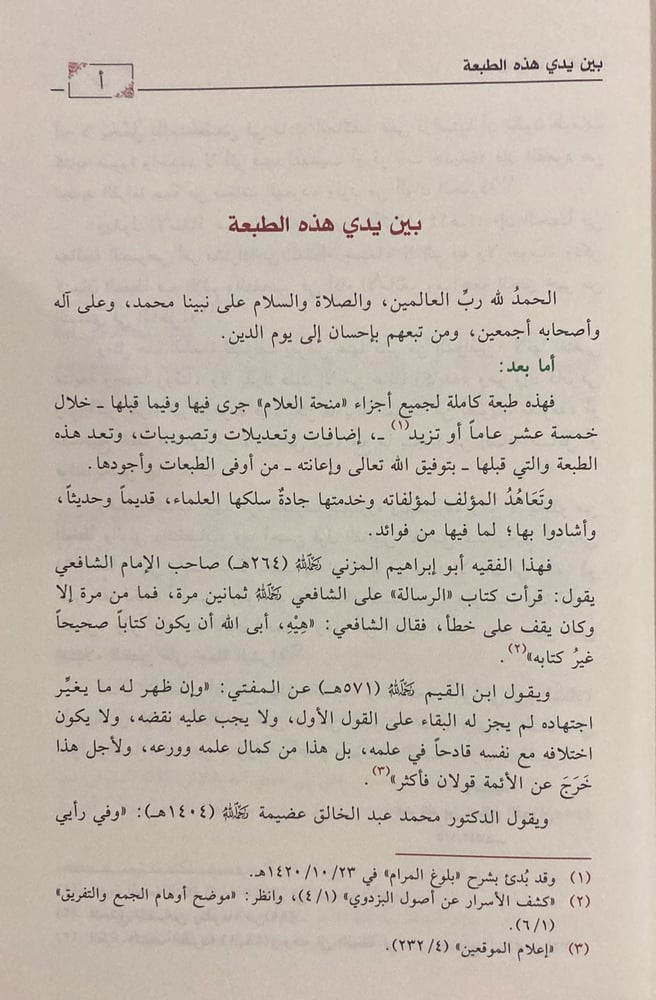
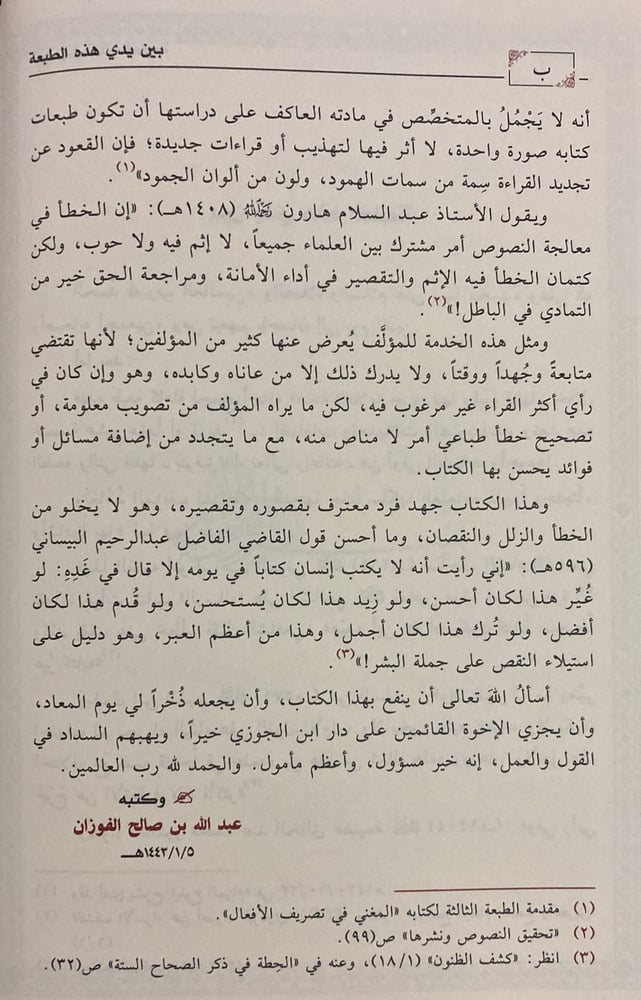
The grant of the العلام شرح بلوغ المرام volume 1
50.60ر.س
Product description
To Sheikh Abdullah Saleh Al-Fawzan
All praise be to Allah, we praise Him, seek His help, ask for His forgiveness, and seek refuge in Allah from the evil of ourselves and from the bad of our deeds. Whom Allah guides, there is no misleader for him, and whom He misguides, there is no guide for him. I bear witness that there is no deity but Allah alone, with no partner, and I bear witness that Muhammad is His servant and Messenger. Allah’s blessings and peace be upon him, and upon his family, his companions, and those who follow them with goodness until the Day of Judgment.
As for what follows:
Knowledge is the noblest of pursuits and the greatest of desires, through it the servant reaches the stations of the righteous and the pious, and the highest ranks in this world and the Hereafter. Among the noblest sciences and the highest in rank — after the Book of Allah — is the knowledge of the Sunnah of the Messenger of Allah, peace and blessings be upon him, in narration and understanding, as they are the foundation for deriving Islamic rulings.
The predecessors paid attention to this type of evidence and adopted various methods in their writings on it. One of these methods was to restrict to the Hadiths of Islamic rulings, and to isolate them from Hadiths related to beliefs, wars, virtues, manners, and others, to facilitate memorization for students and to make it easier during the process of evidence derivation. Among those who wrote according to this method is the Hafiz Ahmad ibn Ali ibn Hajar Al-Asqalani (may Allah have mercy on him), who died in the year 852 AH. He compiled in his book "Buloog al-Maram min Adillah al-Ahkam" (The Reached Goals from Evidence of Rulings) the fundamentals of Hadiths of Islamic rulings, arranged them according to well-known jurisprudential chapters, to make it easier for the reader to review them. He did not limit himself to authentic Hadiths but also included some weak Hadiths so that the student of knowledge would know what has been reported in the matter from weak Hadiths. Knowing the authentic is knowledge, and knowing the weak is also knowledge. He aimed for the student to strive in studying them, and if there were supporting evidences or other chains, he examined them to see whether some could strengthen others or not.
The Hafiz confined himself to general books and chapters without assigning a title to each Hadith — as Al-Majd ibn Taymiyah did in "Al-Muntaqa" — and mentioned at the end the book "Al-Jami" for manners, as if he intended to provide the student of knowledge with these Hadiths after memorizing the Hadiths of rulings, as they are most in need of them. The number of Hadiths in the book reached 1,568, and this number may increase or decrease depending on the different editions of the book or differing views on the narrations and reports.
This book has many advantages, which the observer and the thoughtful can derive. Among the most prominent are:
1. He arranged his books, chapters, and Hadiths according to the jurisprudential chapters, mentioning the name of the book, then the chapter, then listing the relevant Hadiths. Sometimes he mentions the name of the book and then lists the Hadiths without specifying the chapter, as he did in "Funeral" and the beginnings of "Zakat," "Sawm," "Nikah," and others.
2. He limited himself to the raised Hadiths and mentioned only a few Muwatta (stopped) Hadiths, as in the "Nikah" book, "Ilaa" chapter, "Iddah" chapter, and others.
3. He summarized long Hadiths beautifully, without changing the wording or delaying the mention of later parts, focusing only on the point of evidence.
4. He omitted the chains of narration, focusing only on the highest narrator, and sometimes mentioned those before him for a purpose, which is very rare.
5. He clarifies the status of the Hadith as authentic, good, or weak, mostly by quoting others or judging himself. This is one of the most important features, although he rarely explained the reason for weakness, perhaps for brevity. This feature was absent from Al-Majd ibn Taymiyah in "Al-Muntaqa," who only summarized the chains and explained their sources without indicating their grades.
6. Sometimes he mentions what is in the chains of narration from sendings or interruptions or stopping, and he may prefer one over the other if the Hadith has more than one chain, all in a concise manner.
7. Occasionally, he mentions related narrations and Hadiths that support the original Hadith, and he does so only for benefit, such as restricting an absolute, elaborating on a vague, clarifying a concealed matter, or resolving a contradiction. I paid much attention to this aspect, mentioning the Hafiz’s purpose in citing these narrations after the original Hadith, which I believe the commentators overlooked.
Allah has granted this book acceptance among scholars old and new. Scholars praised it, students circulated it, and they committed it to memory. It was taught in some curricula, and scholars explained and clarified it. It was also served from a hadith perspective by authenticating and referencing its Hadiths to their sources, among other efforts.
My method in explaining the book is as follows:
First: I discuss each Hadith in the form of points, after giving a title for the Hadith that defines its subject and clarifies its meaning. The points are:
* The first point: in the biography of the narrator, to briefly identify him.
* The second point: in authenticating the Hadith of the chapter, relying on the sources mentioned by the Hafiz, arranged as he mentioned, unless there is a reason to add more, by indicating its location in the volume or page, or simply by the number if sufficient. I may mention the name of the book and chapter with the number to clarify the subject and location of the Hadith, especially in "Sahih al-Bukhari," "Sahih Muslim," and the Sunan. Note that the chapters in "Sahih Muslim" are not from him. Then I cite the chain of narration, including only what is necessary, and may mention the wording of the Hadith from its source if the Hafiz did not mention it fully or if there is some difference. Then I judge the Hadith as the Hafiz did, with additional comments from scholars, and I sometimes mention the related narrations that the Hafiz includes after the original Hadith, explaining the purpose of citing them. If the Hadith has other narrations useful for deriving rulings, I usually mention them.
* The third point and beyond: concerning issues related to the Hadith, starting with explaining the words of the Hadith and including the biographies of those mentioned in the text.
Second: I limit myself to the jurisprudential issues derived from the Hadith, without diverging into other issues, because the aim is to clarify the jurisprudence of the Hadith, not to list all jurisprudential matters. This is the domain of fiqh books. I avoid lengthy elaboration to prevent increasing the size of the book. I usually mention references for jurisprudential issues, and what I have quoted from Sheikh Abdul Aziz bin Baz, may Allah have mercy on him, is attributed to its source. Otherwise, it is from the Sharh "Al-Buloog" recordings. At the end of the book, there will be comprehensive indexes, God willing.
Third: I do not address controversial issues or debates over evidence; I only mention the chosen opinion supported by evidence and avoid what lacks proof unless the disagreement is strong or the Hafiz mentioned evidence for both sides within his book, for example. I then clarify the preferred opinion to resolve apparent contradictions that might be inferred from the evidence of one side or the other.
Finally, I ask the dear reader, if he notices any slip of the pen or misunderstanding in what I have written, to write to me with reward and gratitude, so I can correct it in the future. The ears are listening, and the chest is open. Human writings are prone to error, and shortcomings are inevitable. I named this explanation: "The Gift of the Scholar in Explaining Buloog al-Maram."
I ask Allah to make my work sincere, purely for His face, beneficial for His servants, and to send blessings and peace upon our Prophet Muhammad, his family, his companions, and those who follow them with goodness until the Day of Judgment.
Written by Abdullah bin Saleh Al-Fawzan
Al-Qassim - Buraidah

From Dammam