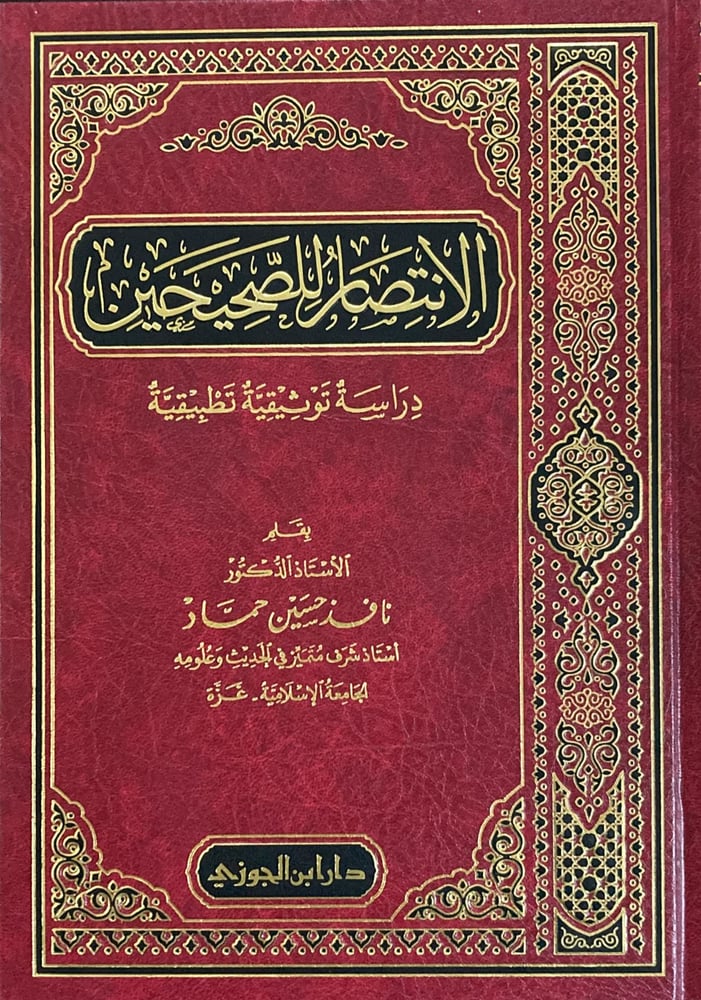


The victory for the two authentic collections: an analytical documentary study
75.90ر.س
Product description
By Dr. Nafez Hussein Hamad
In the name of Allah, the Most Merciful, the Most Compassionate
Introduction
Praise be to Allah, Lord of the worlds, and prayers and peace be upon the Messenger of Allah, and after:
It is known that the two authentic collections, Al-Bukhari and Muslim, have held a high status among scholars across centuries and up to our time. They are the most authentic two collections in Hadith, prioritized over all books of Sunnah, and the first compiled in "Al-Sahih" purely. They contain the highest conditions of authenticity, with no peer in Hadith compilations. The nation has accepted them because of their great importance in producing the authentic Hadith.
The two Sheikhs set constraints and standards as criteria that control whether a Hadith is authenticated or not. These standards are so precise that they lead to certainty that every Hadith in their books is authentic without the slightest doubt.
Scholars of Hadith praised the two Imams and their authentic collections, and their consensus is that the "Al-Sahihain" are the most authentic books after the Book of Allah. Imam Al-Bukhari, the leader of the scholars in Hadith, the mountain of memorization, is the Imam of precision, the owner of the highest level in the revelation: Hadith, knowing the names of narrators, their classifications, their narrations, and their states. He was known for his strong memory, sharp mind, broad knowledge, and sound judgment. He was a rare figure of his time and a wonder of the world, as testified by the Imams from his teachers, peers, students, and those after them.
Al-Tirmidhi, his student and disciple, said: "I have not seen anyone in Iraq or Khorasan in the meaning of defects and history and knowing the chains of narration more knowledgeable than Muhammad ibn Ismail."
Muhammad ibn Ishaq ibn Khuzaymah said: "I have not seen anyone under the sky more knowledgeable of the Hadith of the Messenger of Allah and more memorizing of it than Muhammad ibn Ismail."
Al-Hakim said: "He is the Imam of the people of Hadith without dispute among the transmitters."
Al-Hazimi said: "As for Al-Bukhari, he was unique of his era, a peer of his time, meticulous, critical, investigative, and thorough. After understanding his status in this matter, there is no way to object to him in this field."
Ibn Kathir said: "He is the Imam of the people of Hadith in his time, the one to be followed in his era, and the most advanced among his peers and colleagues."
May Allah have mercy on him, he was an Imam in Hadith, its sciences, its men, and jurisprudence. He was among the early scholars in the science of Hadith, both in narration and understanding and criticism. His writings in the science of men include many critical terminologies.
All of the above motivated me to write this book, which contains four chapters in twelve sections; three sections on the issue of the authenticity of hearing and its denial between the student and the teacher, two sections on two trustworthy narrators who weakened in specific cases, six sections on narrators weakened or described as ignorant, and a final section on those described as ignorant, as follows:
Chapter One: Connection and interruption in Al-Bukhari and Muslim. It includes three sections:
- Section One: Denial of the trustworthiness of narrators' hearing from the teachers, an applied study on Al-Bukhari.
- Section Two: The differing students of Aisha in hearing from her, an applied study on "Al-Sahihain."
- Section Three: The teachers of Qatada who spoke about hearing from them, an applied study on "Al-Sahihain."
Chapter Two: Weak or ignorant narrators and "Al-Sahihain." It includes four sections:
- Section One: The impact of Sulaiman ibn Ayyub's mixing on his narrations in the six books.
- Section Two: The teachers of Maimun ibn Rashed and their weakened students, an applied study on "Al-Sahihain."
- Section Three: Sulaid ibn Sulaid in the critic’s scale and a study of his narrations in "Sahih Muslim."
- Section Four: Those described as ignorant outside the companions in the men of Imam Al-Bukhari, a documentary study.
Chapter Three: Narrators accused of fabrication in "Al-Sahihain." It includes three sections:
- Section One: Repairing the breach of the narrations of those accused of fabrication, who were uniquely narrated by Al-Bukhari over Muslim.
- Section Two: Narrators in "Al-Sahihain" accused by Ibn Hibban of fabrication or similar, a documentary study.
- Section Three: Ismail ibn Abi Uwais in the critic’s scale and the stance of the two Sheikhs towards him in their authentic collections.
Chapter Four: The meaning of specific terms in the men of "Al-Sahihain." It includes two sections:
- Section One: The meaning of the term "not relied upon" (لا يُحْتج به) according to Abu Hatim, an applied study on narrators whose hadiths are agreed upon in the two collections.
- Section Two: The meaning of a term with wondrous implications among the leading critics, a theoretical and applied study.

From Dammam