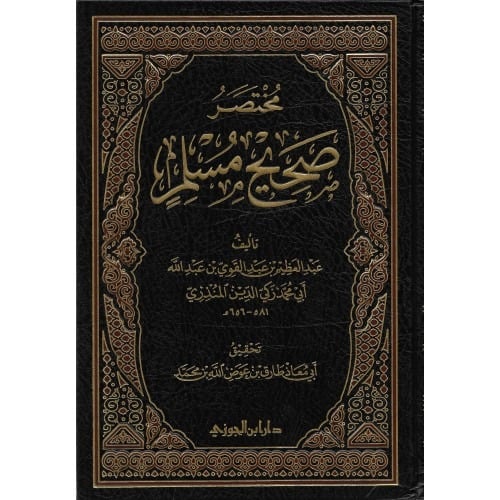

A concise explanation of Sahih Muslim by Al-Mundhiri
75.90ر.س
Product description
Compilation by Abdul-Azeem bin Abdul-Qawi Al-Mundhiri
Verification by Abu Moaz Tareq Awad Allah bin Muhammad
Introduction
In the name of Allah, the Most Merciful, the Most Compassionate.
All praise is due to Allah, we praise Him, seek His help, and ask His forgiveness. We seek refuge in Allah from the evil of ourselves and from the bad of our deeds.
Whom Allah guides, there is no misguidance for him, and whom He misguides, there is no guidance for him.
I bear witness that there is no deity but Allah alone, with no partner, and I bear witness that Muhammad is His servant and Messenger.
After:
It is well known to the people of knowledge that the authentic collection of Imam Muslim ibn al-Hajjaj, may Allah have mercy on him, holds a great place among the books of the Sunnah and Hadith.
He is the second most authentic book after the Book of Allah. Imam Muslim excelled in collecting the narrations of each Hadith with different wordings and routes in one place, which is the closest place for Hadith and the most similar to the chapters, arranging his narrations according to the strongest and strongest, and distinguishing between the narration of each narrator from others, explaining the words of each narration.
The narration that increased from one narration to another in chain or text, knowledge of which is essential to know and understand, and it is not enough to know it and be aware of it.
Therefore, the correct collection of Imam Muslim is the most beneficial and closest to the goal of those seeking to memorize Hadith.
Since ancient and modern scholars have paid attention to it, from those who explain it to those who summarize it, and those who comment on it, and those who condense it.
The best summaries of this authentic collection are the summary of Imam Al-Mundhiri, may Allah have mercy on him.
This summary has been accepted among scholars and sought after. I saw the necessity of caring for it and producing it in a suitable form, with commentary that opens its mysteries, explains its strange words, and helps the seeker to understand his goal from it in the easiest and simplest way.
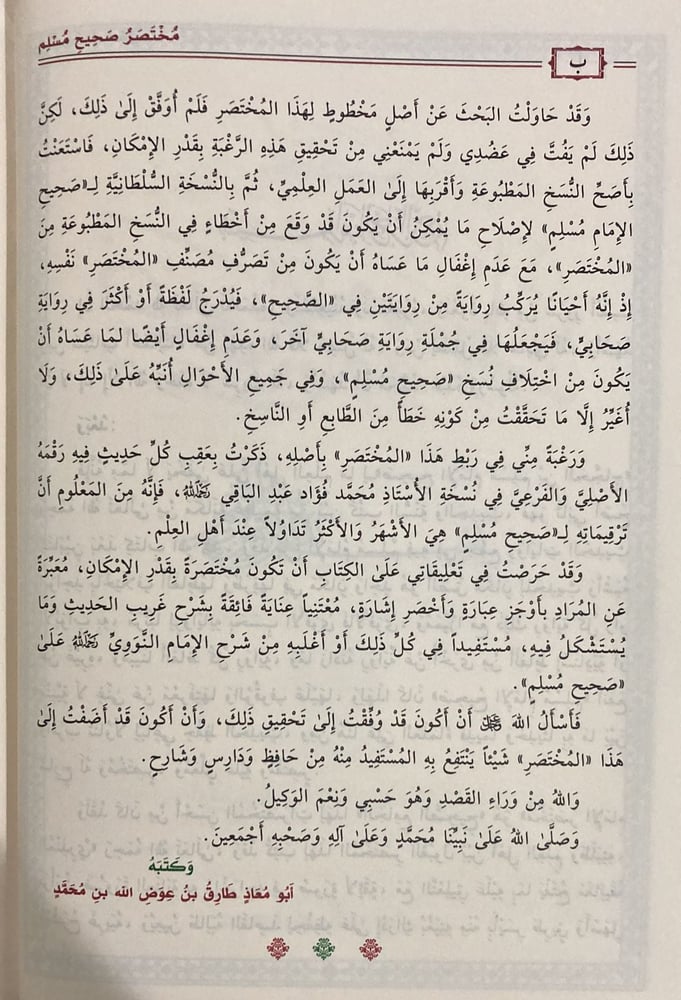
I tried to find the original manuscript of this summary, but I was unsuccessful. However, that did not weaken my resolve nor prevent me from verifying this desire as much as possible.
I relied on the most authentic printed copies closest to scholarly work, then on the Sultan copy of Sahih Imam Muslim to correct what might have been errors in the printed copies of the summary, and to not overlook what might have been from the author's own alterations, as sometimes a narration from two different chains in Sahih is combined, or a word or more is inserted into a narration of a companion, making it part of another companion's narration, and also not neglecting what might be from differences in copies of Sahih Muslim, and in all cases, I point this out.
I only change what I have confirmed to be an error from the printer or the copyist.
Out of my desire to connect this summary to its original, I mentioned after each Hadith its original and branch number in the copy of Professor Muhammad Fuad Abdul-Baqi, may Allah have mercy on him.
It is well known that his numbering for Sahih Muslim is the most famous and most circulated among scholars.
I have endeavored in my comments on the book to be concise as much as possible, expressing the intended meaning in the briefest words and shortest indication, with great care in explaining the strange words of the Hadith and what is confusing in it, benefiting from the explanation of Imam An-Nawawi, may Allah have mercy on him, on Sahih Muslim.
I pray to Allah that I have succeeded in verifying that, and that I have added to this summary something beneficial for the one who preserves, studies, and explains it.
And Allah is the supporter, and He is sufficient for me and the best disposer of affairs.
May Allah send blessings upon our Prophet Muhammad, and upon his family and all his companions.
It was written by Abu Moaz Tareq bin Awad Allah bin Muhammad.