
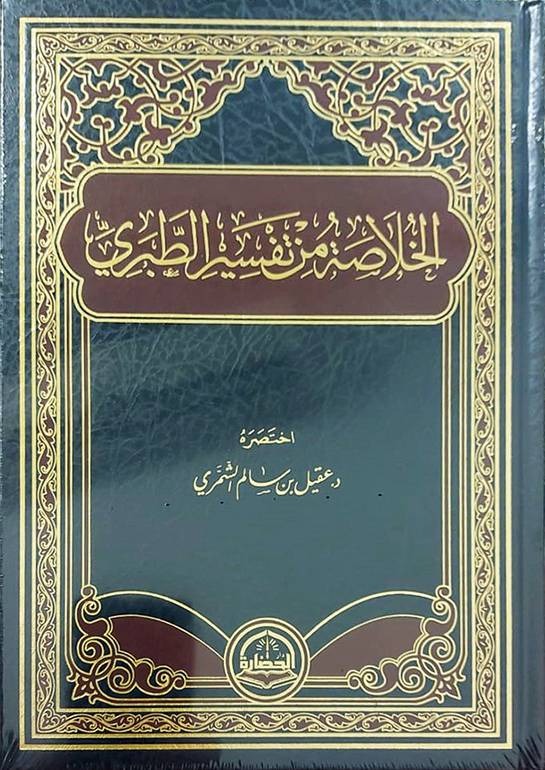
The summary of Tafsir al-Tabari
98ر.س
Out of Stock
Product description
It is summarized by Dr. Aqeel bin Salem Al-Shammari, and it is in a pleasant volume that the author collected the sayings of Imam Al-Tabari in interpretation, where he adhered to the summary of Imam Al-Tabari's phrase in his interpretation of the Quran, as Al-Tabari's interpretation is a great book, lofty in status, and some students of knowledge have abandoned it due to the large size of the book (20 volumes). So, Dr. "Aqeel Al-Shammari" compiled a concise version of the Imam's sayings for each verse only, and made it in the form of the Mushaf. We find that Al-Tabari's interpretation is one of the most noble transmitted interpretations, and the greatest in value, and he is an adherent Imam, supporting the Salafi methodology, and he has supported it with evidence, and he committed to mentioning narrations with their chains, and he generally does not judge on them, and he mentions jurisprudential rulings and the sayings of scholars, and he prefers between them. And Al-Tabari - رحمه الله - has a fixed methodology in interpreting repeated verses, and this in all of the Quran his interpretation hardly ever differs, and thus Al-Tabari makes the interpreter's craft, and enables the reader to formulate the interpretation. Therefore, it was important for a student of knowledge to review Al-Tabari's interpretation, and to be nurtured on the authentic methodology of interpretation. The work of the author in this summary focused on the following: 1) Preserving Al-Tabari's phrase in his interpretation, except what pertains to particles of meaning or connecting pronouns. 2) Limiting himself to what Al-Tabari preferred when mentioning the disagreement among interpreters. 3) Usually mentioning all opinions if Al-Tabari did not prefer one of them. 4) Limiting himself in Al-Tabari's interpretation to reading Hafs from Asim, whether Al-Tabari preferred it or just directed it, as in the saying of Allah Almighty: "And the grain with its husk and the fragrant herbs" [Ar-Rahman: 12]. 5) Repeating Al-Tabari's interpretation of similar verses, such as: "The Most Merciful, the Most Compassionate," because Imam Al-Tabari refers to the first occurrence of it. 6) The author was keen to reduce sentences without losing the meaning and to achieve the intended purpose of Imam Al-Tabari's speech. The author of the interpretation is Muhammad bin Jareer bin Yazid bin Ghalib, known as Imam Abu Jafar Al-Tabari, (224 AH - 310 AH - 839 - 923 AD), an interpreter, historian, and jurist, nicknamed Imam of the interpreters. He was born in Amol, the capital of the Tabaristan region, traveled to Ray, Baghdad, Kufa, Basra, and went to Egypt, then to Fustat in 253 AH, and studied with its scholars the sciences of Malik, Shafi’i, and Ibn Wahb. He returned and settled in Baghdad. Al-Khatib Al-Baghdadi said: "He was a memorizer of the Book of Allah, knowledgeable of the readings, insightful of meanings, jurist in the rulings of the Quran, knowledgeable of the Sunnah and its methods, authentic and weak, abrogating and abrogated, familiar with the sayings of the Companions and the Tabi‘un, and those after them of the dissenters in rulings, and the issues of halal and haram, knowledgeable of the days and news of people." He was offered judgment but refused, and the injustices he refused. He authored many works, and Yaqut Al-Hamawi said: "We found in his inheritance more than eighty parts in his precise handwriting," including: "Differences of the scholars of the cities," which was the first book Al-Tabari wrote, and he used to say about it: "I have two books that a jurist cannot do without: Al-Ikhtilaf and Al-Lateef." He also authored "Jami' Al-Bayan in the interpretation of the Quran," known as Al-Tabari's Tafsir, "History of Nations and Kings," known as Al-Tabari's History, "Tahdhib Al-Athar," "Dhayl Al-Madhil," "Lateef Al-Qawl in the rulings of the Shariah," "Basit Al-Qawl in the rulings of the Shariah," "The Book of Readings," "Sarih Al-Sunnah," "Al-Tabsir fi Ma'alim Al-Din," and he died in the month of Shawwal in 310 AH and was buried in Baghdad. The concise is Dr. "Aqeel bin Salem bin Aqeel Al-Shammari," a graduate of the College of Shariah from Imam Muhammad bin Saud Islamic University, holding a master's degree from the College of Education at King Saud University - Department of Tafsir and Hadith, and also obtained a PhD from King Saud University - specializing in Tafsir. He is a member of the Committee for Testing Imams and Preachers in the Department of Endowments, Mosques, Da'wah, and Guidance in Hawtat Bani Tamim, and a member of the Advisory Committee in the Department of Endowments, Mosques, Da'wah, and Guidance in Hawtat Bani Tamim, and the head of the Department of Da'wah and Guidance in the Department of Endowments, Mosques, Da'wah, and Guidance in Hawtat Bani Tamim.

From Dammam