

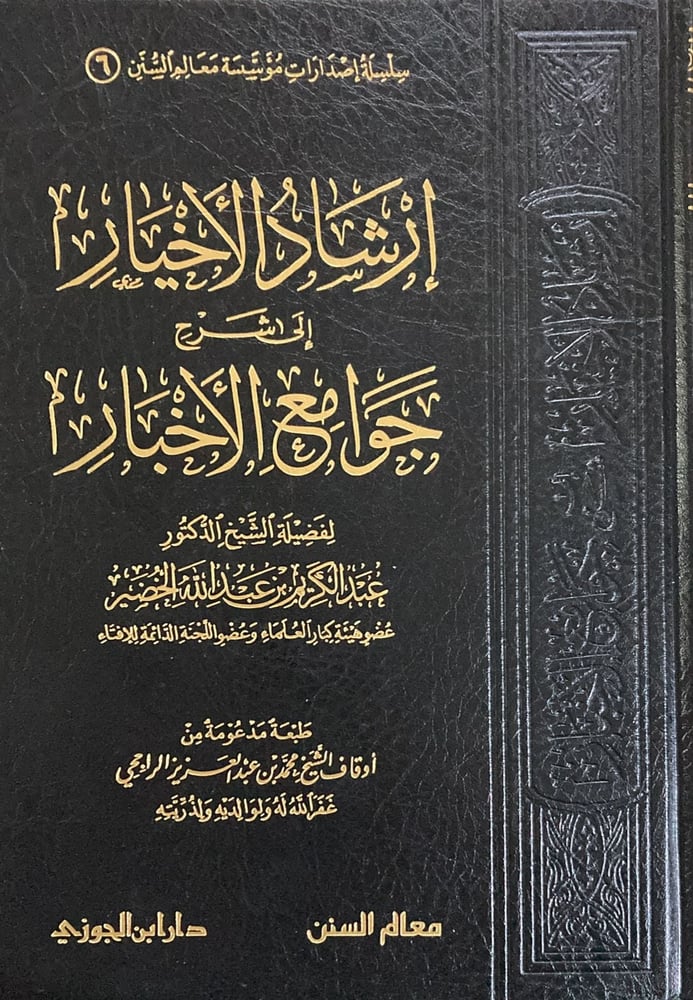

Guidance of the righteous, explanation of the comprehensive news (Pure)
25.30ر.س
Product description
Praise be to Allah, Lord of the worlds, and prayers and peace be upon His servant and Messenger, our Prophet Muhammad, and upon his family and companions all together. To proceed:
I have authored many writings on the topic of recording the Sunnah, and the types of compilations, and the methods and objectives of their authors. There is no need to prolong here by mentioning them. Instead, we note that after the era of recording, during which the original books that narrate the hadiths with chains of narration were written, the ambitions of scholars fell short of studying them, let alone memorizing them. Therefore, scholars turned to simplifying and facilitating them for learners, so they authored concise summaries devoid of chains of narration in all branches of religion; so that students of knowledge could memorize them. They wrote in beliefs, worship, transactions, jihad, manners and trials, apocalyptic signs, spiritual purification, and other branches of religion included in the saying: "Whom Allah intends good for him, He makes him understand the religion" (1).
Thus, memorizing these summaries and studying them became a serious pursuit for learners, guided by their teachers. They start with the most concise ones, then the longer ones, then those longer than that, until the student is qualified to study the original books that concern chains of narration. Among the chapters that scholars paid attention to and diligently included in their writings and parts are the comprehensive hadiths—those that encompass many rulings and meanings—important for Muslims in general and students of knowledge in particular. Every author compiled what he saw as comprehensive of many rulings and meanings in brief, concise words. Imam Nawawi, may Allah have mercy on him, is among the most prominent of those who gathered such hadiths in a single part in his famous book "Al-Arba'in An-Nawawiyyah" (The Forty Hadiths of Nawawi). Despite its brevity, it contains comprehensive rules and principles that a Muslim, whether a student of knowledge or not, cannot do without. Each hadith contains a rule from the rules of Sharia.
It is reported in the collection of this number that the hadith: "Whoever memorizes for my Ummah forty hadiths, Allah will raise him on the Day of Resurrection among the group of jurists" (2). The scholars agree on its weakness, but it is used in virtues of deeds, and the majority work with weak hadiths in virtues of deeds (3). Nawawi mentioned in the introduction to Al-Arba'in that there is consensus on acting upon the weak in virtues, and this consensus, which Nawawi mentioned, is contradicted by the existence of opponents (5). Therefore, acting upon it remains a statement of the majority, with conditions they set (1). Nawawi is among those who see that acting upon weak hadiths in virtues of deeds is permissible. However, he mentioned that his reliance in gathering the forty hadiths was not on this hadith, but rather on following the leading imams and the preservers of Islam who preceded him in such collections, a large group of distinguished scholars known for their virtue, knowledge, and piety.
Among the scholars who compiled in this field is Sheikh Abdul Rahman Al-Sa’di, may Allah have mercy on him, the author of the book before us. However, since the Sheikh did not consider the aforementioned hadith authentic, and his view is that weak hadiths are not acted upon in virtues of deeds, he relied on Nawawi. Instead, he collected nearly one hundred hadiths, which are in fact comprehensive, and thus he named his book "Jami’ Al-Akhbar" (The Collection of Reports). Some people have circulated a distorted name for this book: "Uyoon Al-Akhbar" (Eyes of Reports). The addition in the name "Jami’" (Collection) is by way of attributing the adjective to its noun, and the original is "Al-Akhbar Al-Jami’" (The Comprehensive Reports). The term "Jami’" (Collection) is the plural of "Jami’ah" (Comprehensive), and it refers to concise, summarized speech in its structure that carries more meanings than its apparent in terms of wording. "Al-Akhbar" (Reports) can refer to a hadith or an athar (narration); here, it refers to a collection of hadiths.

From Dammam