


The evidence explains the value
21.85ر.س
Product description
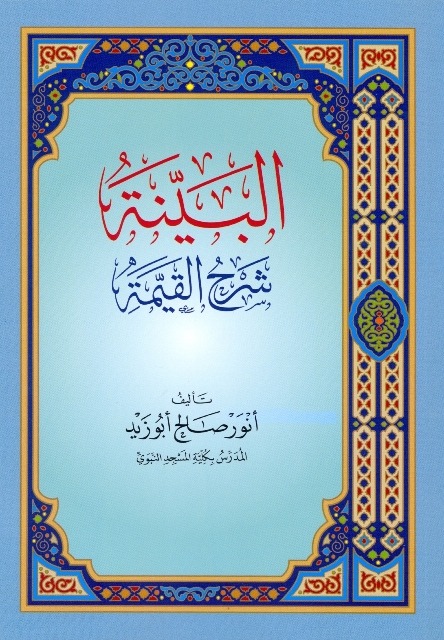
Authorship Anwar Saleh Abu Zaid
Introduction
Praise be to Allah who built the minaret of religion and its signs, and clarified for creation its laws and rulings, and honored the Prophet of this nation, making him the chosen and leader of creation. May His prayers and peace be upon him, and may He be pleased with his companions who were on his right and left, behind him and in front of him, and honor those who followed them with goodness. They were a mark among people, honoring and pleased until the Day of Judgment.
Afterward,
Scholars have historically and recently paid attention to classification in jurisprudence, its roots, and its principles. Al-Qarafi mentioned in "Al-Furooq" (1): that the Shariah of Muhammad is divided into two: the roots of jurisprudence and the general legal rules. He described these rules as noble, numerous, great in scope, containing the secrets of Shariah and its wisdom. Each branch of the law in the Shariah has what cannot be counted. He said: These rules are important in jurisprudence, of great benefit, and to the extent of comprehending them, the value of the jurist is magnified, and he is honored, and the elegance of jurisprudence appears and is recognized, and the methods of fatwas become clear and revealed. He said: Whoever makes branches come out through specific correspondences without the general principles, the branches will contradict and differ, and he will need to memorize endless details. And whoever controls jurisprudence with its rules, he is free from memorizing most of the details because they are included in the general principles, and what contradicts at others becomes unified for him. End.
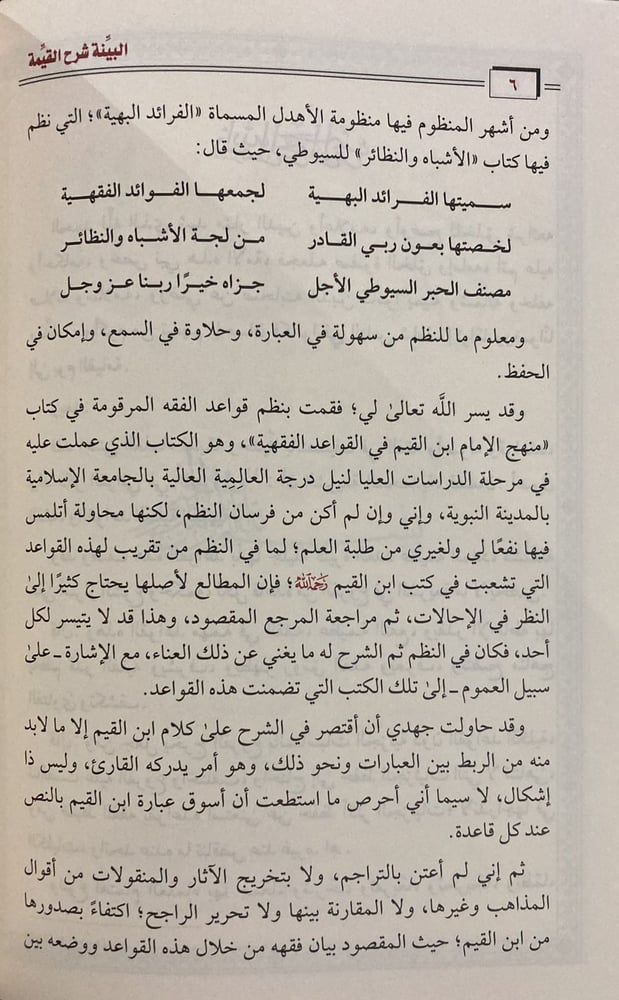
The interest of scholars in these rules has varied in collection, explanation, derivation, and organization, and among the most famous is the poem by Al-Ahdal called "Al-Fara'id Al-Bahiyyah," in which he organized the book "Al-Ashbah wa Al-Nazair" by Al-Suyuti. He said:
I named it "Al-Fara'id Al-Bahiyyah" because it gathers jurisprudential benefits, summarized by the help of my Lord, the capable, from the depths of "Al-Ashbah wa Al-Nazair," authored by the esteemed Al-Suyuti. May Allah reward him well. Our Lord, Glory be to Him, knows how easy the poem is in expression, sweet in listening, and easy to memorize.
Allah made it easy for me; so I composed a poem on the rules of jurisprudence numbered in the book "Manhaj Al-Imam Ibn Al-Qayyim in Jurisprudential Rules," which I worked on during my postgraduate studies to obtain the high-level degree at the Islamic University in Madinah. Though I am not a master of poetry, this is an attempt to benefit myself and others seeking knowledge, as the poem simplifies these rules that are scattered in Ibn Al-Qayyim's books. For the reader who studies the original, it requires much looking into references, then reviewing the intended source, which may not be easy for everyone. So, the poem and its explanation contain what suffices from that effort, with general references to the books that contain these rules.
I have tried my best to limit the explanation to Ibn Al-Qayyim's words, except what is necessary to connect phrases and similar matters, which the reader can understand. It is not problematic, especially since I strive to quote Ibn Al-Qayyim's words verbatim for each rule.
I did not focus on biographies, nor on deriving the sayings and transmitted statements from the schools of thought and others, nor on comparing them or determining the preferred opinion. I relied solely on Ibn Al-Qayyim's words, as the goal is to clarify his jurisprudence through these rules and present it to the reader for benefit, whether the opinion is strong or weak. Moreover, this may make the book larger. I have only referenced the verses and the authentic sayings of the Prophet. When I mention the verse or hadith explained, I use the phrase "His saying: ..." directing the reader to understand whom the pronoun refers to.
I named the poem "Al-Qayyim" and its explanation "Al-Bayyina," so the full name is "Al-Bayyina Sharh Al-Qayyim."
Written by Anwar Saleh Abu Zaid
Teacher in the Higher Department at the Prophet's Mosque Institute

From Dammam