
The classification disagreement and its semantic effect in the Holy Quran
32.20ر.س
Product description
Authorship / Farid Abdul Aziz Al-Zamlal
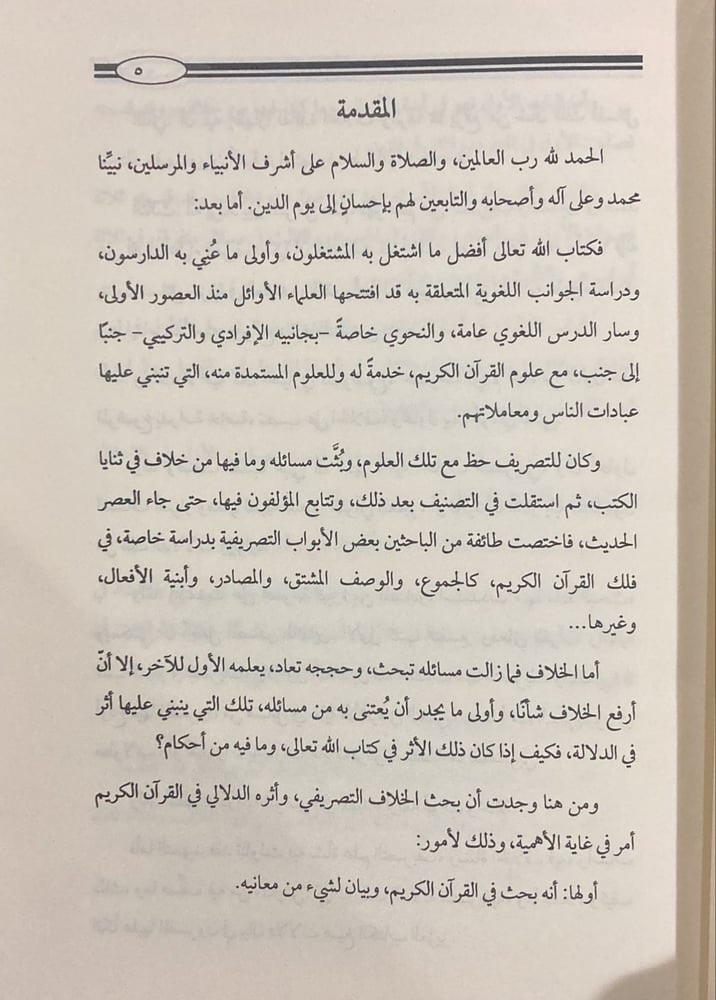
Introduction
Praise be to Allah, Lord of the worlds, and peace and blessings be upon the noblest of prophets and messengers, our Prophet Muhammad, and upon his family, companions, and followers who follow them with goodness until the Day of Judgment.
To proceed:
The Book of Allah the Almighty is the best of what engaged workers, and the most deserving of what scholars have cared for. Studying the linguistic aspects related to it was initiated by early scholars from the earliest ages, and the linguistic study in general, and grammar in particular—both its individual and structural aspects—has progressed alongside the sciences of the Holy Qur'an, serving it and the sciences derived from it, upon which people's acts of worship and dealings are built.
Morphology (al-Tasreef) has also had a share with these sciences, and its issues and the disagreements therein have been discussed within the books. Later, it became independent in classification, and authors continued to write on it until the modern era, when a group of researchers specialized in some morphological chapters with a particular focus on the Holy Qur'an, such as collections, derived adjectives, sources, verb structures, and others.
As for the disagreements, their issues are still being researched, and their proofs are repeatedly taught from the first to the last. However, the most elevated and worthy of attention are those issues that have an impact on meaning, especially when that impact is in the Book of Allah the Almighty and its rulings.
From here, I found that researching morphological disagreement and its semantic impact in the Holy Qur'an is of utmost importance, for reasons:
First: It is a study within the Qur'an, clarifying some of its meanings.

From Dammam