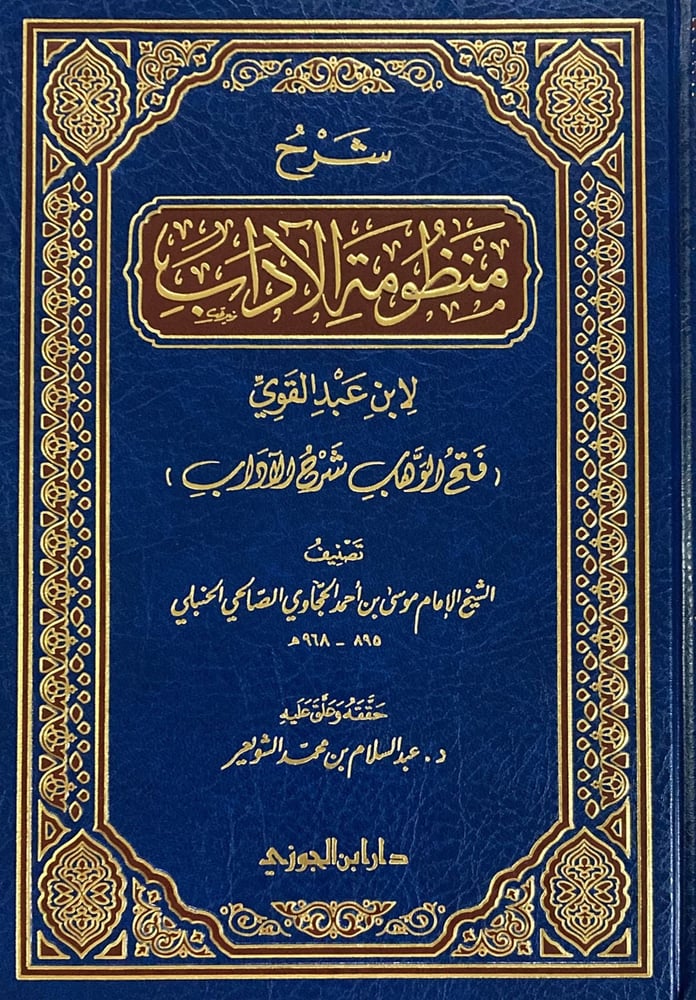


Explanation of the Etiquette System
29.90ر.س
Out of Stock
Product description
Aban Abdul Qawi
Classification of the Sheikh, the scholar, Mufti Musa bin Ahmed Al-Salihi
Verified by Dr. Abdul Salam Al-Shuwayr
Introduction of the verification
Praise be to Allah, and prayers and peace be upon our Prophet Muhammad, and upon his family and all his companions.
As for what follows:
It has been established in the authentic hadith of Muawiya bin Abi Sufyan that the Prophet, peace be upon him, said: "Whoever Allah wishes good for, He grants him understanding in the religion."
And understanding in the religion — here — is not limited to the specific custom agreed upon by the people of the field; that it is the specific doors made in the books called "books of jurisprudence."
Rather, it extends to all Islamic sciences; knowledge of Allah the Almighty, His names and attributes, and His monotheism through them, in addition to knowledge of the unseen which He informed about, and which His Messenger informed about. These are part of understanding in the religion, and perhaps it is called "the greater understanding" or "the big one," as Abu Hanifa — may Allah have mercy on him — labeled it.
Likewise, knowledge of Islamic manners, ethics, and good conduct, and good behavior, and acting upon them is part of perfecting understanding in the religion; as Abdullah Al-Mubarak said: "A man will not be exhausted by a type of knowledge unless he adorns his work with manners."
Imam Malik advised a young man from Quraysh saying: "Learn manners before you learn knowledge."
The jurists have dedicated separate chapters and various writings to this branch of jurisprudence; for example, the Hanafi jurists mention many issues of manners under the title "Al-Hadhar wal-Ibahah" (Presence and Permissibility).
The Maliki jurists, following their Imam, usually conclude their books with a "Jami'" (comprehensive) book in which these topics are mentioned.
The Shafi’i jurists mention manners in various places; including the "Siyar" (biography) book when discussing "Furood al-Kifaya" (obligations of collective duty), and in the chapter on foods after sacrifices, and in other places.
As for the Hanbali jurists, they paid special attention to this chapter, comparable to the Maliki jurists, as many of their jurisprudential books contain a chapter on "Manners," either at the beginning or at the end.
Sheikh Musa Al-Hajjawi mentioned this, saying about Ibn Abdul Qawi: "And when he composed the long poem in jurisprudence, he followed it with this poem on manners, in imitation of a group of companions, such as Ibn Abi Musa, Al-Qadi, Ibn Hamdan in his care, and the companion of Al-Mustawab," and others close to them.
Following the book with an introduction on manners, so he followed his book with this poem.
And similar to them are Sheikh Abdul Qadir in "Al-Ghina," Ibn Aqil in "Al-Fusul," Al-Jarra’i in "Ghayat Al-Matlab," and Ibn Balban in "Mukhtasar Al-Iafadat."
In addition, many Hanbali scholars dedicated separate works to the rulings of manners, such as Al-Shaykh Ibn Al-Qayyim in "Zad Al-Ma'ad," Ibn Muflih in his three books on Islamic manners, Al-Mardaawi, Al-Hajjawi, Yusuf bin Abdul Hadi, As-Safarini, and others.
And our book is from this approach in dedicating chapters on manners in a separate classification from the books of jurisprudence.
And after:
I present to the dear reader the book "Sharh Manzumat Al-Adab" (Explanation of the Poem on Manners) by the scholar Sheikh Musa bin Ahmed Al-Hajjawi (968 AH), which is an explanation of "Nazm Al-Adab" (Poem of Manners) by Ibn Abdul Qawi (699 AH) — may Allah have mercy on both of them.
This book was among the books that were confined to library shelves and the depths of manuscript safes, and it was from Allah’s blessings — and His blessings are many — that He lifted the dust from them and brought them out for printing.
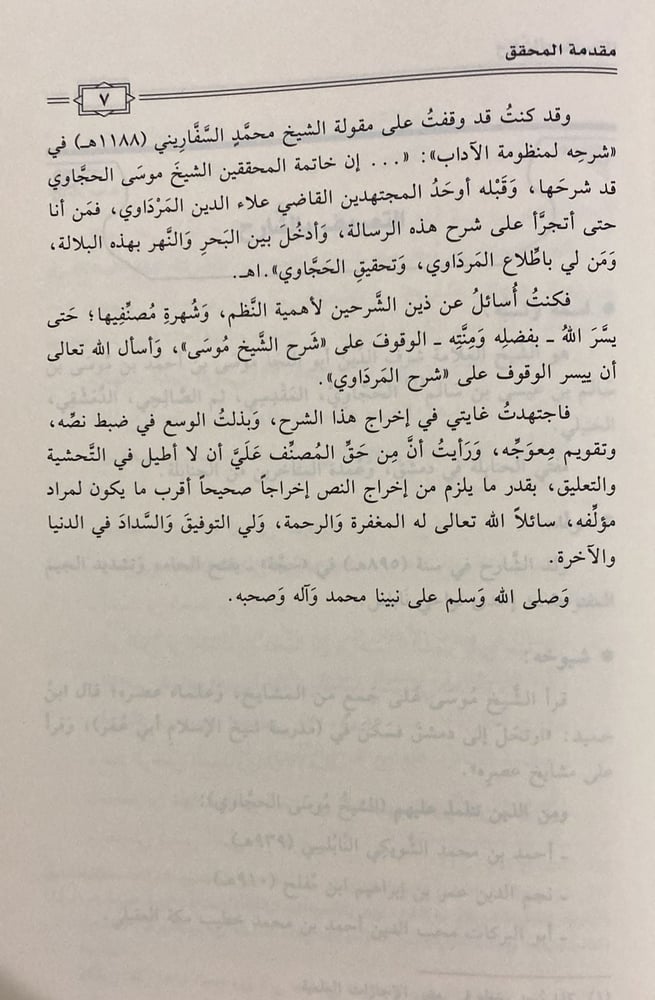
I had previously come across the statement of Sheikh Muhammad As-Safarini (1188 AH) in his explanation of "Nazm Al-Adab":
"... That the conclusion of the investigators, Sheikh Musa Al-Hajjawi, has explained it, and before him, the one who was the only mujtahid, Qadi Alaa Al-Din Al-Mardaawi. So who am I to dare to explain this message and to enter between the sea and the river with this boldness, and who has access to Al-Mardaawi’s insight, and the verification of Al-Hajjawi."
And I wondered about these two explanations due to the importance of the poem and the fame of its authors, until Allah made it easy — by His grace and favor — to access Sheikh Musa’s explanation.
I ask Allah to facilitate access to Al-Mardaawi’s explanation, and I have strived to produce this explanation, exerted effort in correcting its text, and rectifying its misalignments.
And I saw that it is the right of the author upon me not to prolong in annotations and comments, as much as necessary to produce a correct text that is as close as possible to the intention of its author.
I ask Allah for forgiveness and mercy for him, and for success and guidance in this world and the Hereafter.
And may Allah’s peace and blessings be upon our Prophet Muhammad, his family, and his companions.

From Dammam