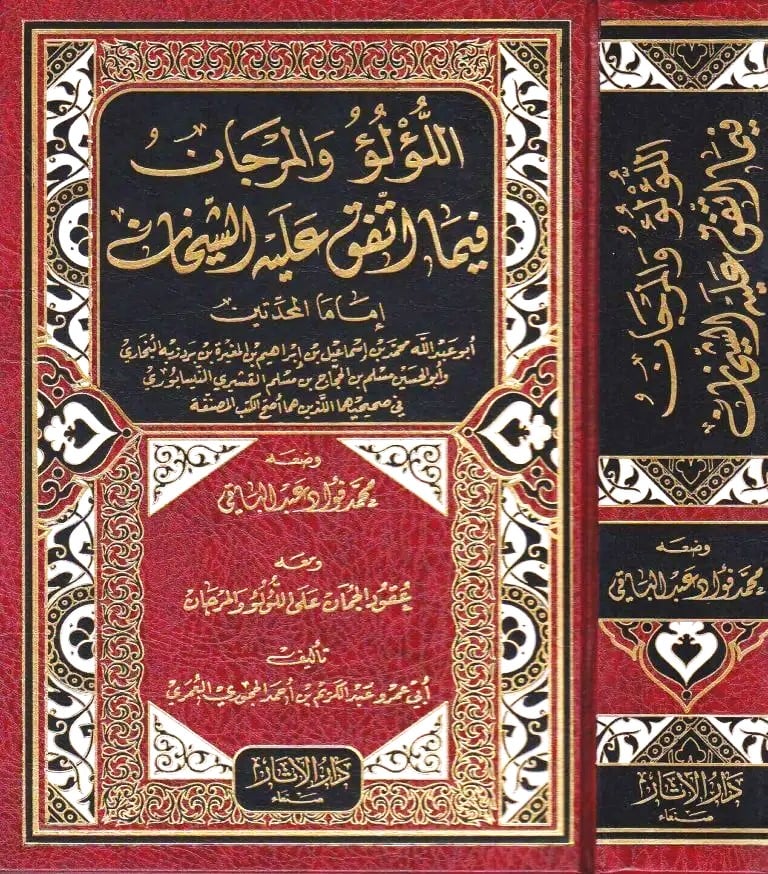
Pearl and coral in what the two sheikhs agreed upon
92ر.س
Out of Stock
Product description
The House of Ibn Hazm Beirut and Al-Murjan concerning the two sheikhs, the Imams of the Hadith scholars: Abu Abdullah Muhammad bin Ismail bin Ibrahim bin Al-Mughirah bin Bardaizbah Al-Bukhari Al-Ju'fi, born in 194 AH, died in 256 AH. And Abu Al-Hussein Muslim bin Al-Hajjaj bin Muslimir Al-Qash Naysaburi, born in 204 AH, died in 261 AH. Contributed to this, the publisher and the person responsible for its printing: Mr. Muhammad Al-Halabi, director of Dar Mosiqi Al-Kutub Al-Arabiya. And he obligated me in it to mention the text of the Hadith of Al-Bukhari, which is the original text, exactly matching the text of the Hadith that is somewhat different in Muslim, with him. For this obligation, there is a difficulty and hardship on both sides, more than any difficulty and hardship. And enough for me as an indication of the severity of this commitment that no one among those who authored or said that this Hadith is agreed upon, ever adhered to such a restriction. Because Al-Hafiz Ibn Hajar, the teacher of the world in modern science, when he states, that the purpose of Muslim’s agreement with Al-Bukhari is his agreement on the derivation of the Hadith from its narrators, even if some contradiction occurs in some contexts, and this is the matter. He, the commentator of Sahih Muslim, when he wrote the book “The Forty Mindful” and started it with the Hadith of deeds, with intention, and the animal, to the extent that it was a mistake he was forced to, he did not prevent the text of Al-Bukhari from the text of Muslim, but he mentioned his first text from Al-Bukhari in his Sahih, and showed the difference between it and the Hadith that Muslim opposes in some context… This effort that conflicts with me, and almost blocks the connection from this, has been alleviated by my books: The Comprehensive Musnad of Sahih Al-Bukhari and the Joy of the Sheikh in the two appendices of the second book, which guided to the agreed-upon Hadiths, with their enumeration and restriction, and from the beginning I rely on the text that I am obligated to, which the publisher imposed on me, and I committed to mentioning the remnants of the book based on what Ibn Al-Salah mentioned when discussing the sections, and because what is exclusive to children and Muslim, as the scholars of Hadith often say: “Sahih Muttaq” (authentic and agreed upon), and they generally mean the two Imams, Bukhari and Muslim, and they do not transmit the nation upon it; but the occurrence of transmission on it is necessary, and it is the consensus of the nation to accept what is ambiguous to it. The three most important aspects of the book: The book skillfully benefits from three sources—text from Bukhari, and the arrangement from Sahih Muslim, the chapters are what he uses in explaining Sahih Muslim. And Abdul Mohsin commented exactly on the rest of Abdul Baki: “He is not from the people of knowledge, but from the people of organization, meaning his classification and indexing in this field… He paid careful attention to Sahih Muslim, with multiple numbering of its Hadiths based on paper, but without precision, and it was printed in four volumes by Fuad Abdul Baki, and its parts are fully indexed, Sahih on ten indexes, all of Sahih Muslim, serving Muslim independently. Besides, the numbering of Hadiths and the indexing in Fath Al-Bari with the Salafi edition is the numbering of Muhammad Fuad Abdul Baki, and the book Al-Lu’lu’ wal-Murjan is used by three people. The words present are for Bukhari, and the texts present and the content in Al-Lu’lu’ wal-Murjan are the words of Bukhari, and the arrangement is Muslim… And the chapters relied upon are not for Muslim nor for Bukhari but for Nawawi in his book explaining Muslim. Because after the words in the explanation, there is a footnote, and Muslim did not set chapters in his Sahih; only books should be set.”
Abdul Baki began the book with the narration of the Hadith: “The Prophet, peace be upon him, said: Do not lie upon me, for whoever lies upon me intentionally, let him prepare his seat in the fire.”

From Dammam
Questions you might have