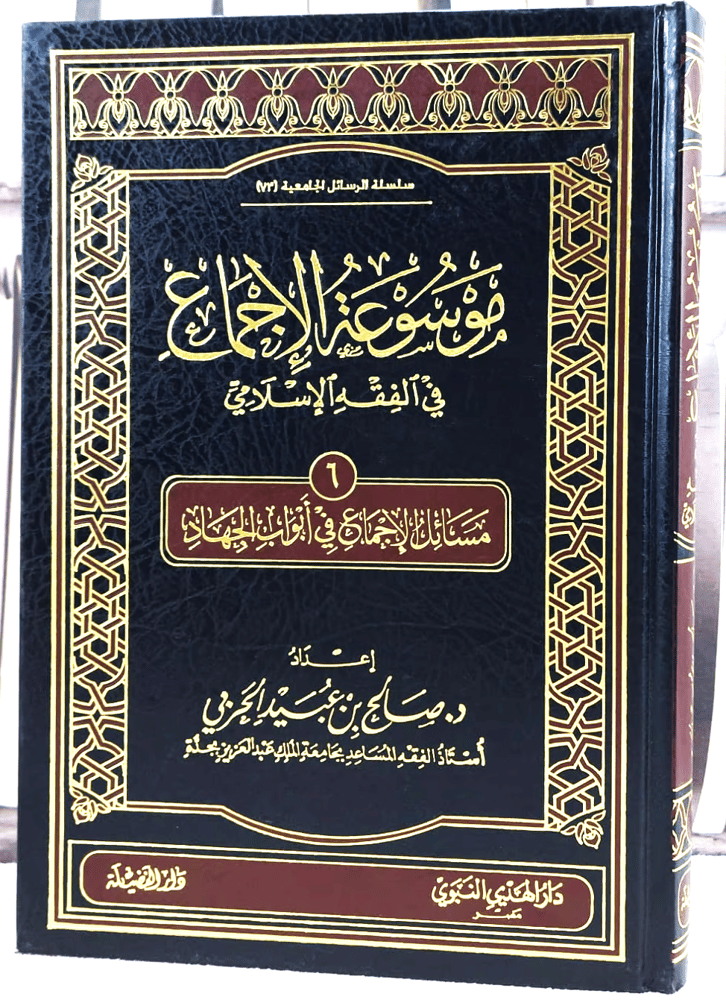
Encyclopedia of Ijma 6 chapters of Jihad
74.75ر.س
Product description
Encyclopedia of Ijma in Islamic Jurisprudence - Issues of Ijma in the Chapters of Jihad
Saif bin Ubaid Al-Harbi
Book Title: Encyclopedia of Ijma in Islamic Jurisprudence - Issues of Ijma in the Chapters of Jihad
Publisher: Dar Al-Fadila - Riyadh
Edition: First
Year of Printing: 1434 AH
Number of Pages: 500
Type of Book: The original of this book is a scientific thesis submitted by the author to obtain a doctorate from King Saud University - Riyadh.
Introduction to the topic of the book:
Ijma holds a high status and a noble position among the evidence of Islamic rulings; it is the third evidence after the Holy Quran and the purified Sunnah. Therefore, scholars have often included it in their writings and used it as evidence for the issues they discuss. However, after examining the transmitted Ijma, we find that some of the Ijma transmitted by scholars in different jurisprudential schools contains statements from some other scholars that break or contradict it. This necessitated studying these Ijmas to verify their transmission and authenticity.
This week's book was compiled to gather issues of Ijma transmitted in the book of Jihad and its appendices, based on the trusted books of the author. They were organized according to the jurisprudential chapters following the order adopted by later Hanbali scholars, with appropriate titles for each issue, explaining its form, clarifying it, illustrating it, and providing examples. It also identifies which scholars narrated or reported the Ijma, arranged them chronologically by their death dates, and highlighted points of agreement or disagreement—if any—and cited the evidence for the Ijma from the Quran, Sunnah, or other sources. The accuracy of the Ijma was verified by searching for the absence of opposing views, and the conclusion was drawn regarding whether the Ijma was achieved or not.
The book begins with an introduction that highlights the importance of the research topic, reasons for choosing it, previous studies, and other typical elements of scientific theses. It also includes a preface defining Ijma, clarifying its authority and its position in legislation.
Then, the book is divided into three chapters:
The first chapter lists issues of Ijma regarding rulings of Jihad, spoils, and prisoners, divided into four sections:
- Section One: Issues of Ijma in the ruling of Jihad
- Section Two: Issues of Ijma in the rulings of Jihad (repeated title, possibly different aspects)
- Section Three: Issues of Ijma in the rulings of spoils
- Section Four: Issues of Ijma in the rulings of prisoners
The second chapter discusses issues of Ijma in rulings of jizyah (tax), Fayy (spoils of war), security, and truce, also in four sections:
- Section One: Issues of Ijma in rulings of jizyah
- Section Two: Issues of Ijma in rulings of Fayy
- Section Three: Issues of Ijma in rulings of security
- Section Four: Issues of Ijma in rulings of truce
The third chapter covers issues of Ijma in rulings concerning the combatants, the People of the Book, and the covenant of protection, divided into three sections:
- Section One: Issues of Ijma in rulings of the combatants
- Section Two: Issues of Ijma in rulings of the People of the Book
- Section Three: Issues of Ijma in rulings of the People of the Covenant
The author concludes his book with a summary that includes the findings from his study and his recommendations.
This book is the sixth part of the project "Encyclopedia of Ijma in Islamic Jurisprudence," undertaken by a select group of faculty members from the Department of Islamic Culture - College of Education at King Saud University.

Questions you might have