
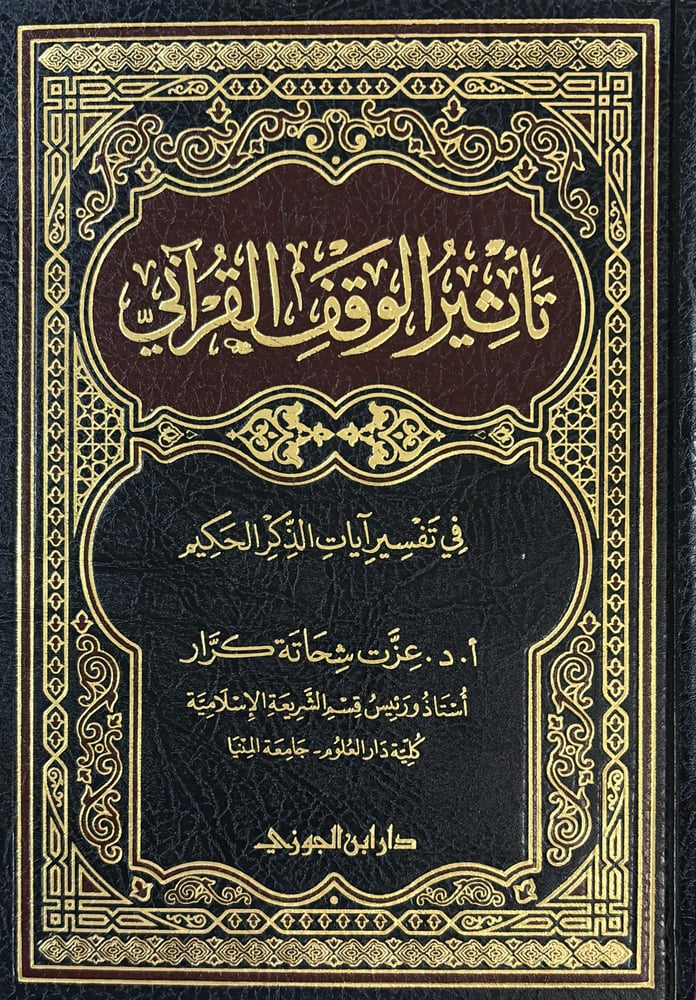


The effect of Quranic endowment in the interpretation of the verses of the Noble Reminder
48.30ر.س
Product description
Al-Zeit Shahatah Karrar
Introduction
Praise be to Allah, Lord of the worlds, and blessings and peace be upon the most honorable of messengers, our master Muhammad, and upon his family, companions, and followers until the Day of Judgment.
After:
The science of Waqf (pause and stopping in recitation) is considered one of the most important sciences that Muslim scholars paid attention to, to the extent that they dedicated special classifications to it. The first person to write about Waqf was Shaybah ibn Nisaḥ al-Kufi (died in 747 AH).
Among the most important printed works that I came across and praised by scholars, both old and new, are five books:
The book "Iḍāḥ al-Waqf wal-Ibdā’" by Ibn al-Anbari,
The book "Al-Maqṣad" by al-Ansari,
The book "Al-Qaṭ‘ wal-Isti’nāf" by al-Nu‘mān,
The book "Al-Mutkaffā fī al-Waqf wal-Ibdā’" by Abu ‘Amr al-Dani,
And the book "Manār al-Huda" by al-Ashmūnī.
Ali ibn Abi Talib says in explaining the verse:
"And recite the Qur'an with measured recitation" (1):
"Measured recitation is the beautification of the letters and knowing the stops" (3).
Al-Nakzaẓāwī further clarifies the matter by saying:
"The chapter of Waqf is of great importance and significance; because understanding the meanings of the Qur'an and deriving the legal evidences from it cannot be achieved without knowing the pauses."
Al-Hudhali said:
"Waqf is the ornament of recitation, the adornment of the reciter, the eloquence of the follower, the understanding of the listener, and the pride of the scholar. Through it, the difference between two different meanings, the contradictory and opposing ones, and the two different rulings is recognized."
Some scholars have gone so far as to say:
"Whoever does not know Waqf does not know the Qur'an," because it is impossible for anyone to understand the Qur'an without knowing the pauses.
Previously, I mentioned in my book "The Qur'anic Waqf and Its Effect on Preference among the Hanafi School" that I would dedicate an independent research on the influence of Waqf in interpretation.
This was achieved for me after Allah's success, as its preparation took more than three years.
In this research, I tried to present the opinions of the interpreters, rarely favoring one over the other; this is because most of the interpretations' opinions are supported by the verse in both cases of Waqf and Wasil (continuation).
I did not expand on the jurisprudential rulings; as they were discussed with their related evidences in the previously mentioned research on Qur'anic Waqf.
Therefore, I minimized mentioning them as much as possible.
Also, in presenting them, I relied on the opinions of the interpreters from Tafsir books, rarely referring to fiqh books, so as not to repeat what I said in the first book.
This study is divided into two parts:
The first part: the introduction, in which I included the theoretical study, defining recitations, their origins, the relationship between recitations and letters, defining Waqf and its types, and whether Waqf is Tawkif (stopping) or not, among other issues related to the theoretical aspect.
The second part: the practical study, where I presented the verses and the effect of Waqf on them, arranging the verses according to their occurrence in the Ottoman Mushaf.
I ask Allah that this work be sincere for His face.
Author
Dr. ‘Ezat Shahatah Karrar

Questions you might have