


In the interest of the preservers in the evidence of rulings from the two authentic collections
50.60ر.س
Out of Stock
Product description
I want to, Ibn Abdulkhaleq Al-Emad, in the name of Allah, the Most Merciful, the Most Compassionate.
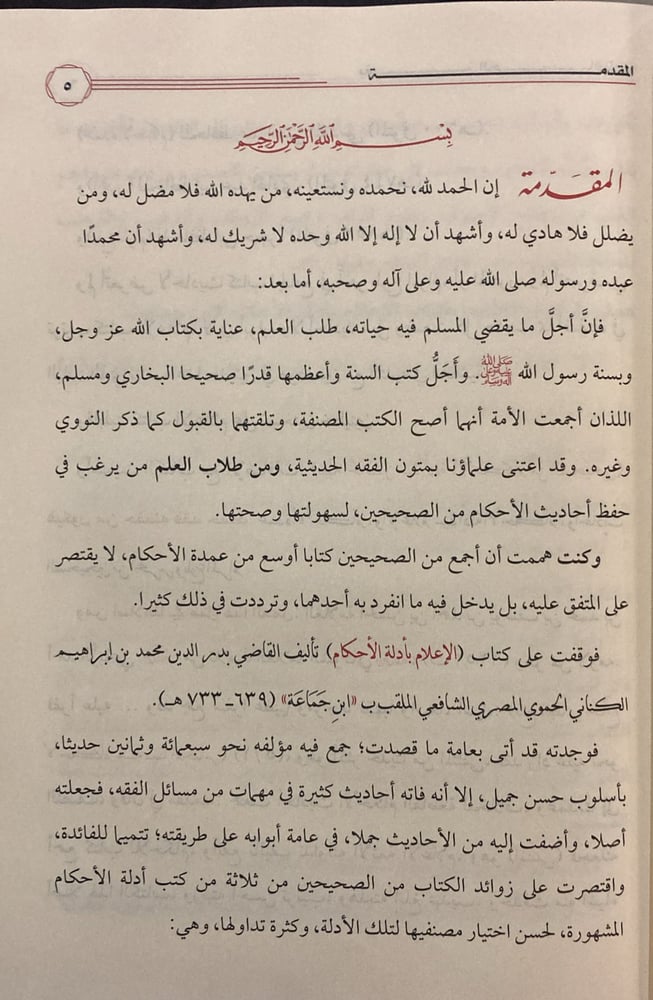
Introduction
Indeed, the most honorable thing in a Muslim's life is seeking knowledge, caring for the Book of Allah, Glorified and Exalted, and the Sunnah of the Messenger of Allah.
And the most important books of the Sunnah and the greatest in value are Sahih Al-Bukhari and Sahih Muslim, which the consensus of the Ummah has deemed the most authentic classified books, and they have been accepted as narrated by Al-Nawawi and others.
Our scholars have paid attention to the texts of jurisprudence and Hadith, and some students of knowledge desire to memorize the sayings of rulings from the two Sahihs, due to their ease and authenticity.
I intended to compile from the two Sahihs a book broader than 'Umdat Al-Ahkam', not limited to what is agreed upon, but including what either of them alone narrated, and I hesitated a lot in doing so.
Then I came across the book "Al-I'lam bi Adillat al-Ahkam" authored by Judge Badr al-Din Muhammad ibn Ibrahim Al-Kanani Al-Hamawi Al-Masri Al-Shafi'i, nicknamed Ibn Jamma'a (639-733 AH).
I found that he included most of what I aimed to gather, about seven hundred and eighty hadiths, in a good and beautiful style, but he missed many important hadiths on issues of jurisprudence.
So I made his work a foundation, and I added to it some sayings, in most of its chapters, following his method, to enhance the benefit.
I limited myself to the additions from the Sahihain, from three well-known books of rulings evidence, chosen for their good selection by their authors, their widespread circulation, and their usefulness:
- 'Umdat al-Ahkam' by Hafiz Abdul Ghani Al-Maqdisi (d. 600 AH)
- 'Al-Muharrar' by Hafiz Ibn Abdul Hadi (d. 744 AH)
- 'Buloogh al-Marām' by Hafiz Ibn Hajar (d. 852 AH)
I did not deal with the hadiths in the 'Jami' at the end of Buloogh al-Marām or Al-Muharrar, nor did I alter the arrangement of 'Al-I'lam', neither in its chapters nor its hadiths.
Instead, I placed each added hadith in the chapter that suits it, except for two hadiths in two places, with a note in the footnote.
I compared 'Al-I'lam' with two handwritten copies.
I named the book with the additions 'The Aim of the Preservers in the Evidence of Rulings from the Sahihain', so whoever memorizes it has memorized 'Umdat al-Ahkam', 'Al-I'lam' in the evidence of rulings, and the hadiths of the two Sahihs from Al-Muharrar and Buloogh al-Marām.
Among our ancestors who worked similarly in this field is the scholar Al-Hassan ibn Ahmad ibn Yusuf ibn Muhammad ibn Ahmad Al-Ruba'i, may Allah have mercy on him.
He was a student of Al-Shawkani, may Allah have mercy on him (d. 1252 AH), and he read upon him.
He compiled a great and comprehensive jurisprudential reference called:
'Fath Al-Ghaffar Al-Jami' Li Ahkam Sunnat Nabiyyina Al-Mukhtar' (1/5).
It contains more hadiths than Al-Muntaqa, having added about half more.
In its introduction, he said: "I gathered the decisive hadiths on rulings that eliminate disagreement, and I aimed to compile the most comprehensive book of rulings, and the most beneficial compilation circulated among the eminent Imams, which is Al-Muntaqa."
He made it the foundation for this book, arranged it in the best order, refined it with the utmost refinement, removed repetitions, and replaced some headings with suitable ones, and moved others to later.
He placed each hadith where it deserves to be introduced, and added many hadiths from Jami' Al-Usul, Buloogh al-Marām, Majma' Al-Zawa'id, and Al-Targhib wa Al-Tarhib by Hafiz Al-Mundhiri, as well as from Al-Jami' Al-Saghir and its commentary.
My work on the original book is based on 'Al-I'lam bi Adillat al-Ahkam' by Ibn Jamma'a.
First: writing the number of the hadith and its reference in front of it within parentheses, and indicating Bukhari (خ) and Muslim (م) with the hadith number.
Second: adding what was missing from the text of the hadith in the two manuscripts of the Sahihs, placing it between brackets [], and sometimes the addition is long because the hadith is in the Zawa'id.
Third: verifying the text and comparing it with the two manuscripts, the first (271), marked as (A), and the second (652), marked as (B), and we will mention the description of the two manuscripts, God willing.
Fourth: alerting to any mistakes made by the author in the text, noting them in the footnotes along with the correct version.
We often prefer the wording of the two Sahihs over the wording taken from other sources, because the book is prepared for memorization.
You may find in the footnotes, for example in (A) and (B), such and such, and we mention the text not in the Sahihs, and we confirm the wording of the Sahih, even if we do not say "and the confirmed wording of the Sahih."
Fifth: if the mistake is in attributing the hadith, it has cases. He said: "and Muslim," and the hadith is in Bukhari, so we correct it within parentheses.

From Dammam
Questions you might have