
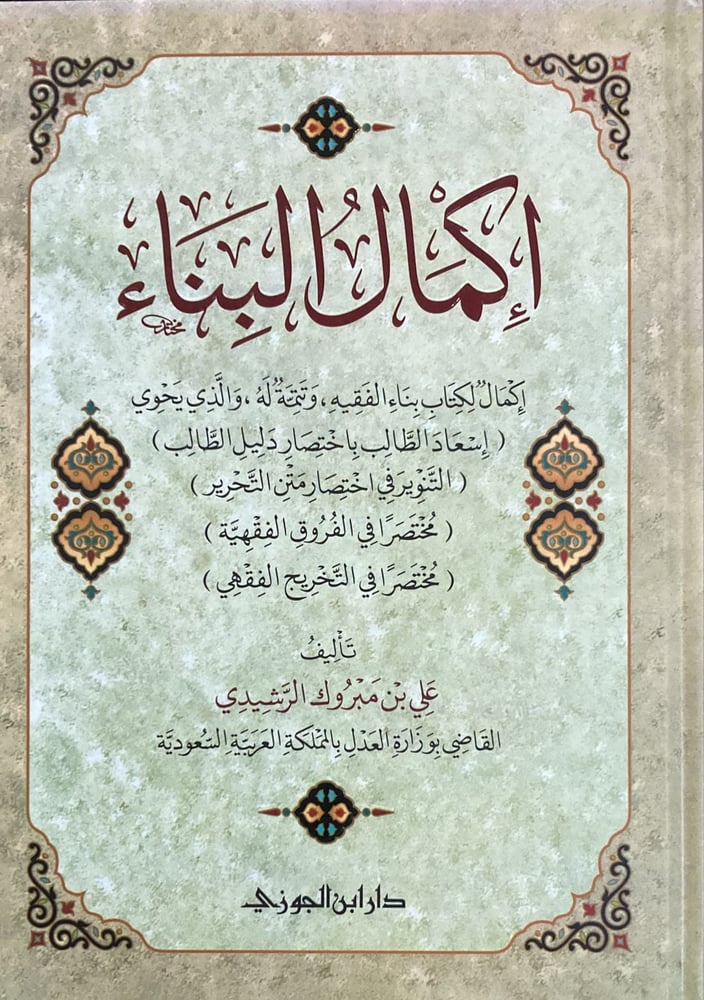


Completion of construction
35.65ر.س
Product description
Continuation of the book Building the Jurist
Authored by Ali Mabrouk Al-Rashidi
Introduction
Praise be to Allah who made knowledge a light for those seeking guidance, and a beacon for those who wish to oppose the path of misguidance. He illuminated minds with it, increased understanding through it, raised the ranks of its seekers, and magnified their good deeds. He grants increase to those who act upon it, and provides guidance to those who are granted success in working with it. Allah, the Most High, elevates the scholars for His sake, inspires them with many realizations. Glory be to Him, the Lord of the worlds, and blessings and peace be upon the best of scholars, the master of noble ones, the generous of virtuous ones, the master of the first and the last, the intimate friend of the Lord of the worlds, Muhammad ibn Abdullah the trustworthy, and upon his pure and good family, his righteous companions, and those who follow them with goodness, and peace be upon them all until the Day of Judgment and resurrection.
And after:
Allah has blessed me and guided me to compile the collection (Building the Jurist), which includes the most important sciences that serve the science of jurisprudence, with a summary of the text (Zad Al-Mustaqni‘). This collection has gathered various sciences and different arts. I saw that I should follow this collection with another collection that completes it, in terms of remaining sciences that serve the science included in this collection, which contains a summarized text, always mentioning Zad Al-Mustaqni‘ when discussing the ranks of the jurists. Many jurists have spoken extensively about the preference between it and the text Zad, between its introduction and its conclusion, which is the book Daleel Al-Talib. By the grace of Allah, I summarized it similarly to the summary of Zad Al-Mustaqni‘, focusing on the most important foundational issues of jurisprudence mentioned in the original text to facilitate the study for beginner students, so that they reach the level following Taqaffuh by studying the text Al-Imad in a summarized form of Zad, which I named in conjunction with the text Sa‘ad Al-Talib, summarized from Daleel Al-Talib.
Studying these two summaries of these two texts is sufficient to grasp the most important issues of Hanbali jurisprudence. I believe that a student who studies these two texts has comprehended most jurisprudential issues, and thus will be prepared to study the original two texts (Zad Al-Mustaqni‘ and Daleel Al-Talib) easily and smoothly. I also wanted to add a summary of an important text from the Hanbali texts in the roots of jurisprudence, which is the school of thought according to the text (Tahrir Al-Manqul and Tahdhib ‘Ilm Al-Usul) by the scholar Alaa Al-Din Al-Mardawi. It is one of the most important texts in the science of roots of jurisprudence among late scholars. The student’s jurisprudence in the roots of jurisprudence among late scholars revolves around its summarized version (Mukhtasar Al-Tahrir), called (Al-Kawkab Al-Muneer) by the scholar Bin Al-Najjar Al-Hanbali. Some of my virtuous teachers pointed out to me when I presented my book (Building the Jurist) for their comments that I should summarize (Tahrir Al-Manqul) of Al-Mardawi in the style of the summary of (Mukhtasar Al-Rawdah) by the scholar Al-Tawfi, so I found this idea suitable and summarized the text in a way appropriate for beginners, as an introduction to studying (Tahrir Al-Manqul), and its summarized version (Tahrir Al-Tahrir). I named it (Enlightenment in the Summary of Tahrir).
I wrote, with Allah’s help, a summarized work in my science (Jurisprudential Differences) and (Fiqhi Extraction), so that the building of jurisprudence would be complete by mentioning everything that serves the science of jurisprudence. Undoubtedly, studying these two sciences is very important to develop the jurisprudential ability of the student, by understanding the jurisprudential differences between similar issues in different cases, so that the student can follow a firm path and solid rules in his study of jurisprudence, and to be able, when qualified, to derive new issues based on the principles and roots of the Imam, so that he remains on a single straight path in deduction.
I named this collection (Completing the Building), as a continuation of the book (Building the Jurist), to be like the stage that follows the study of the collection (Building the Jurist).
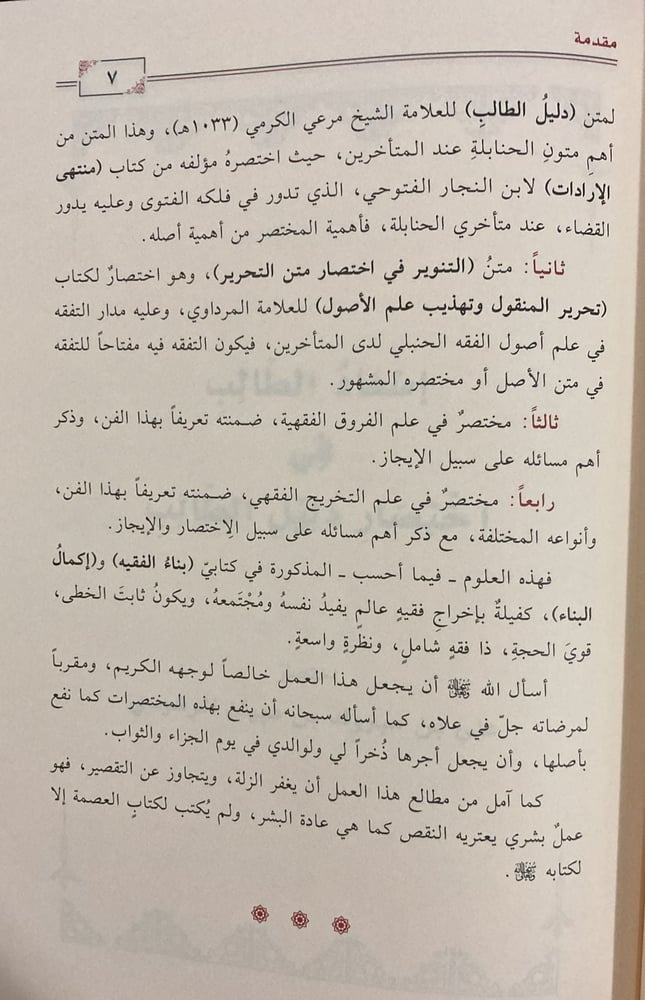
This collection contains several sciences:
First: The text (Sa‘ad Al-Talib in summarized form of Daleel Al-Talib), which is a summary of the text (Daleel Al-Talib) by the scholar Sheikh Murad Al-Karmi (1033 AH). This text is one of the most important Hanbali texts among late scholars, as its author summarized it from the book (Muntaha Al-Iradat) by Ibn Al-Najjar Al-Fatawi, which revolves around fatwa and judicial matters among late Hanbali scholars, making the importance of the summarized text equal to that of its original.
Second: The text (Enlightenment in the Summary of Tahrir), which is a summary of the book Tahrir Al-Manqul and Tahdhib ‘Ilm Al-Usul by the scholar Al-Mardawi. It is the foundation of jurisprudence among late scholars in the science of roots of jurisprudence, making studying it a key to understanding the original text or its famous summary.
Third: A summarized work in the science of jurisprudential differences, in which I included a definition of this art and mentioned its most important issues briefly.
Fourth: A summarized work in the science of jurisprudential extraction, including a definition of this art, its various types, and the most important issues summarized briefly.
I believe that these sciences—mentioned in my books (Building the Jurist) and (Completing the Building)—are sufficient to produce a knowledgeable jurist who benefits himself and his community, with firm steps, strong arguments, comprehensive jurisprudence, and broad vision.
I ask Allah to make this work purely for His face, close to His pleasure, Glory be to Him, and I ask Him to benefit from these summaries as we benefit from their original texts, and to make their reward a treasure for me and my parents on the Day of Judgment and recompense. I also hope that those who read this work will forgive the slip, overlook shortcomings, for that is human nature, and that the book of infallibility is only written for human work, which is subject to deficiency, as Allah, the Most High, has created.

From Dammam